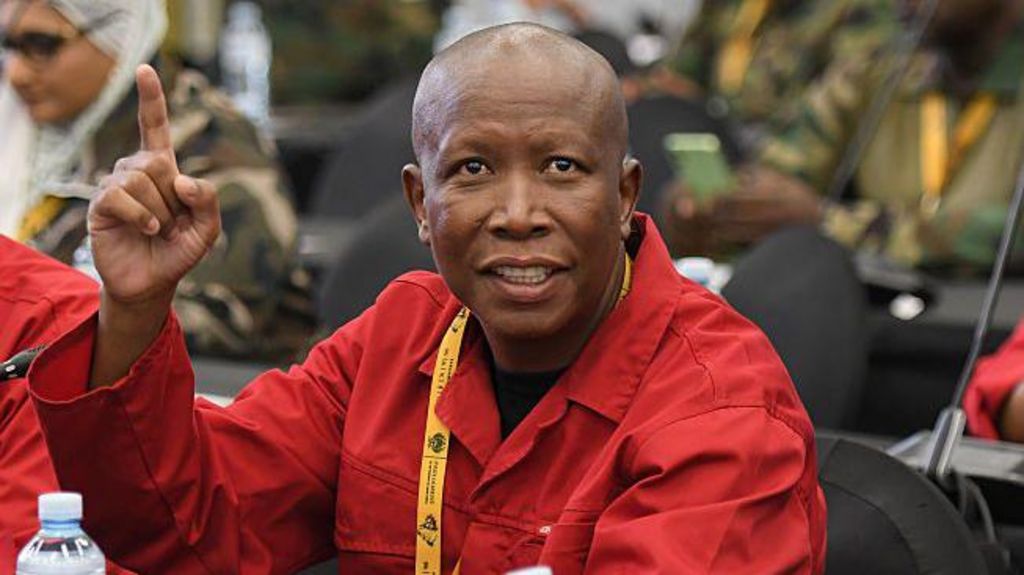
South African opposition leader Julius Malema, the firebrand head of the Economic Freedom Fighters (EFF), is facing a five-year prison term after being convicted on weapons charges — but legal complexities and ongoing appeals mean he remains free to lead his party into the country’s upcoming local government elections this year. The 45-year-old politician was found guilty on five separate criminal offenses, including unlawful possession of a firearm, discharging the weapon in a public space, and reckless endangerment, following a trial held in KuGompo, the newly renamed former East London in Eastern Cape province. During court proceedings, Malema testified that he fired the weapon as part of a celebratory gathering.
Malema, a polarizing figure in South African politics, has built his political brand around unapologetic criticism of what he frames as Western imperialism, and calls for the full nationalization of land currently owned by white South African descendants — a policy designed to redress decades of harm caused by colonial rule and the apartheid system. His anti-establishment rhetoric has earned him a fervent base of support, particularly among young South Africans frustrated by slow economic transformation and persistent inequality. But the EFF leader has also drawn widespread condemnation across the political spectrum, from women’s rights advocacy groups to white agricultural communities, and has faced repeated legal troubles: he has been convicted of hate speech on multiple occasions, and was denied entry to the United Kingdom twice in 2025. Known colloquially as the “Red Berets” for the red overalls party members wear in parliament — a symbolic gesture of solidarity with the country’s working class — the EFF has emerged as one of South Africa’s most high-profile opposition groups since its founding.
Following his conviction and sentencing, the court granted Malema permission to appeal his sentence, though not the initial guilty verdict. The EFF has pushed back aggressively against the ruling, with Malema’s legal team confirming they will challenge both the conviction and the five-year term in higher courts. According to Ulrich Roux, a South African legal expert interviewed by the BBC, the appeal process will require Malema to first secure approval from the Eastern Cape High Court to challenge his conviction. Roux noted that state prosecutors are almost certain to oppose the appeal application. Malema has publicly vowed to escalate his challenge all the way to South Africa’s highest judicial body, the Constitutional Court, if needed. If the case follows that full legal path, Roux projects a final ruling could take four to five years to reach.
Under South Africa’s constitution, any person sentenced to more than 12 months in prison without the option of a fine is disqualified from serving as a Member of Parliament. However, this disqualification does not take effect until all appeal processes have been exhausted and a sentence is considered final. Because Malema’s appeal is still pending, he retains his parliamentary seat and is eligible to lead his party’s campaign in the upcoming local elections. Political analysts say this timeline could even allow Malema to run for re-election to parliament in the 2029 national elections, even if his appeal ultimately fails. Even in the worst-case scenario for Malema — a failed appeal that results in prison time — the sentence would only bar him from office for five years after his release, leaving the door open for a future political return.
This precedent already exists in recent South African political history: former President Jacob Zuma was sentenced to 15 months in prison in 2021, which barred him from serving as an MP. Despite that, Zuma launched a new political party, uMkhonto weSizwe, in 2024, and led the party to a third-place finish in that year’s national elections — outperforming Malema’s EFF, which lost significant vote share to Zuma’s new movement.
Some political analysts argue that the conviction could actually benefit Malema’s campaign. Khanyi Magubane, a South Africa-based political analyst, told the BBC that the sentence may be the “trump card” Malema needs ahead of the local elections. “I believe this will position the EFF and Malema well. It’s actually going to have unintended consequences… because he will play on the public sympathy and use this opportunity to continue standing his ground,” Magubane explained. For Malema, the timing comes as he seeks to reverse the EFF’s recent electoral decline: the party lost significant support to Zuma’s uMkhonto weSizwe in 2024, and saw a number of high-profile departures after the election, including that of deputy leader and party co-founder Floyd Shivambu. In the wake of the sentencing, thousands of Malema’s supporters have already rallied behind their leader, signaling continued loyalty to the polarizing politician.