Global financial markets swung dramatically on Friday, triggered by a key announcement from Iranian Foreign Minister Abbas Araghchi that the Strait of Hormuz, the world’s most critical chokepoint for global oil supplies, will remain fully open to commercial shipping for the duration of the ongoing ceasefire between Iran and the United States. The news sent crude oil prices tumbling more than 10 percent and pushed major U.S. stock indices to uncharted record territory, capping a rapid two-week rebound from conflict-driven losses.
The Strait of Hormuz, which carries roughly one-fifth of the world’s daily crude oil shipments, had seen growing supply disruption risks after the outbreak of regional hostilities linked to the U.S.-Israeli offensive. Those tensions pushed oil prices to a peak of nearly $120 a barrel earlier this month, stoking widespread fears of inflationary pressure that could destabilize the global economy. Within hours of Araghchi’s statement posted on X, both benchmark Brent Crude and U.S. West Texas Intermediate fell below the $90 per barrel threshold, recording their largest single-day drop in years. By 1330 GMT, Brent traded at $89.56 a barrel, down 9.9 percent, while WTI fell 10.2 percent to settle at $81.88.
“This news is having an immediate impact on markets,” noted Kathleen Brooks, research director at XTB. The development marks the most significant breakthrough since the ceasefire went into effect, she added, saying “it gives hope that the war will end soon, and supply chains will return to some normality.”
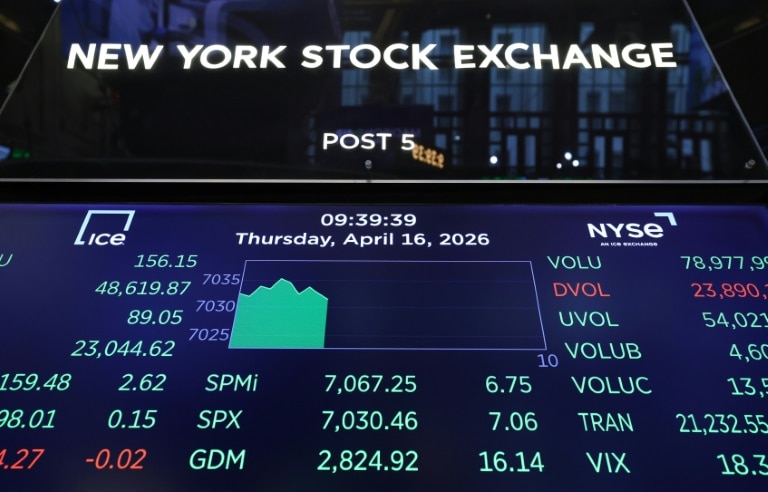
Wall Street opened sharply higher on the news, with the Dow Jones jumping 1.3 percent to 49,221.56 points, while the S&P 500 gained 0.7 percent to hit a new record of 7,092.15. The Nasdaq Composite also climbed 0.9 percent to 24,317.32, extending all-time highs set the previous trading session. In Europe, major benchmarks followed the upward trend: Frankfurt’s DAX gained 2.2 percent, while Paris’ CAC 40 rose 2 percent, and London’s FTSE 100 added 0.5 percent. Asian markets mostly closed lower, however, after recent record-setting runs, with Tokyo’s Nikkei 225 falling 1.8 percent and Hong Kong’s Hang Seng Index dropping 0.9 percent.
The speed of the U.S. stock rally has surprised many market participants. David Morrison, a senior analyst at Trade Nation, pointed out that the S&P 500 has bounced nearly 12 percent in just over two weeks, a move that caught many investors off guard. “Many investors sold during the first few weeks of the war, either to flatten their exposure or go net short,” he explained. “Now these investors are having to pay up to re-establish their existing positions, or cover their shorts and suffer painful losses.” The rally has also been fueled by a resurgent “fear of missing out” as indices hit new records, supported by stronger-than-expected earnings growth during the first-quarter reporting season.
Uncertainty remains over the exact scope of the ceasefire referenced in Araghchi’s announcement. It remains unclear whether he was referring to the 10-day Israel-Lebanon truce that took effect at midnight or the earlier two-week Iran-U.S. truce that began on April 8. Even with the positive announcement, U.S. President Donald Trump reaffirmed that the American blockade of Iranian ports remains in force. Still, the declaration has boosted market hopes for extended ceasefire negotiations and long-term de-escalation.
Meanwhile, Western leaders were moving forward with contingency planning Friday: French President Emmanuel Macron and UK Prime Minister Keir Starmer chaired an alliance meeting to discuss the deployment of a multinational naval task force to guarantee free navigation through the strait once the conflict concludes. Currency markets also reflected the improved risk sentiment, with the euro and pound gaining against the U.S. dollar, while the dollar softened against the Japanese yen.