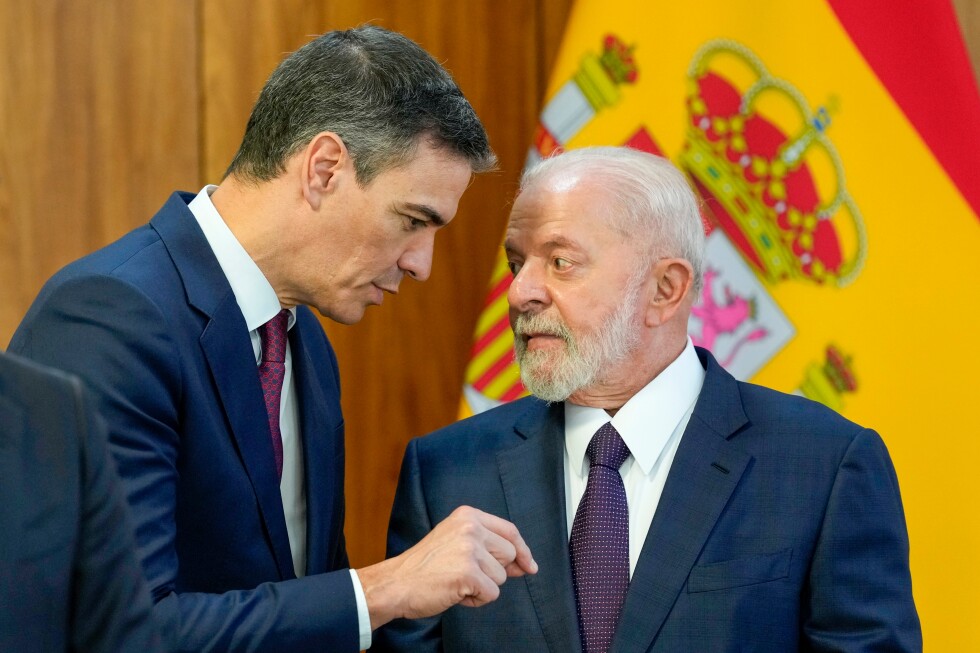
BARCELONA, Spain – Brazil’s progressive President Luiz Inácio Lula da Silva touched down in Barcelona Friday for a high-profile two-day official visit, kicking off a series of multilateral gatherings that bring together like-minded leaders of small and mid-sized nations united by shared concerns over eroding democratic norms and the expanding influence of far-right populism across the globe.
Lula and his Spanish counterpart Pedro Sánchez, both widely recognized as leading standard-bearers of progressive politics across their respective continents, have positioned themselves as vocal critics of the policies and agenda of U.S. President Donald Trump, who has previously imposed and threatened additional punitive tariffs on both of their economies. For years, reactionary political factions and far-right populist movements have gained steady traction across the Americas and Europe, creating a urgent push for coordinated action from centrist and left-leaning democratic leaders.
The visit opens with a bilateral meeting between Lula, Sánchez and their full cabinet delegations at Barcelona’s historic former royal palace, where the two heads of state are set to sign a series of new bilateral agreements covering economic cooperation, technological innovation and joint social policy initiatives. These one-on-one talks will serve as a precursor to two major multilateral summits scheduled for Saturday, held at Barcelona’s sprawling central conference center, which will draw political leaders from every populated continent.
The first of Saturday’s gatherings is the fourth edition of the Meeting in Defense of Democracy, a forum first launched by Brazil and Spain in 2024 to facilitate cross-border collaboration against what organizers frame as three core threats to participatory democracy: rising extremism, deepening political polarization, and rampant misinformation. Previous iterations of the summit have been hosted at United Nations headquarters in New York and in Santiago, Chile, in 2024.
Despite both leaders’ public opposition to many of Trump’s policy choices – including his joint military strike against Iran alongside Israel – Lula pushed back against framing the summit as an explicit anti-Trump rally. Speaking in an interview with Spanish national newspaper El País Thursday, Lula clarified: “This is not going to be an anti-Trump meeting. We are going to discuss the state of democracy, to see what went wrong and what we have to do to repair it.”
This year’s summit will boast an impressive lineup of attending heads of state and senior leaders, including European Council President Antonio Costa, Mexican President Claudia Sheinbaum, South African President Cyril Ramaphosa, and Colombian President Gustavo Petro, alongside leaders from smaller nations ranging from Uruguay and Lithuania to Ghana and Albania.
Sheinbaum’s presence at the gathering comes on the heels of a breakthrough in a long-running diplomatic dispute between Madrid and Mexico City, when Spain’s King Felipe VI recently acknowledged that the Spanish conquest of the Americas resulted in widespread abuse against Indigenous peoples, clearing a path for normalized high-level engagement. Sheinbaum, who has emerged as one of the most influential progressive voices in Latin America amid the region’s recent rightward political shift and mounting pressure from the Trump administration, maintains high approval ratings at home and has struck a careful diplomatic balance: preserving functional ties with Washington while firmly pushing back on Trump’s policies that threaten regional sovereignty.
Following the close of the democracy summit, most attending leaders will remain in Barcelona for the inaugural Global Progressive Mobilization, a new gathering of left-leaning politicians and policy experts hosted at the same venue later Saturday. The initiative grew out of a 2024 conversation between Sánchez and former Swedish Prime Minister Stefan Löfven, now president of the Party of European Socialists, during a meeting of European socialist leaders.
Both Lula and Sánchez are set to deliver keynote addresses at the mobilization, which is expected to draw 3,000 total attendees including U.S. Democratic Senator Chris Murphy. The event will feature a full schedule of roundtable discussions covering a wide range of progressive priorities, from addressing global wage inequality to developing new strategies to improve progressive electoral performance at the national level.
The summits cap a busy stretch of international diplomacy for Sánchez, who recently returned from a meeting with Chinese President Xi Jinping – his fourth trip to Beijing in just over three years. In a striking break with Washington, Sánchez’s center-left government has already closed Spanish airspace to U.S. military aircraft deployed for operations in the Iran war, and has refused to allow the U.S. access to jointly operated military bases in southern Spain for any activities related to the conflict. Earlier this week, Lula also released a public video message expressing “deep solidarity” with Pope Leo XIV, after Trump launched a series of public criticisms of the pontiff following the Pope’s public condemnation of the Iran war.
Pol Morillas, director of Barcelona-based foreign affairs think tank CIDOB, notes that the dual summits represent a deliberate show of force by mainstream democratic leaders, who have watched far-right populist groups successfully leverage international gatherings to spread their core messages of anti-immigration policy and economic nationalism. Morillas frames the gatherings as aligned with the core argument of Canadian Prime Minister Mark Carney’s widely discussed January speech at the Davos World Economic Forum, which called on global “middle powers” to develop new collective strategies to navigate an increasingly fragmented world dominated by confrontational superpowers.
Morillas told the Associated Press that Lula, Sánchez and the other participating leaders “share the understanding that the world is not just for the great powers.” The event reflects a growing push among mid-sized and smaller democratic nations to carve out a collective, independent voice on global issues ranging from democratic governance to conflict resolution. AP correspondents Megan Janetsky in Mexico City and Mauricio Savarese in Sao Paulo, Brazil contributed reporting to this article.