Six years after Nigeria passed landmark anti-discrimination legislation for people living with disabilities, widespread systemic barriers continue to lock millions of citizens out of education, employment and public life, even as activists push for faster, more meaningful inclusive reform across the country.
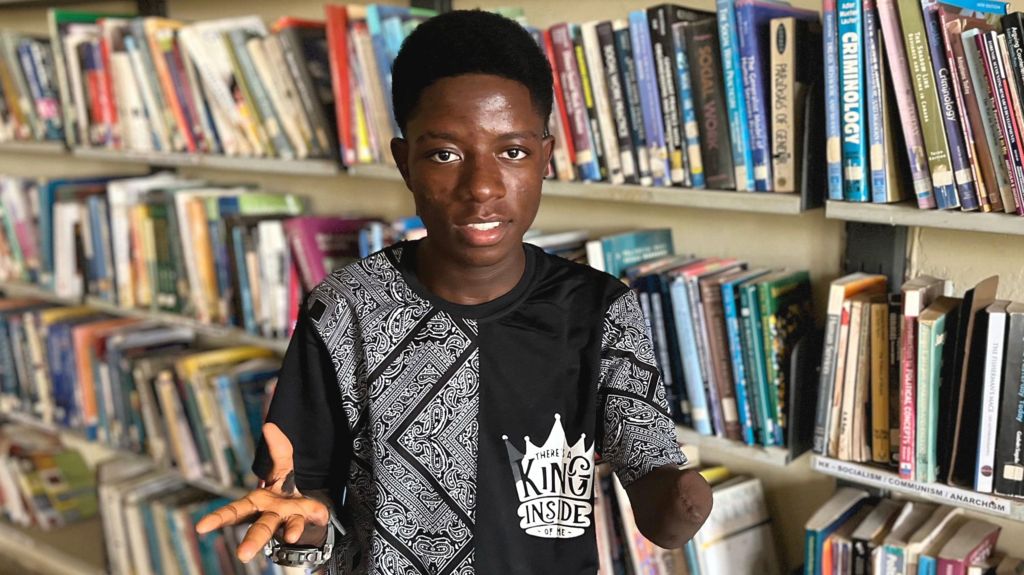
For 19-year-old Ovey Friday, the lifelong trauma of a childhood attack nearly cost him the educational opportunity he had worked his entire life to earn. At age 13, Friday’s stepmother falsely accused him of witchcraft and turned him over to a traditional herbalist in Nigeria’s central Nasarawa State, where he was brutally tortured. When a neighbor finally intervened and alerted police, the damage to his hands was too severe to repair. Surgeons were forced to amputate his entire left hand, and remove or permanently scar most of the fingers on his right hand, leaving him without usable thumbprints for biometric verification.
When Friday qualified to take Nigeria’s national university entrance exam administered by the Joint Admissions and Matriculation Board (Jamb) two years ago, the testing system’s mandatory fingerprint scan could not recognize his damaged hands. It was only through the urgent advocacy of his guardians and disability rights activists that officials agreed to accept a toe print as a valid form of identification. Today, Friday is the first member of his family to attend university, where he studies English and literary studies, re-learning how to write and adapt to independent life on campus. Despite his traumatic past and the barriers he has faced, Friday has emerged as an example of what disabled people can achieve when given access to opportunity. “Not everyone has someone to push for them. Some people will just stop trying,” he reflected.
Friday’s struggle is far from unique. Scarlett Eduoku, a radio presenter based in Nigeria’s northern Kano State, lost her left eye when she was just 18 months old, and she now faces constant barriers to basic digital services. Most modern facial recognition-enabled identity verification apps are unable to scan her face correctly, preventing her from completing routine tasks remotely. When she needed to upgrade her mobile SIM card from 3G to 5G, she was forced to travel across the city to her provider’s main headquarters to complete the process in person, a time-consuming and frustrating inconvenience that most Nigerians never have to navigate.
Invisible disabilities bring their own unique set of challenges. Opeyemi Ademola, a 28-year-old project manager based in Lagos, lives with mixed hearing loss, an invisible condition that creates constant communication barriers. “People assume that if you can speak fluently, you don’t experience communication challenges,” Ademola explained. He requires intense focus to follow conversations in meetings, and crowded, noisy environments leave him completely mentally exhausted. Simple, low-cost adjustments like post-meeting written summaries and closed captions for video calls would drastically improve his ability to participate fully in the workplace, he said. “Accessibility is not about ability. It’s about support.”
Experts estimate that more than 35 million Nigerians – roughly 15% of the country’s total population – live with some form of disability. In 2019, Nigeria’s national parliament passed landmark legislation that banned discrimination against disabled people and guaranteed equal access to public services, leading to the creation of the National Commission for Persons with Disabilities (NCPWD) to advocate for disabled rights. But according to NCPWD executive secretary Ayuba Burki-Gufwan, progress on implementation has moved at a glacial pace.
Burki-Gufwan notes that small, incremental gains have already proven how impactful policy change can be. Jumb has eliminated exam fees for disabled students and set up dedicated testing centers for people with diverse accessibility needs. At the Federal University of Lafia in Nasarawa State, officials have waived up to 75% of tuition fees for disabled students, which led to an immediate surge in disabled enrollment as hundreds of students rushed to access the opportunity they had long been denied.
Disability advocates emphasize that true inclusion requires far more than incremental adjustments. Lagos-based special educator Chukwuemeka Chimdiebere argues that accessibility extends well beyond physical building ramps, a common afterthought in most Nigerian infrastructure. True inclusion requires sign-language interpreters in all classrooms, adaptive learning materials for students with visual impairments, specialized training for educators, and digital platforms designed from the start to accommodate diverse user needs. “Many persons with disabilities are not limited by their impairment. They are limited by systems that were never designed with them in mind,” Chimdiebere said. “Inclusion is not a favour. It is a responsibility.”
Physical infrastructure remains one of the most persistent daily barriers for disabled Nigerians, especially for people who use wheelchairs. Abiose Falade, a 48-year-old author and wheelchair user based in Ibadan in southwestern Nigeria, says disability “is part of the circle of life,” but public spaces are not built to welcome people like her. In most Nigerian cities, sidewalks are uneven, blocked by open drainage ditches, or non-existent, and accessibility-focused dropped curbs are extremely rare. Rural areas have no paved sidewalks at all, forcing wheelchair users to travel on unsafe, unpaved public roads. Most public buildings, from banks to hospitals to government offices, do not have ramps, meaning wheelchair users cannot enter without physical assistance from another person. “There’s a list of places I can go and a list I can’t,” Falade said. “When I want to go out, I take someone with me so that when people start staring, start pointing, I don’t notice. It’s easier than facing it alone.”
Compounding these challenges is a total lack of local manufacturing for assistive devices. Every wheelchair, hearing aid and mobility aid used in Nigeria must be imported, driving up costs and making critical tools inaccessible to most low-income disabled Nigerians. “If nine out of every 10 person with disabilities requires some form of assistive device and none are locally manufactured, then we have a huge challenge on our hands,” Burki-Gufwan said.
Disability advocates are calling for all levels of Nigerian government to set aside 1% of public budgets for accessibility initiatives and disabled rights. They acknowledge that limited public funding and competing national priorities slow progress, even for government leaders who support inclusion. Expanding accessible infrastructure and local assistive device production will require significant upfront investment, but activists stress that stronger political commitment and consistent enforcement of existing anti-discrimination laws are just as critical as increased funding.
For Burki-Gufwan, the end goal is clear: true accessibility that leaves no one behind, in education, in employment, and in public life. For young students like Ovey Friday, that vision is already becoming a reality – one hard-won victory at a time.