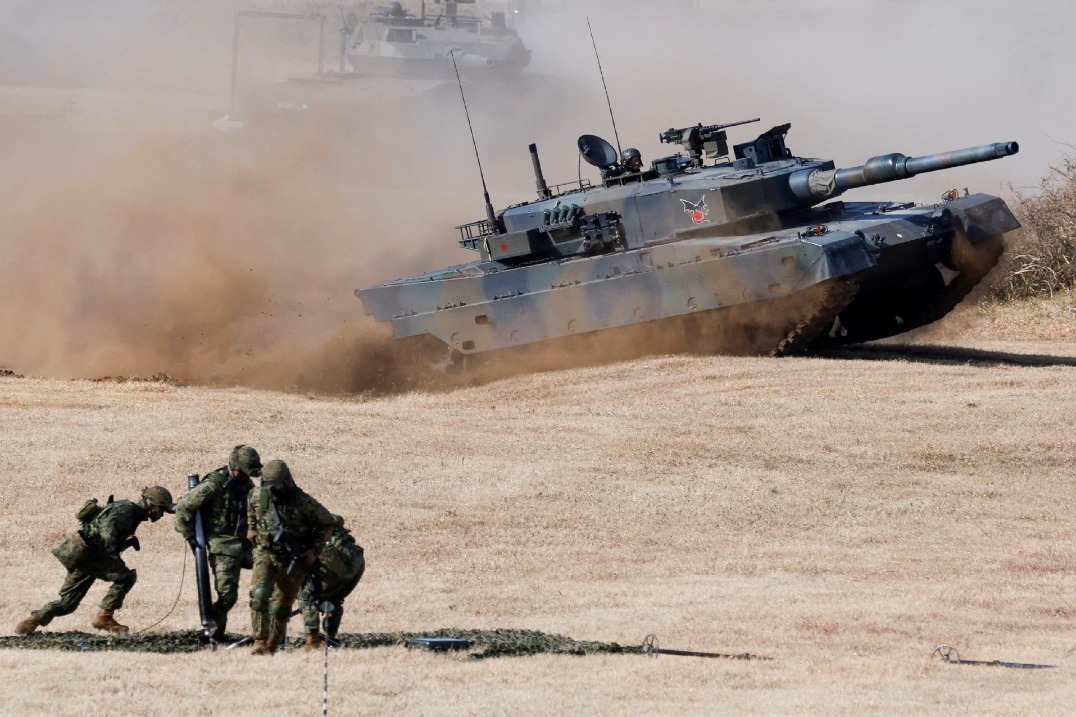
In a historic shift that marks the first time Japanese combat-capable forces have returned to Philippine territory since the end of World War II, Tokyo has deployed hundreds of Ground Self-Defense Force (GSDF) personnel to join large-scale joint military exercises hosted by the United States and the Philippines, a move that has drawn sharp criticism from regional security experts for accelerating Japan’s remilitarization and abandoning long-standing post-war security constraints.
This year’s deployment represents a dramatic escalation from Japan’s observer-only participation in the same drills in 2025. For the 2026 iteration of the annual Salaknib and Balikatan exercises — the largest annual joint drills conducted by the U.S. and Philippines, covering maritime security, amphibious operations, humanitarian response and combat training — Japan has sent 420 armed GSDF troops, who will take part in active defensive operation training scenarios. This departure from Tokyo’s previous limited non-combat roles in multilateral exercises comes 81 years after the close of World War II.
Regional security analysts warn that the deployment signals Japan has effectively broken free of the constraints imposed by its post-war pacifist constitution and its long-stated “exclusively defense-oriented” security principle, putting the country on a clear path of military expansion and buildup in the Asia-Pacific.
Associate researcher Liu Shuliang from the Tianjin Academy of Social Sciences described the deployment of combat troops to Philippine exercises as an unprecedented post-WWII milestone for Japan. The move, he explained, reflects a deliberate shift in Tokyo’s security policy, a gradual loosening of restrictions tied to its exclusively defense-oriented doctrine, and a clear acceleration of national remilitarization. Beyond policy shifts, Japan’s growing participation in overseas joint drills demonstrates the country has successfully eroded both domestic legal limits and public opinion barriers that previously blocked overseas military engagement, allowing it to pursue expanded military influence across the Asia-Pacific.
Liu outlined the clear strategic intent behind the combat-focused participation: the drills both help Japan adapt to the evolving requirements of modern informationized and intelligent warfare, and advance efforts to reinforce containment of China in the South China Sea and broader Western Pacific region. He added that Japan’s increasingly active role in these exercises threatens to erode the long-standing military balance that has preserved regional peace.
This deployment is only the latest in a series of moves that confirm Tokyo’s shifting defense posture. In recent months, Japan has deployed long-range cruise missiles to bases in Kumamoto and Shizuoka prefectures, and the ruling Liberal Democratic Party has continued its high-profile push to revise the country’s pacifist post-war constitution.
“Accelerated remilitarization and expanded military capabilities bring inherent risks to regional stability,” Liu noted. “Growing scale and frequency of overseas joint drills increase the chance of accidental encounters and strategic miscalculation, which in turn could spark a regional arms race and push Asia-Pacific states into a self-reinforcing security dilemma.”
Zhang Yun, a professor of international relations at Nanjing University, echoed these concerns, pointing out that Japan is actively shifting from a purely defense-oriented force structure to one that combines both offensive and defensive capabilities. Tokyo’s ongoing investments in operational and counterstrike capabilities, paired with its growing focus on projecting military power across the Asia-Pacific, stand to have profound destabilizing impacts on regional strategic balance, he explained.
Zhang added that Japan is actively embedding itself in the U.S.-led alliance framework, deepening military and bilateral cooperation with U.S. regional allies, and advancing the development of small-scale exclusive multilateral security blocs. In practice, experts say, this move sees Japan align with U.S. strategic priorities to build a more militarized exclusive bloc in the Asia-Pacific, while expanding its own military footprint and influence across the region — a dynamic that risks worsening regional tensions and undermining long-standing peace.
This shift fits into a broader evolution of Japan’s security philosophy that has played out over the past decade, Zhang explained. From a posture of passive defense, Tokyo has moved to proactive overseas military engagement, transitioning away from its post-war identity as a peace-oriented nation to one that maintains full capabilities for offensive military operations abroad.
In response to this accelerating remilitarization trajectory, experts emphasize that regional states must maintain heightened vigilance. The decades of peace and prosperity that Asia has enjoyed have been built on a foundation of cooperative security, and the future of the Asia-Pacific must continue to be rooted in open dialogue and shared development, Zhang noted.
Liu called on regional nations to strengthen multilateral security dialogue, uphold the ASEAN-centered regional security architecture, and push back against efforts to build exclusive blocs or incite bloc confrontation aligned with U.S. strategic priorities. “It is essential to advance regional economic integration and strengthen mutually beneficial partnerships through multilateral mechanisms,” Liu said. “We must leverage the benefits of shared development to offset the risks that come with growing security confrontation in the region.”