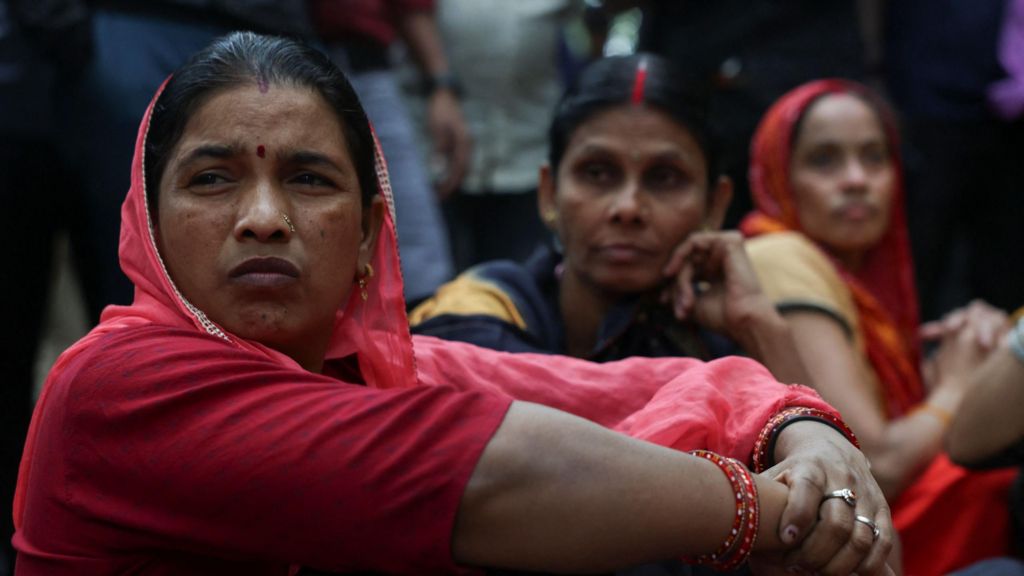
A grassroots movement of discontented factory workers has erupted across major industrial hubs in northern India, bringing rare mass unrest to the region as thousands demand living wages and improved working conditions that have stagnated for years amid soaring living costs.
What began a week ago as small, largely peaceful demonstrations across Uttar Pradesh state and neighboring regions has escalated rapidly, with major disruptions in Noida — a key manufacturing satellite city adjacent to India’s capital New Delhi. Thousands of mostly non-unionized contract workers, employed across small-scale factories producing auto components, electronics, and ready-made garments, blocked major highways and industrial access roads in coordinated actions this week. The movement has since spread beyond factory floors, with domestic workers in Noida joining the protests to demand better pay, affordable housing, and improved access to healthcare and education for their children.
Most of the participating factory workers earn between 10,000 and 15,000 Indian rupees ($107 to £79) per month, a pay rate that has remained frozen for years despite sharp increases in the cost of basic goods. The vast majority are migrant workers from poorer rural regions, who live paycheck to paycheck in cramped, low-cost informal housing on the outskirts of industrial cities. Even a single missed day of work cuts deeply into their already strained household budgets.
The anger that fueled the protests was partially triggered by a stark example of regional pay inequality: neighboring Haryana state recently approved a 35% increase to its minimum wage after a separate round of worker demonstrations, highlighting the large gaps in pay for similar work across Indian state borders. As protests intensified, the Uttar Pradesh state government, where Noida is located, announced a temporary wage hike for two districts and promised additional policy adjustments. But workers widely rejected the proposal, arguing the increase failed to keep up with rising costs and did not address longstanding systemic issues.
Worker accounts reveal the daily exploitation many face. Soni Singh, a Noida factory worker, told reporters he works 12 to 14-hour shifts six days a week, but only receives overtime pay for three of the four hours beyond his mandatory 8-hour shift, bringing his monthly income to roughly 13,000 rupees. Another anonymous female worker explained that her monthly costs leave no room for savings: “I pay 5,000 rupees in rent and spend another 4,000 on groceries and necessities. What do we save? Nothing. We just get by.”
Labor experts and activists emphasize the unrest is rooted not just in low pay, but in the inconsistent enforcement of India’s existing labor regulations. Minimum wage rates are set by individual Indian states, leading to massive geographic variations for identical work, and periodic required revisions are routinely delayed across much of the country. Weak enforcement means many small-scale employers simply ignore minimum wage mandates, and workers have little leverage to push back because formal jobs remain scarce.
What makes this wave of protests unusual for India is the absence of leadership from major national trade unions, marking a spontaneous grassroots uprising of informal and contract workers who are typically excluded from formal labor organizing. The movement has quickly taken on political overtones: Uttar Pradesh Chief Minister Yogi Adityanath has labeled instances of protest violence a “conspiracy” to undermine the state’s economic development, while leading opposition figure Rahul Gandhi has backed the workers, accusing the ruling government of ignoring their legitimate grievances.
Beyond immediate political tensions, the protests expose deep structural flaws in India’s rapidly growing economy. Official government data shows that nine out of 10 Indian workers earn less than 25,000 rupees (roughly $300) per month — a figure that aligns with the highest minimum wage for skilled workers in the country, underscoring how low earnings remain for most of the workforce. More than 310 million Indians work in the informal sector, which offers almost no job security or social protections. Wages have failed to keep pace with skyrocketing living costs, with recent global supply disruptions linked to Middle East conflicts pushing up cooking gas and other essential energy prices, adding additional strain to working households.
The situation creates a difficult bind for all sides, analysts note. Small and micro enterprises, which form the backbone of India’s manufacturing sector and employ the vast majority of industrial workers, typically operate on extremely thin profit margins. Vaibhav Gupta, who owns a small plastic utensil factory in Delhi with 50 employees, acknowledged workers’ pressure to keep up with rising costs, but said sudden mandatory wage hikes threaten the survival of small businesses like his. “When labour comes together to demand a raise, we have to listen, but that often means cutting into already thin margins or absorbing losses on existing purchase orders,” he explained.
Recent national labor code reforms, which consolidated dozens of overlapping existing labor laws into four streamlined frameworks, were intended to both strengthen worker protections and simplify compliance for employers, but many analysts say the reforms have not delivered on their promises. Arvind Goel, co-chair of the industrial relations committee at the Confederation of Indian Industry, has proposed that the government cover part of social security costs for micro and small enterprises to help them comply with minimum wage rules and reduce labor conflict.
As of this week, most Noida workers have returned to their jobs, though small-scale protests continue across the region. State officials have announced steps to enforce existing overtime pay rules and ensure timely wage payments, and news reports indicate that a broader national minimum wage revision is currently under consultation. But many workers remain skeptical that meaningful change will come. “We’re working more every year, but not getting ahead,” one Noida factory worker said. “If this is the future, how will we ever live a decent life — or save anything for our children?”