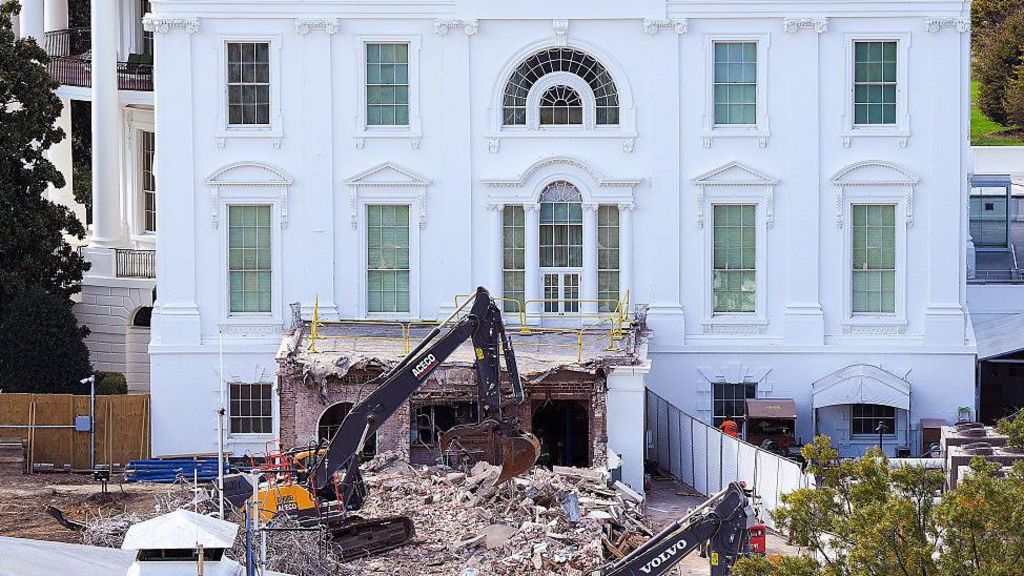
A decades-long era of White House architectural tradition has hit a new point of legal and political friction, after a federal judge delivered a mixed ruling Thursday halting above-ground construction on former President Donald Trump’s ambitious White House ballroom expansion while permitting work on the project’s underground bunker component to move forward.
In his 14-page ruling, District Court Judge Richard Leon pushed back firmly against the Trump administration’s framing of the entire ballroom complex as a critical national security asset, arguing that the executive branch had attempted to bypass congressionally mandated approval processes to advance the controversial project. Leon wrote that the classification of the above-ground ballroom as a national security priority appeared to be a deliberate maneuver to skirt an earlier temporary restraining order the court issued in late March, when it first paused construction over procedural violations.
“National security is not a blank check to proceed with otherwise unlawful activity,” Leon emphasized in his ruling.
The legal battle stems from a lawsuit filed by the National Trust for Historic Preservation, a non-profit advocacy group that argued the Trump administration violated multiple federal laws when it demolished the 122-year-old East Wing of the White House last October to clear space for the multi-million dollar project. The organization outlined three core violations: the administration failed to submit project plans to the National Capital Planning Commission for required review, declined to complete a mandatory environmental assessment, and never secured formal authorization from Congress to alter federally owned White House property. The lawsuit also notes the project violates the U.S. Constitution’s Property Clause, which grants Congress exclusive authority to regulate and manage all federal property.
This mixed ruling marks the latest legal setback for the ballroom project, which has grown in scope and cost since it was first proposed. Initial plans called for a 500-person capacity ballroom, but the blueprint has since expanded to accommodate 1,350 guests. The White House has publicly stated the entire $400 million project is funded entirely by private donors, but critics have raised ongoing questions about transparency around donor sources and the need for the large-scale expansion.
The ruling came hours after the Department of Justice filed formal notice of its intent to appeal the earlier March temporary halt, and it quickly signaled it would challenge the new ruling as well. For his part, Trump took to his Truth Social platform hours after the ruling to blast Judge Leon’s decision, arguing the entire project is critical to U.S. national security and that the court does not have authority to block it.
Trump emphasized that the above-ground ballroom and underground bunker are inextricably linked, writing that “It’s all tied together as one big, expensive, and very complex unit, which is vital for National Security and Military Operations of the United States of America!” The president added that the underground component, which he has previously described as a storage “shed” for the lower complex, “doesn’t work, isn’t necessary, and would indeed be useless, without the above ground sections.” He also framed the ruling as an attack on presidential authority, arguing the court was “attempting to prevent future Presidents and World Leaders from having a safe and secure large scale Meeting Place.” He reiterated that construction remains on budget and ahead of schedule, despite the legal delays.
The ballroom project is just the centerpiece of a broader push by the Trump administration to reshape the capital’s historic landscape. On the same day as the ballroom ruling, a federal advisory panel stacked with Trump allies gave preliminary approval to another controversial proposal: a 250-foot-tall gold-accented victory arch, dubbed by critics the “Arc de Trump,” to be built on federal land in Washington D.C.
The Commission of Fine Arts voted to advance the plan, despite receiving overwhelming negative feedback from the public and historic preservation groups, who argue the giant monument would overwhelm the capital’s restrained neoclassical skyline. If given final approval, the arch would stand taller than both the U.S. Capitol Building and the Lincoln Memorial, and will feature a golden statue modeled after the Statue of Liberty holding a torch and crown.
Unlike the privately funded ballroom, the victory arch will draw direct taxpayer support. A public spending plan for the National Endowment for the Humanities (NEH) released by the White House allocates $2 million in direct NEH special funds plus an additional $13 million in matching public funds for the project. Trump has previously stated that unspent funds from the ballroom project would also be diverted to cover arch construction costs.
Legal analysts note that the appeal of the ballroom ruling could take months to resolve, creating significant delays for a project the president has pushed to complete before the next general election. Preservation groups have pledged to continue challenging both the ballroom and victory arch projects in court, arguing they violate federal law and erode protections for Washington’s historic federal landscape.