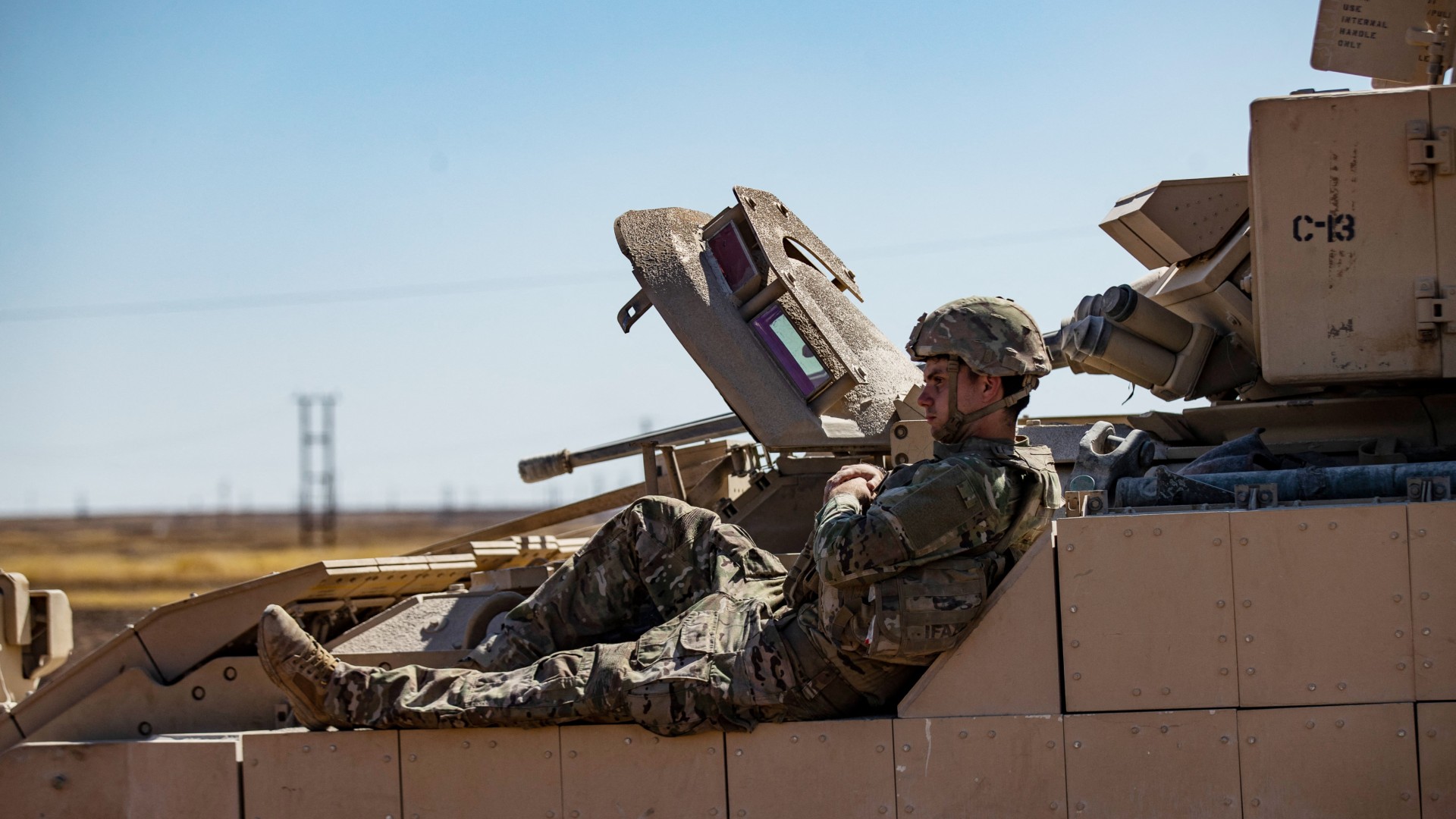
After a decade-long deployment focused on countering the Islamic State group, the last remaining U.S. military forces have exited their final base in Syria’s northeastern Hasakah province, marking the end of Washington’s active military presence in the war-torn country, Syrian officials confirmed to Middle East Eye.
Within hours of the U.S. pullout, Syrian government forces entered the Qasrak base, a strategic site that includes an operational airstrip, with local officials confirming the full completion of the withdrawal process.
Leading Syria analyst Charles Lister clarified in a public social media post that the unit tasked with securing the former U.S. base is the 60th Division of the Syrian national army, a formation mostly made up of Kurdish fighters previously aligned with the Syrian Democratic Forces (SDF)—a militia that served as Washington’s primary on-the-ground partner for 10 years. Lister added that U.S. troops and their military equipment exited Syria through neighboring Jordan, a route chosen to evade potential attacks by Iranian-aligned paramilitary groups operating in Iraq.
In an official statement released Thursday, Syria’s foreign ministry welcomed the full transfer of all former U.S. military sites to the sovereign Syrian government. The ministry emphasized that the handover demonstrates the successful integration of the SDF into Syrian national institutional structures, and confirms the Syrian state’s right and full responsibility to lead counterterrorism efforts and address all regional security threats within its own borders.
The full U.S. withdrawal comes in the wake of a major political shift in Syria: new President Ahmed al-Sharaa’s defeat of longtime ruler Bashar al-Assad in December 2024, which ended more than 14 years of civil war. Washington has thrown its support behind Sharaa’s new transitional government, and had maintained roughly 1,000 troops in Syria through most of its deployment.
Earlier in 2025, the U.S. already withdrew from two other major military bases in Syria: the al-Tanf outpost in southern Syria and the al-Shaddadi base in the country’s northeast. The withdrawal also followed a U.S.-brokered deal between the SDF and Damascus reached earlier this year, under which the Syrian government agreed to take primary responsibility for rooting out remaining Islamic State cells and other militant factions across the country.
U.S. military presence in Syria first launched in 2015, built on a long-standing partnership with the SDF that repeatedly frayed U.S.-Turkey relations. Ankara has long viewed the SDF as a front for the People’s Protection Units (YPG), the Syrian affiliate of the Kurdistan Workers’ Party (PKK)—a group labeled a terrorist organization by the U.S., European Union, and Turkey, which has waged an insurgency against the Turkish state for 40 years.
Over the past two years, however, peace negotiations between Ankara and the PKK created new space for the Damascus government to reach a formal agreement with the SDF, which had long sought regional autonomy in northeastern Syria. A brief, limited offensive by Syrian government forces, paired with mediation from U.S. envoy Tom Barrack, ultimately paved the way for a deal that stabilized the northeastern region. Under that agreement, the SDF ceded control of large stretches of territory, including the former Islamic State capital Raqqa and the key eastern province of Deir Ezzor, back to Syrian national authorities.