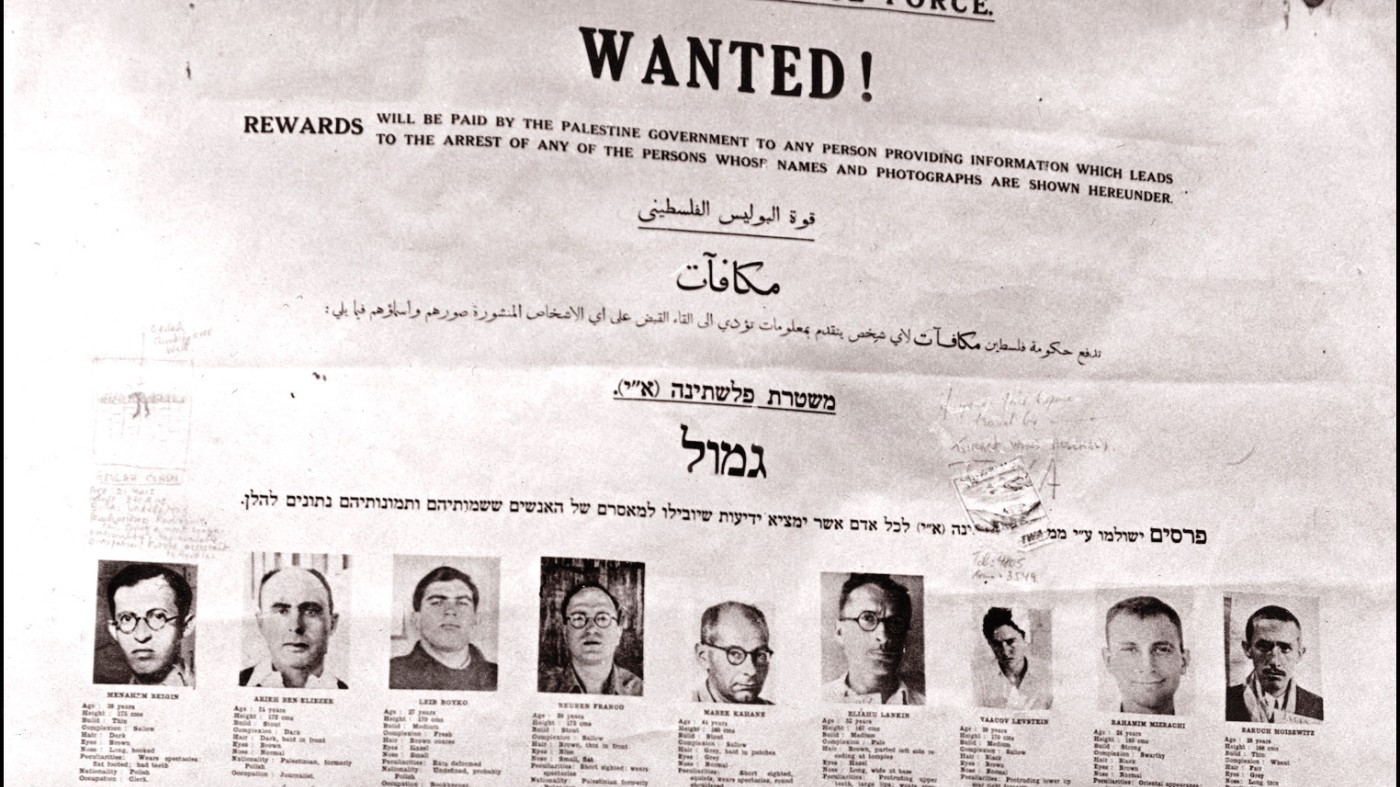
Long-sealed documents pulled from Israeli state archives have recently brought a long-rumored chapter of Zionist paramilitary history into sharp, new clarity, detailing repeated efforts by the radical Zionist Stern Gang to forge a strategic partnership with Nazi Germany during the 1930s and 1940s, when British forces held the Mandate of Palestine. First reported by leading Israeli newspaper Haaretz, the declassified files trace these secret outreach attempts directly to Avraham Stern, founder of the extremist armed group that split from the larger Irgun Zionist militia to continue anti-British resistance through World War II. The core ideological foundation for the proposed alliance, records show, was shared opposition to British rule in Palestine – the territory the wider Zionist movement targeted as the site of a future independent Jewish state.
The documents lay out how the Stern Gang dispatched member Naftali Lubenchik to meet secretly with German officials on the group’s behalf. A 1951 archival account notes that Lubenchik held the false belief that Nazi Germany did not aim for the total physical annihilation of European Jewry, but only sought to expel Jewish populations from the continent and concentrate them in a single territory. This misreading of Nazi intentions laid the groundwork for the militia’s diplomatic overtures.
Long before these contacts became public, the mainstream Zionist paramilitary Haganah – the dominant armed Zionist organization in Mandatory Palestine – was already aware of the Stern Gang’s actions. A 1941 Haganah intelligence document, titled “Contacts with the Axis” (a reference to the Nazi Germany-Fascist Italy alliance), contains previously unreported remarks from Eliyahu Golomb, the Haganah’s de facto commander at the time. Speaking to a small, closed circle of associates, Golomb acknowledged he had received intelligence that a high-profile Jewish militant codenamed “S” had been in contact with German enemy forces. The newly released records confirm the “S” in question was Avraham Stern.
A Polish immigrant who settled in Palestine in the 1920s, Stern held radical views: he pushed for unrestricted Jewish immigration to the region and demanded the full expulsion of what he called the “foreign” British presence from land he deemed inherently Jewish. His animosity toward British rule ran so deep that he was willing to set aside ideological differences with the Nazi regime to achieve his goal of a Jewish state, a stance that put him sharply at odds with the other major Zionist factions of the era. While the Irgun and Haganah had agreed to a moratorium on anti-British attacks for the duration of the war against Nazi Germany, the Stern Gang continued to launch assaults on British targets and even rival Jewish groups throughout the conflict.
Historical records compiled by Haaretz confirm multiple separate outreach attempts to German leadership. One formal proposal even outlined terms for “active partnership” with Nazi Germany in the war, framing the alignment as rooted in “shared interests between German policy and Jewish national aspirations” and calling for a formal post-war alliance between a newly established Jewish state and the German Reich. As late as 1943, Stern Gang member Natan Friedman – who later changed his name to Natan Yellin-Mor and went on to serve as a member of Israel’s parliament, the Knesset – wrote that “Germany has not yet been defeated and may still become our ally.”
Ultimately, the Stern Gang’s efforts to secure a Nazi alliance never came to fruition, but the Haganah closely monitored every step of the outreach, per Haaretz’s reporting. By 1942, after a string of deadly bank robberies and violent shootouts between the militia and British mandatory authorities, British forces tracked down Stern, killing him at the age of 34. At the time, Stern’s collaboration overtures were a major source of embarrassment for the mainstream Zionist movement, and the Haganah even joined British efforts to crack down on the Stern Gang, hunting down its members.
The newly declassified files also lay bare the full extent of Stern’s core worldview at the time. One document records his conviction that Britain had “betrayed the Jewish people and will never allow the establishment of a Jewish state.” In contrast, he argued, “Germany has no special interest in Palestine, and since the Nazis want to cleanse Europe of Jews, nothing is simpler than transferring them to their own state.” Stern firmly believed a practical agreement with the Nazis was achievable, writing, “negotiations should be opened, and Jews of Europe should be recruited into a special army that would fight its way to Palestine and conquer it from the British.” Additional files confirm Stern sought to “seize control of all of Eretz Yisrael [Greater Israel] by force with the help of a foreign power” – a foreign power explicitly identified as Nazi Germany.
For his part, Yair Stern, son of Avraham Stern, has pushed back on the framing of his father’s actions in an interview with Middle East Eye for a documentary focused on the militia founder. He downplays the Nazi overtures as a minor, context-specific episode intended to rescue European Jews from persecution, arguing his father could not have known the full scope of the Nazis’ planned Holocaust – which was not formalized until shortly before Avraham Stern’s death in 1942. He also dismisses confessions from former Stern Gang members about the collaboration efforts, claiming the statements were extracted under duress during Haganah interrogations and cannot be considered credible.