Against a backdrop of escalating global economic disruption fueled by the US-Israel-Iran conflict, China’s first-quarter economic growth has outperformed projections, offering a rare bright spot for the world economy while revealing deep-rooted and emerging challenges that continue to shape its trajectory.
Official data released shows China’s gross domestic product expanded 5% year-on-year in the first three months of 2026, exceeding the 4.8% growth forecast by a consensus of economists. This stronger-than-expected result comes even as the Middle East conflict, which erupted in late February, has severely roiled global energy markets, hitting Asian economies particularly hard.
The better-than-anticipated growth reading marks the first official GDP release since Beijing downgraded its 2026 full-year growth target to a range of 4.5% to 5% last month, the lowest annual growth goal China has set since 1991. The new target was formally announced alongside broader economic priorities for the latest Five-Year Plan in March, where Chinese leadership outlined commitments to heavy investment in innovation and high-tech manufacturing, paired with policy measures to stimulate flagging domestic consumer spending.
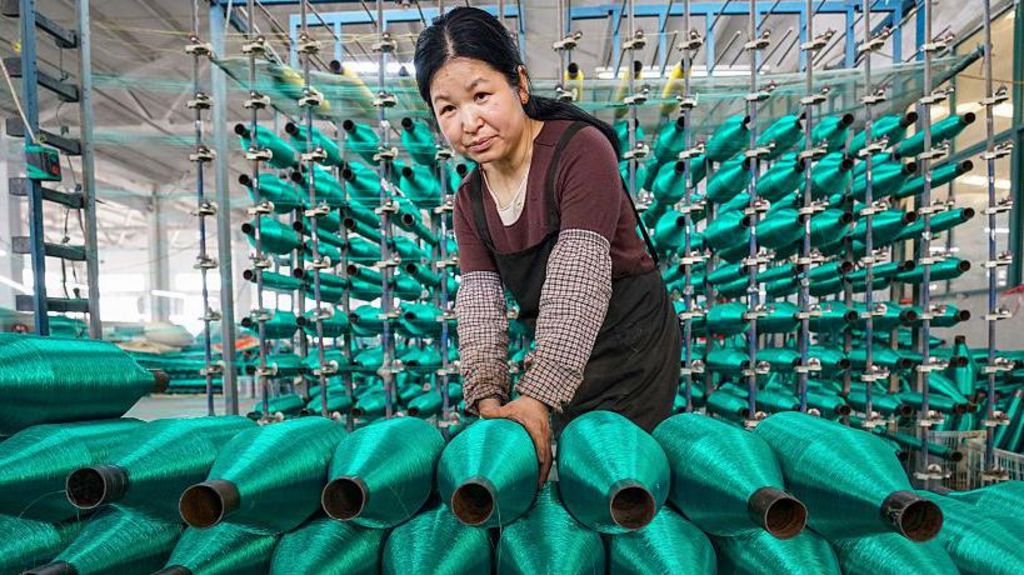
The ruling Communist Party has been working to recalibrate China’s economic model, which has been grappling with a cascade of persistent headwinds for years: stagnant household consumption, a rapidly shrinking working-age population, and a years-long ongoing property sector crisis that has dampened investment across the real estate industry. This quarter’s growth was largely driven by expansion in manufacturing output, while the broader economy continues to be dragged down by falling investment in the property sector, according to the official data.
Beyond domestic challenges, China also faces external pressure from energy market volatility tied to the Middle East conflict and ongoing global trade frictions, particularly long-standing tariff policies enacted by former US President Donald Trump. Currently, most Chinese goods exported to the US face a 10% US tariff, but US Treasury Secretary Scott Bessent indicated in comments Tuesday that the administration could restore tariffs to their pre-Supreme Court ruling levels by early July, after the high court struck down a large portion of Trump’s original import levies.
Despite the positive GDP surprise, new trade data released Tuesday points to growing external strain on China’s economy. March export growth slowed sharply to just 2.5% year-on-year, down from a more than 20% combined surge in exports across January and February, and hitting a six-month low. China aggregates January and February trade data annually to account for shifting Lunar New Year holiday dates, which typically cause large seasonal fluctuations in trade activity. The earlier jump in exports had been fueled by strong global demand for Chinese electronics and manufactured goods.
In a counterpoint to slowing exports, March imports surged nearly 28% year-on-year in value terms, driving China’s monthly trade surplus – the gap between total exports and total imports – down to just over $50 billion (£36.85 billion), the smallest surplus recorded in more than a year.
Yixiao Zhou, an economics lecturer at the Australian National University, explained that the sharp rise in the value of imports is largely a reflection of higher global commodity costs driven by the Middle East conflict. Iran’s threats to block commercial traffic through the Strait of Hormuz, a critical chokepoint that carries roughly a fifth of the world’s daily oil supply, have pushed up global prices for crude oil and petroleum-derived products including plastics, which China imports in large volumes.
For exports, Zhou added, slowing growth stems from reduced consumer spending power across global markets, as conflict-driven inflation erodes household budgets. “Export growth ultimately depends on your trading partners’ economies,” she noted. “It is hard to sustain that growth at a very high rate continuously.”
Looking ahead, high-level diplomatic attention is already focused on an expected meeting between US President Donald Trump and Chinese President Xi Jinping scheduled to take place in China in May, where trade policy and tariff disputes are expected to top the agenda.