Against a backdrop of intensifying global armed conflict and mounting diplomatic pressure from the United States, the Australian government announced Thursday a sharp upward revision of its long-term defence spending target, pledging to lift military expenditure to 3.0 percent of gross domestic product by 2033.
The new policy marks a significant jump from the previous projection, which forecast defence outlays would reach only 2.3 percent of GDP by the same year. Department of Defence officials confirmed the adjusted target will inject an extra AU$53 billion (equivalent to US$38 billion) into national defence over the coming decade, compared to the 2024 defence strategy framework. In the immediate four-year period, an additional AU$14 billion will be allocated to military programs.
To align with the new target and meet international accounting standards, Australia has revised its defence budget calculation methodology to adopt the NATO definition, which includes items such as military pensions in official spending tallies. The announcement comes after years of consistent pressure from successive U.S. administrations urging Canberra to increase the share of GDP dedicated to defence. Notably, the new 3.0 percent target still falls short of the 3.5 percent of GDP demand issued by U.S. Defence Secretary Pete Hegseth last year.
In justifying the substantial spending increase, Defence Minister Richard Marles emphasized the shifting global security landscape in a pre-prepared speech obtained by Agence France-Presse. “International norms that once constrained the use of force and military coercion continue to erode,” Marles said. “More countries are engaged in conflict today than at any time since the end of World War II, and this is occurring across every region of the world.”
As a U.S. ally positioned in the Indo-Pacific, Australia has increasingly centered its defence planning on countering perceived military risks tied to China’s naval expansion in recent years, reshaping its force structure to prioritize long-range missile strike capabilities and deterrence along its northern strategic approaches. The elevated defence budget will accelerate ongoing high-priority projects, most notably the expansion of a major shipbuilding facility in Western Australia built to accommodate nuclear-powered submarines under the landmark AUKUS trilateral security pact with the United States and the United Kingdom. Under the 2021 agreement, Washington and London have committed to delivering nuclear-powered submarine technology to the Royal Australian Navy within 15 years, though the deal has drawn sharp criticism from opponents who argue it provides no guarantee Australia will ever take delivery of the vessels and leaves a critical capability gap in Australian defence for the next decade.
Australia’s unique geographic characteristics — a vast coastline paired with a relatively small population — have also driven the development of indigenous autonomous military systems, including the large autonomous Ghost Shark submarine and Ghost Bat fighter drone. In a related announcement earlier this week, Canberra confirmed it would allocate up to AU$5 billion to expand drone development and procurement, a move framed as a response to evolving warfare tactics observed in ongoing conflicts in Ukraine and the Middle East. In an additional indication of Australia’s expanding global military posture, Prime Minister Anthony Albanese confirmed March 10, 2026 that Canberra will deploy a long-range military reconnaissance aircraft to the Gulf region to support civilian protection efforts.
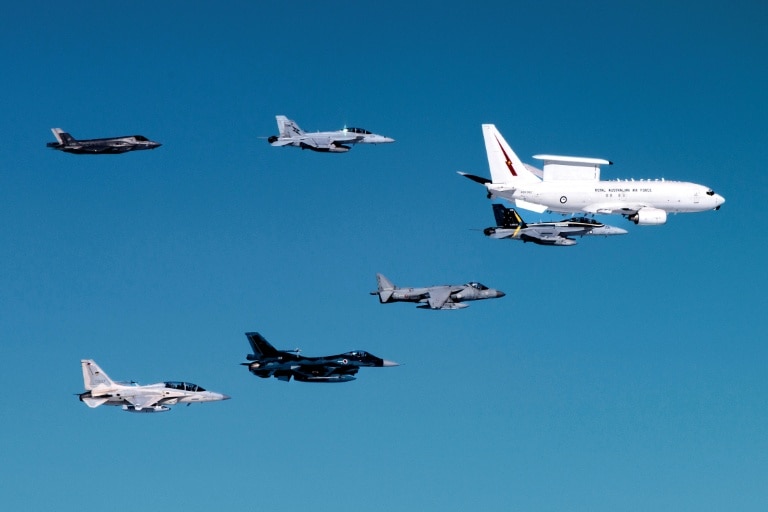
The revised defence spending plan comes as the Australian Defence Force hosts Exercise Pitch Black 2024, a large-scale multinational air exercise over northern Australia that has brought together military aircraft from Australia, Japan, the Philippines, Spain and other partner nations to practice integrated air operations.