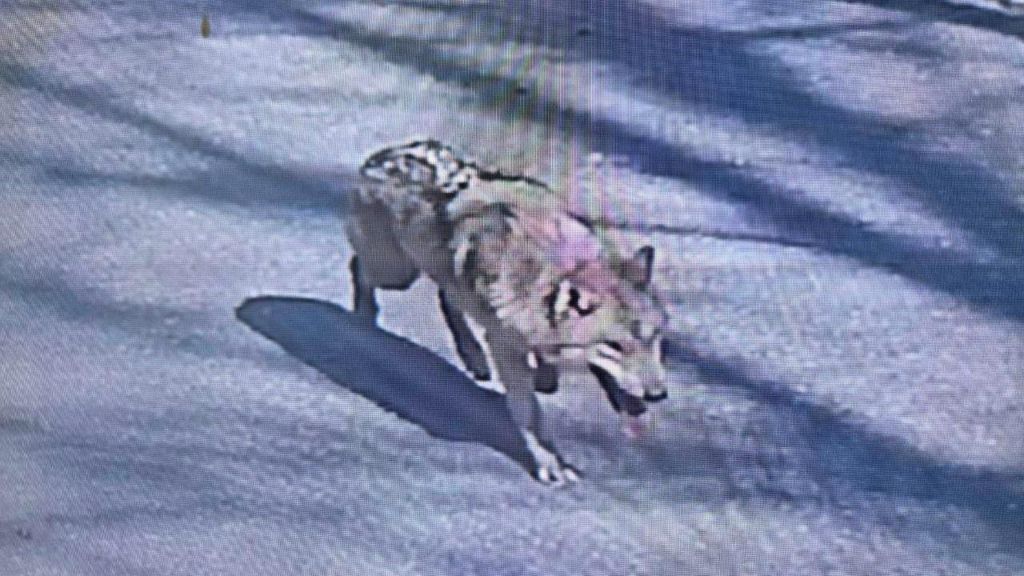
A two-year-old captive wolf has captured the collective imagination of South Korea after escaping a zoo in Daejeon last week, sparking a massive multi-agency manhunt that has stretched into its second week with the animal still at large. Named Neukgu, the young wolf squeezed under a perimeter fence at Daejeon’s O-World, a combined zoo and theme park, to win his freedom, turning into an unexpected national sensation and even inspiring a namesake meme cryptocurrency.
More than 300 personnel, including local firefighters, police officers, and military troops, have been deployed across the wooded hills and suburban neighborhoods surrounding O-World to track Neukgu down, but the wily animal has repeatedly outsmarted search teams, slipping away just as searchers close in. The first close call came just 24 hours after his escape, when thermal imaging cameras picked up Neukgu’s heat signature moving through thick foliage within a few kilometers of the zoo. Search teams lost his trail, however, when a drone battery needed to be replaced, allowing the wolf to slip away undetected.
A new lead emerged on Monday night after a local resident reported spotting Neukgu on a mountain roughly 1.2 miles from O-World. Social media users quickly shared a video showing the wolf trotting down a dark rural road, illuminated by oncoming vehicle headlights. Dozens of officers and military drones were immediately dispatched to the area, but by the following morning, Neukgu had once again vanished from search grids.
As the manhunt drags on, the case has gripped the South Korean public, spurring a wave of uncoordinated community participation and false leads. Within a day of Neukgu’s escape, authorities received dozens of unconfirmed sighting reports. Local newspaper Chosun Daily documented multiple cases of misidentification, including a group of elementary school children who mistook stray dogs for the fugitive wolf. One local resident even showed up to aid the search with their personal wolfdog, a move never coordinated with official search teams. A widely shared image that appeared to show Neukgu walking down a paved city street, which prompted authorities to expand their search into populated residential areas, was later confirmed to be a fabricated AI-generated image.
Public anxiety and sympathy for Neukgu have been shaped by a haunting precedent: in 2018, an 8-year-old puma named Porongi escaped from the same O-World facility and was shot and killed by responding police. This history has put pressure on authorities to capture Neukgu alive, with high-profile figures and advocacy groups adding their voices to calls for a safe resolution. South Korean President Lee Jae Myung publicly shared his hopes for the manhunt in a post on X, writing, “I hope no human casualties occur and I pray that Neukgu also returns home safely.”
Local animal rights organization Animal Freedom Solidarity has also spoken out, criticizing the zoo for repeated safety failures. “The same accident has occurred again,” the group stated in comments reported by Chosun Daily. “We hope Neukgu will be safely captured without repeating Porongi’s fate… the reality that the life of an animal may be at stake due to an accident caused by poor management and structural defects of its facility is clearly unjust.”
Beyond public debate over animal welfare and zoo safety, Neukgu’s escape has spawned unexpected cultural and economic side effects. Crypto creators have launched a meme coin named after the fugitive wolf, framing Neukgu as a “symbol of independence” and a “wolf that wouldn’t stay caged”. In the 24 hours after the token launched, it recorded roughly $150,000 (£110,000) in trading volume.
Neukgu was born in captivity in 2024 as part of O-World’s conservation program for Korean wolves, a subspecies that once roamed across the entire Korean Peninsula but is currently classified as extinct in the wild. For Neukgu, the challenges of life on the run extend beyond evading search teams: wildlife experts and observers have raised concerns about his ability to survive in the wild, given his lack of hunting experience and captive upbringing. The last confirmed meal Neukgu ate was two chickens, served the night before his escape. While wild wolves can survive for days or even weeks without food, Neukgu has never had to hunt for prey, the primary food source for wild packs, which typically rely on hoofed herbivores such as deer, wild boar, and cattle.
As part of the search strategy, authorities have kept O-World closed to visitors and have been playing recorded wolf howls and park announcements that Neukgu was exposed to during his time in captivity, in hopes of luring him back to the zoo grounds. As a precautionary measure, a nearby elementary school was also closed immediately after the escape to protect students from any potential encounter.
In the most recent publicly released footage of Neukgu, shared by Daejeon city authorities, the young wolf is seen resting on a bed of forest leaves before rising to pace through the undergrowth. The video’s caption closes with a public appeal: “Please, wish for a safe capture of Neukgu.”