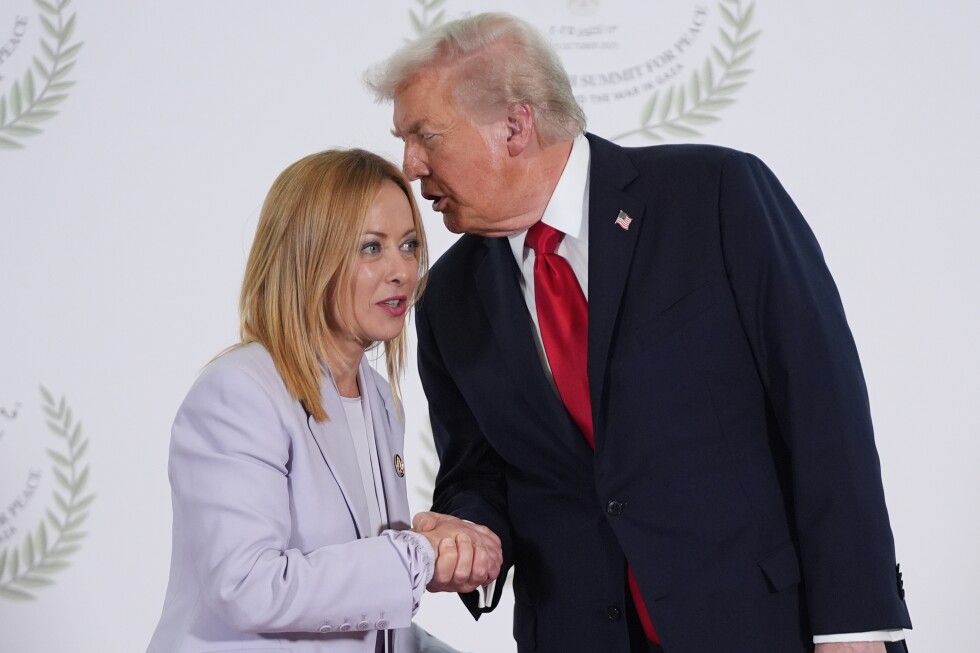
The once-anticipated role of Italian Prime Minister Giorgia Meloni as Europe’s primary bridge to U.S. President Donald Trump now teeters on collapse, after a series of public broadsides from the American leader over her refusal to back his administration’s war on Iran and her condemnation of his criticism of Pope Leo XIV.
In an interview with leading Italian national newspaper Corriere della Sera, Trump made clear his disillusionment with Meloni, who had long been counted among his closest European allies. “I thought she had courage,” Trump told the outlet. “I was wrong.” The verbal rebuke came after Meloni publicly labeled Trump’s attack on the pope “unacceptable,” and maintained Italy’s firm refusal to join the U.S.-led military campaign against Iran – a stance that included blocking U.S. bombers from accessing a key Italian air base in Sicily last month.
Meloni has yet to issue a direct public response to Trump’s attacks, but foreign policy analysts widely agree the split could work to her political advantage, as she navigates the aftermath of a lopsided referendum defeat last month and seeks to insulate her government from backlash over the deeply unpopular Iran war, which has sent domestic energy prices soaring across Italy.
“I actually think this is a godsend for her,” explained Nathalie Tocci, director of the International Affairs Institute and a professor at Johns Hopkins SAIS Europe. “Trump has become completely toxic across Europe, across much of the world, including Italy.”
Trump doubled down on his criticism during an appearance on Fox News Wednesday, confirming what insiders had hinted at for months: the once-close personal and political bond between the two nationalist leaders has definitively frayed. “She’s been negative,” Trump said. “Anybody that turned us down to helping with this Iran situation, we do not have the same relationship.”
The breakdown of the alliance follows a 15-month arc that began with high expectations. Meloni was the only European Union leader invited to Trump’s second inauguration, and political observers widely predicted she would leverage her close personal ties to advance Italian interests after he returned to office. Both leaders share nationalist ideological leanings and hard-line positions on immigration, creating what was seen as a natural alignment. But the relationship began to sour almost immediately, when Italy was hit hard by Trump’s global tariffs, leaving Meloni with little tangible gain to show for her overtures to the White House. When asked if the two leaders had spoken this month, Trump told Corriere della Sera, “No, not in a long time.”
Tensions grew after an awkward Oval Office meeting one year ago, where Meloni avoided direct confrontation over Trump’s tariff policies. The rift widened sharply over the Iran war, with Meloni holding firm to Italy’s neutral position. Her public rebuke of Trump’s comments on the pope marked the most direct public criticism she has leveled at the U.S. president to date.
Tocci argues the split is not the result of a deliberate shift by Meloni away from Trump, but rather a consequence of the U.S. president’s increasingly erratic public posture. “It’s been building up over time, not so much because she is moving away from him but because he has become increasingly unhinged,” she noted.
Senior members of Meloni’s government have sought to downplay the public dispute, emphasizing that the broader U.S.-Italy transatlantic alliance remains intact. Adolfo Urso, a cabinet minister from Meloni’s far-right Brothers of Italy party, told Italian outlet Radio 24 that the row would not shake the longstanding partnership between the two nations. “Italy and the United States are allied countries and maintain their relationship and alliance within international institutions, starting obviously with the Atlantic Alliance,” Urso said, adding that the Catholic Church’s moral teachings “cannot crack relationships consecrated in alliances signed a few decades ago.”
Mariangela Zappia, president of the Italian think tank ISPI and a former Italian ambassador to the United States, framed Trump’s heated reaction as symptomatic of broader frustration with Europe, not just Italy. Beyond failing to secure unified European backing for the Iran war, Trump recently lost one of his most loyal far-right European allies after Viktor Orbán’s electoral defeat in Hungary over the weekend.
Even so, Zappia stressed that Trump’s personal attack on Meloni should not be interpreted as a permanent fracture to the broader transatlantic alliance. “Europe absolutely considers the United States its historic ally, but in some way wants to be involved in the decisions that are taken,” Zappia said. For Trump, she added, the takeaway is clear: “this European Union is not easy to dismantle. We are different, we react differently. Some are clearly anti-Trump, some are pro-Trump but in the end, destroying the European project, separating us on the things on which we see as our future, that is very difficult.”
For Meloni, the immediate priority is shoring up domestic political support after last month’s referendum defeat, which functioned as an informal confidence vote on her leadership. She recently embarked on a high-profile two-day tour of three Gulf states, seeking to secure new long-term gas and oil deals to ease Italy’s ongoing energy crisis driven by the Iran conflict, but returned to Rome without any binding formal agreements. Earlier this week, she announced Italy would not automatically renew its defense cooperation agreement with Israel, after warning shots struck an Italian UN peacekeeping convoy in southern Lebanon. Analysts widely view the move as a symbolic gesture driven by domestic politics, rather than a substantive shift in Italian foreign policy, given deep public opposition to Israel’s actions in the region among Italian voters.
“The Gulf tour was a way to show public opinion that she was being proactive. The fact it didn’t actually lead to anything is beside the point,” Tocci explained. Of the non-renewal of the Israel agreement, she added: “substantively is rather meaningless because there is not much in this agreement but symbolically it helps because Israel has become just so unpopular in Italian public opinion.”
Even with these political calculations working in her favor, some political analysts predict a challenging remaining 18 months of Meloni’s mandate before national elections scheduled for 2027, with the economic fallout of the Iran war continuing to weigh on household finances. Roberto D’Alimonte, a professor of government at Rome’s LUISS University, noted that Italian voters are focused on tangible relief from rising energy costs, not just symbolic political gestures. “People want to see their gas bills go down, not just see Meloni talk about gas,” D’Alimonte said. “What matters are the bills you get every month.”