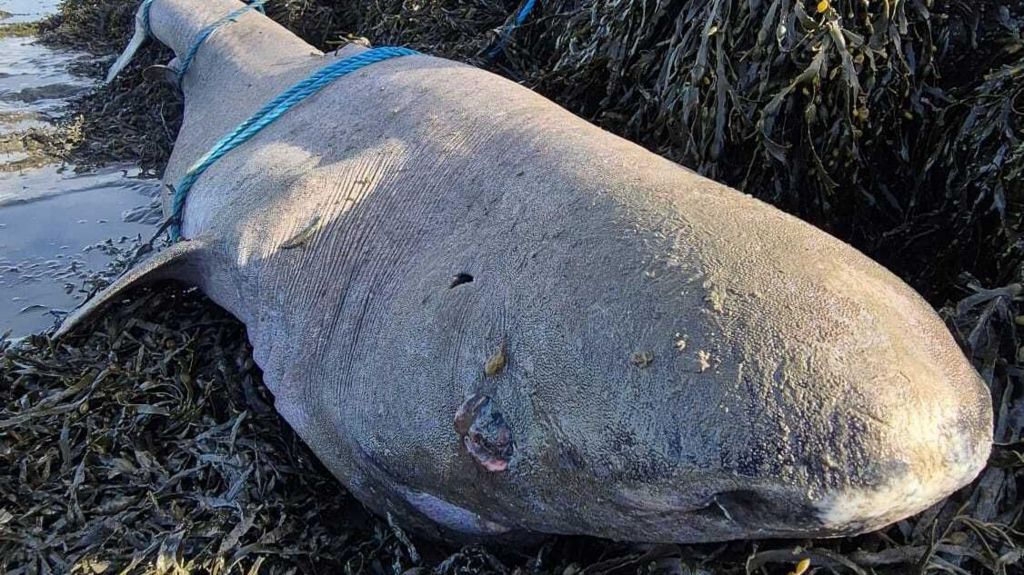
In a groundbreaking discovery for Irish marine science, a rare Greenland shark — a species that holds the title of the longest-living vertebrate on Earth — has washed ashore on the coast of County Sligo, marking the first confirmed stranding of the species ever recorded on Irish shores.
The 2-meter male specimen was found on the beaches of Finisklin last Saturday, and initial reports to the Irish Whale and Dolphin Group (IWDG) first misidentified it as a common basking shark. Only after reviewing detailed photos did experts confirm the animal’s true identity: a young Greenland shark estimated to be around 150 years old, on the cusp of sexual maturity. Emilie De Loose, an IWDG researcher, noted the shark already had fully developed claspers, a trait consistent with an individual approaching breeding age.
Native to the frigid deep waters of the Arctic and North Atlantic, Greenland sharks are one of the most elusive marine species on the planet. These extraordinary creatures can live for more than 500 years, with the oldest recorded specimen verified to be over 500 years old. Adults typically grow to between 4 and 6 meters long, thriving in extreme environments where water temperatures often drop below zero. Their slow, low-energy lifestyle allows them to survive on scavenging, with a powerful suction feeding mechanism that can pull prey into their mouths from more than a meter away. Many Greenland sharks are blind, but they compensate for this with an extremely advanced sense of smell that guides them to food. The species also has one of the longest reproductive cycles of any animal: they reach sexual maturity at roughly 150 years old, and gestation takes between 8 and 18 years before pups are born.
Following confirmation of the stranding, the Natural History Museum of Ireland (NHMI) coordinated a complex recovery operation to retrieve the specimen from the remote, hard-to-access shoreline. The effort required heavy specialized equipment, including a crane, to lift the shark from the rocky coast.
Museum officials announced plans to conduct a full scientific post-mortem examination to expand global understanding of this little-studied deep-sea species. Tissue samples and key anatomical specimens will be added to the NHMI’s permanent scientific research collection for future study. If the shark’s skin remains in good enough condition to preserve, the museum also hopes to put the entire specimen on public display, giving visitors a unique opportunity to engage with one of the ocean’s most mysterious creatures.
Marine biologists across Ireland have called the discovery a once-in-a-generation opportunity to advance research into a species that is rarely seen by humans, particularly in Irish waters.