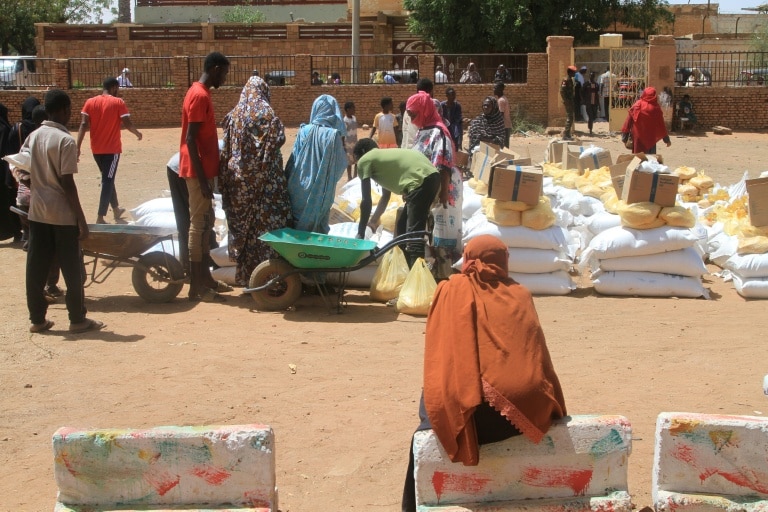
Three years after conflict erupted between Sudan’s regular army and the Rapid Support Forces (RSF) paramilitary group in April 2023, the northeastern African nation remains mired in one of the world’s worst humanitarian catastrophes, even as global attention has shifted to other crisis hotspots. As international stakeholders gathered in Berlin this week for a high-stakes donor conference, German officials are pushing to secure more than $1 billion in new humanitarian pledges — exceeding the total raised at the previous London-hosted conference — to address an unfolding emergency that has been largely overlooked by the international community.
Speaking to public broadcaster Deutschlandfunk ahead of the conference opening, German Foreign Minister Johann Wadephul expressed cautious optimism that the funding target would be met, noting that new pledges were already flowing in ahead of the gathering. “Despite the fact that global diplomatic focus is currently absorbed by Ukraine and Iran, this massive humanitarian catastrophe in Africa cannot be pushed to the margins of global consciousness,” Wadephul emphasized.
Unlike previous diplomatic gatherings, neither the Sudanese army nor the RSF — the two warring parties that have torn the country apart since 2023 — were invited to participate in the Berlin conference. Beyond rallying much-needed humanitarian funding, the gathering also carries a secondary diplomatic goal: to jumpstart stalled peace talks that have collapsed since last November. The so-called Quad diplomatic bloc, made up of the United States, Saudi Arabia, the United Arab Emirates and Egypt, has led international peace efforts to date, but those efforts have ground to a halt amid deep disagreements and accusations of foreign interference. Rival regional powers back opposing sides in the conflict: Saudi Arabia, Egypt and Turkey publicly support the Sudanese army, while the UAE has been widely accused of supplying arms to the RSF. All four nations deny direct involvement in the fighting, and talks collapsed after Sudanese army chief Abdel Fattah al-Burhan accused the Quad of pro-RSF bias due to the UAE’s membership in the group.
Wadephul argued that even without the warring parties in the room, the Berlin conference can still advance the cause of peace by creating space for local Sudanese stakeholders to open dialogue with one another. But Luca Renda, the United Nations Development Programme’s representative in Sudan, struck a far more pessimistic tone. “There are many external actors involved in this war, and as long as this continues, unfortunately, the chances of peace are very slim,” Renda warned.
The human cost of three years of continuous war is staggering. Tens of thousands of people have been killed since fighting began, with the United Nations recording nearly 700 civilian deaths from drone strikes alone since the start of 2025, as attacks have intensified in southern Kordofan and Blue Nile State. More than 11 million Sudanese have been displaced from their homes, and nearly 25 million — almost half the country’s population — face acute food insecurity. Famine was officially declared last year in El-Fasher, the capital of North Darfur, and Kadugli, the capital of South Kordofan, with 20 additional regions across the country at imminent risk of famine. The conflict has pushed more than 90 percent of Sudan’s population below the poverty line, and global humanitarian funding for the crisis currently meets only 16 percent of the UN’s requested target.
For ordinary Sudanese who have lived through three years of violence, the toll has been crippling. “People are exhausted,” Amgad Ahmed, a 42-year-old resident of Omdurman, Khartoum’s twin city, told Agence France-Presse. “Three years of war have worn people down. We have lost work, savings and any sense of stability.”
A fragile veneer of normality has begun to emerge in Khartoum after the Sudanese army retook full control of the capital last year. Roughly 1.7 million displaced residents have returned to the city, markets have reopened, traffic has returned to long-deserted streets, and national secondary school exams were held this week for the first time after two years of widespread school closures. But visible scars of war remain everywhere, and deadly hazards still lurk beneath the tentative recovery: authorities are still working slowly to clear tens of thousands of unexploded ordnance left scattered across the city by years of urban combat.
Al-Basheer Babker al-Basheer, a 41-year-old Sudanese who returned to Khartoum twice this year after three years away, said the capital will require decades to fully recover from the destruction. “I was happy to come back,” he said. “But when I went into the city centre, it was heartbreaking. The road to the university where I studied is no longer the same. The walls are black. They are not the same places we used to go to.”
The Berlin conference brings together more than 80 participants, including foreign government representatives, international aid agencies, and Sudanese civil society groups, marking the third high-level international donor gathering for Sudan after conferences hosted by London and Paris over the past two years. Organizers hope the new pledges will help scale up life-saving aid across the country, even as the ongoing conflict and lack of progress on peace leave the long-term future of the world’s third-poorest nation deeply uncertain.