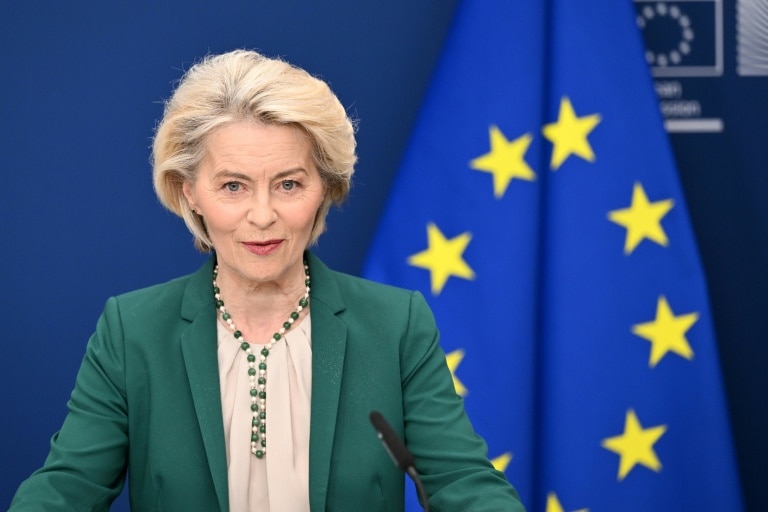
European Commission President Ursula von der Leyen announced Wednesday that a bloc-developed age verification mobile application, designed to protect minors from harmful online content, has reached full technical readiness, marking a key milestone in the EU’s years-long push to strengthen digital protections for children.
The push for a standardized age-check tool comes as policymakers across the bloc face growing public pressure to enact tougher regulations on digital platforms, with multiple member states already advancing domestic legislation to set minimum age limits for social media use. The project originated last year, when five founding member states — including France and Italy — launched pilot trials to test the tool’s functionality and user experience.
Von der Leyen, speaking to reporters in Brussels, drew a comparison to the age verification protocols used in brick-and-mortar retail for age-restricted purchases like alcohol. “This app will allow users to prove their age when accessing online platforms. Just like shops ask for proof of age for people buying alcoholic beverages,” she explained. The app draws on the technical framework developed for the EU’s digital COVID-19 vaccine certificate, a widely adopted system that enabled cross-border travel during the pandemic’s reopening phase.
For end users, the process will be straightforward: once launched, the app can be downloaded from major app stores, linked to a national passport or government-issued ID card, and then used to confirm a user meets a platform’s minimum age requirement. To address widespread privacy concerns that have derailed past age verification efforts, von der Leyen emphasized the tool is built with full anonymity to prevent user tracking across websites. It also runs on open-source code, meaning non-EU countries are free to adapt the system for their own use if they choose.
“Online platforms can easily rely on our age verification app. So there are no more excuses,” von der Leyen said. “Europe offers a free and easy to use solution that can shield our children from harmful and illegal content.”
Pressure for coordinated EU action has mounted significantly since Australia implemented its landmark ban on social media use for children under 16 last year. France has emerged as a leading advocate for tighter rules, alongside Denmark, Greece and Spain, and is currently debating a domestic ban on social media for users under 15 that is working its way through the French national parliament. Even if the legislation passes, however, implementing the ban without a standardized verification system has long been seen as a major logistical hurdle. The new EU app is designed specifically to help member states enforce whatever national age limit rules they ultimately adopt, as long as those rules align with existing EU legislation, with the bloc taking on formal enforcement responsibilities.
Despite the progress, policy experts and policymakers alike acknowledge outstanding challenges. Even with formal age limits and a verification system in place, concerns persist that tech-savvy minors will circumvent checks by using virtual private networks (VPNs) to hide their location or shift to smaller, unregulated platforms that do not enforce age rules. The EU already enforces some of the world’s strictest digital regulations, with ongoing regulatory probes into the harms that major platforms including Instagram and TikTok pose to children.
Von der Leyen has publicly supported moving toward a bloc-wide mandatory minimum age for social media use, but has said the commission will wait for expert input before formalizing that proposal. A special expert panel convened to study additional regulatory measures is set to release its final recommendations by this summer.
“It is our duty to protect our children in the online world, just as we do in the offline world, and to do that effectively, we need a harmonised European approach,” she said.