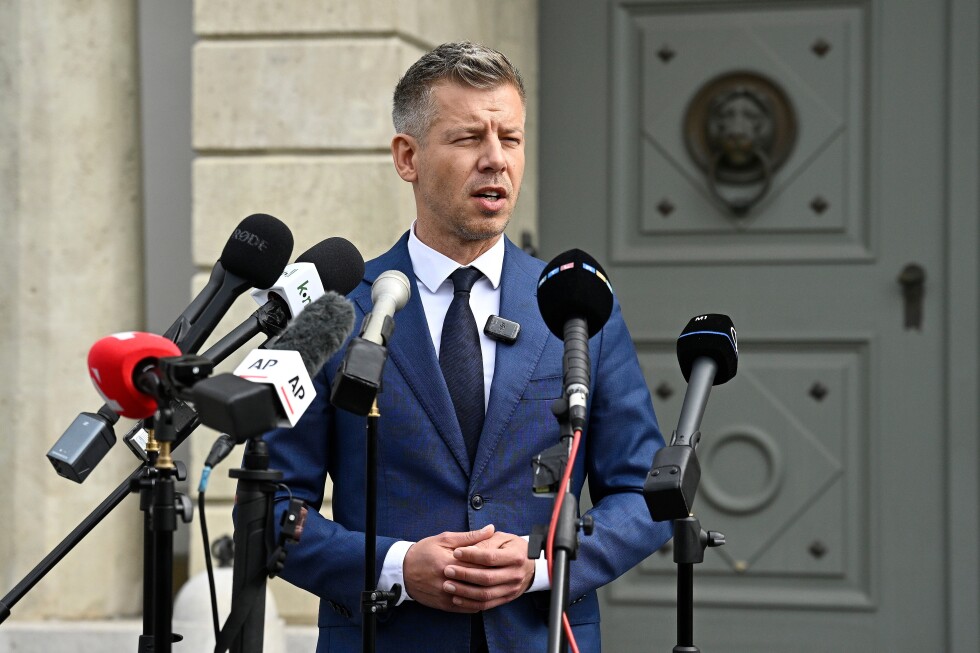
BUDAPEST, Hungary – Just three days after his center-right Tisza Party secured a historic landslide victory that ended Viktor Orbán’s 16-year hold on Hungary’s premiership, opposition leader Péter Magyar has confirmed an accelerated timeline for the handover of power, with the new government set to take office in the first week of May. Magyar’s win came on the back of broad voter support that delivered Tisza a two-thirds supermajority in Hungary’s parliament – a threshold that gives the incoming administration the legal power to rewrite the constitution and dismantle core elements of Orbán’s long-standing political framework. In a press briefing outside the Budapest presidential palace Wednesday, Magyar told reporters that following a closed-door meeting with Hungarian President Tamás Sulyok, the head of state has committed to scheduling the new parliament’s inaugural session for either May 6 or 7, putting the transition nearly a week ahead of the legal deadline of May 12 required by Hungarian election law. Sulyok, who was appointed to the presidency by Orbán’s outgoing parliamentary majority, also confirmed he will nominate Magyar as the country’s next prime minister, a formal step required to confirm his appointment. “All parties agree that after such a clear, overwhelming mandate from Hungarian voters, it serves the best interests of the nation for this government and regime change to take place as quickly as possible,” Magyar told reporters Wednesday. The accelerated transition caps a dramatic political upset that saw Orbán, one of Europe’s longest-serving incumbent leaders, ousted from power after 16 consecutive years in office, with youth turnout and widespread discontent with Orbán’s governance driving the opposition’s historic win. Since Sunday’s result, Magyar has moved quickly to lay out his policy and institutional overhaul plans, including a commitment to restructure Hungary’s cabinet system to reestablish standalone ministries for health, environmental protection, and education – three portfolios that were merged into larger government departments under Orbán’s administration. In his first appearance on Hungary’s public state broadcaster in nearly two years Wednesday morning, Magyar announced a sweeping immediate change to the outlet’s operations: once his government takes office, all existing news programming will be suspended until new, independent governance structures can be put in place to guarantee objective, unbiased coverage. For over a decade, the public broadcaster has been widely criticized as a propaganda mouthpiece for Orbán’s Fidesz party, a flaw Magyar has made a core target of his reform agenda. “One of the central promises of our campaign is that this factory of lies will be shut down the moment the Tisza government is formed,” he told the broadcaster’s host Wednesday. Magyar has also called on Orbán’s outgoing administration to serve only as a caretaker government during its final weeks in office, warning the departing leadership against making any last-minute policy decisions that could harm national interests or create obstacles for the incoming government. A key point of tension between the incoming leadership and the presidency remains Sulyok’s future in office: Magyar has formally asked Sulyok to step down once the new government is installed, arguing the president, as an appointee of the Orbán regime, is unfit to represent national unity and uphold the rule of law. Sulyok has said he will consider the resignation request. If Sulyok refuses to step down voluntarily, Magyar confirmed Wednesday that his supermajority-controlled parliament will pass constitutional changes to remove Sulyok along with other political appointees installed by Orbán’s government. “I reiterated to the president that he is unworthy of embodying the unity of the Hungarian nation, and unfit to be the guardian of the law,” Magyar said. The early inauguration schedule clears the way for Magyar’s administration to begin its wide-ranging reform agenda sooner than initially expected, marking a definitive end to Orbán’s era of populist governance in Hungary.