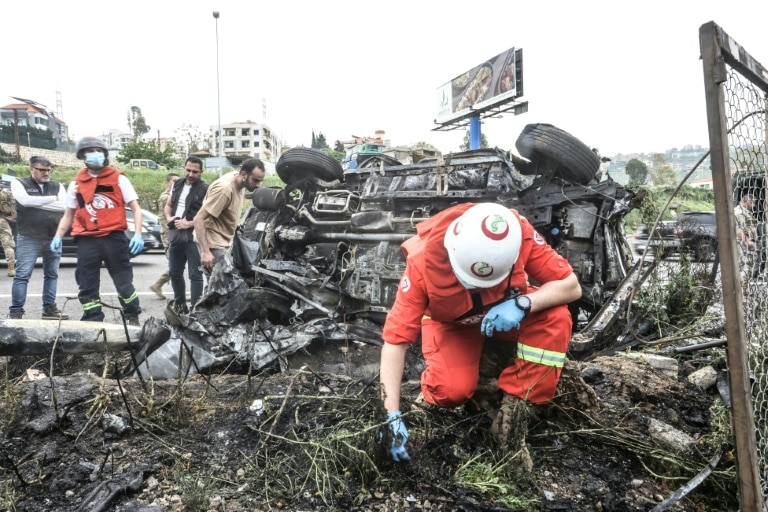
Just hours after Lebanon and Israel reached an agreement to begin direct negotiations in Washington, fresh military violence upended the region on Wednesday, bringing new volatility to a conflict that continues to ripple across global energy markets and international diplomacy.
Israeli military forces carried out two targeted strikes on vehicles in southern Lebanon, Lebanese state media confirmed Wednesday. One strike hit a vehicle in the coastal town of Saadiyat, while the second targeted a car on the coastal highway in nearby Jiyeh, located roughly 12 miles south of Beirut and outside the traditional strongholds of the Iran-aligned militant group Hezbollah. In response to the strikes, Hezbollah launched approximately 30 rocket projectiles toward northern Israeli territory starting in the early hours of Wednesday, an Israel Defense Forces spokesperson confirmed to Agence France-Presse. Israeli authorities also issued a new mandatory evacuation order for civilian residents in southern Lebanon, escalating warnings ahead of anticipated further clashes.
The fresh outbreak of violence came as diplomatic activity surrounding the broader Middle East conflict accelerated across multiple fronts. Pakistan’s Prime Minister Shehbaz Sharif launched a four-day shuttle diplomacy tour Wednesday, with stops planned in Saudi Arabia, Qatar and Turkey, as regional powers position themselves ahead of potential new peace negotiations between the United States and Iran.
In a major development that lifted global market sentiment, former U.S. President Donald Trump announced Wednesday that a second round of direct talks between U.S. and Iranian negotiators could begin within 48 hours, stoking widespread optimism that a breakthrough deal could reopen the strategically vital Strait of Hormuz, through which roughly a fifth of global oil supplies pass daily. Trump reinforced that optimistic tone in an interview with Fox Business Network’s *Mornings with Maria*, set to air Wednesday, saying the open conflict with Iran is “very close to being over.”
Market indicators reacted immediately to the news of upcoming talks: South Korea’s Kospi index surged more than 2%, ending the trading session just hundreds of points away from its all-time record high, while major European indices in London and Frankfurt held steady. Crude oil prices, which have spiked repeatedly amid conflict-related supply disruptions, dropped for a second consecutive session, with West Texas Intermediate crude trading at approximately $90.39 per barrel and Brent North Sea crude settling at $94.62 per barrel.
Despite the upbeat rhetoric around upcoming negotiations, U.S. authorities have moved to maintain harsh economic pressure on Tehran. U.S. Central Command confirmed that American naval forces have “completely halted economic trade going into and out of Iran by sea,” though maritime tracking data from Tuesday showed multiple commercial vessels that recently docked at Iranian ports passing through the Strait of Hormuz in open defiance of the U.S. naval blockade. Industry analysts note that Trump’s blockade strategy targets not just Iranian oil export revenue, but also aims to pressure China — Iran’s largest crude oil customer — to compel Tehran to reopen the critical chokepoint.
The U.S. Treasury Department announced Tuesday it will not extend a temporary sanctions waiver that allowed for the sale of Iranian oil already held in storage tankers at sea, a measure originally introduced to cushion global supply shocks caused by the conflict. The short-term authorization is set to expire in coming days and will not be renewed, the department confirmed, adding that it remains committed to “maintaining maximum pressure” on the Iranian government.
U.S. Vice President JD Vance laid out the core U.S. negotiating position Wednesday during an event hosted by conservative advocacy group Turning Point USA, saying Trump has offered Iran a clear grand bargain: Tehran will be allowed to rebuild economically and “thrive” if it commits to permanently abandoning its nuclear weapons program. The dispute over Iran’s nuclear activities remains the central sticking point in any potential diplomatic deal; Trump launched the original conflict on the claim that Iran was developing an atomic weapon, a charge Tehran has repeatedly denied. “That’s the kind of Trumpian grand bargain that the president has put on the table. Man, we’re going to keep on negotiating and try to make it happen,” Vance said.
Diplomatic activity is also ramping up in Beijing, where regional and global powers are coordinating positions amid the conflict. Chinese President Xi Jinping met with Russian Foreign Minister Sergei Lavrov this week, Chinese state media reported, as a wave of leaders from conflict-impacted states travel to the Chinese capital for talks. Lavrov told reporters after the meeting that Russia stands ready to “compensate” for any energy shortages China may face if Strait of Hormuz shipping remains disrupted by the ongoing conflict, according to Russian state media reports.
In a separate humanitarian development, Sri Lanka has completed the repatriation of 238 Iranian sailors who were stranded in the South Asian nation after their vessel was torpedoed by a U.S. submarine in the Indian Ocean on March 4, a Sri Lankan government minister confirmed to AFP.