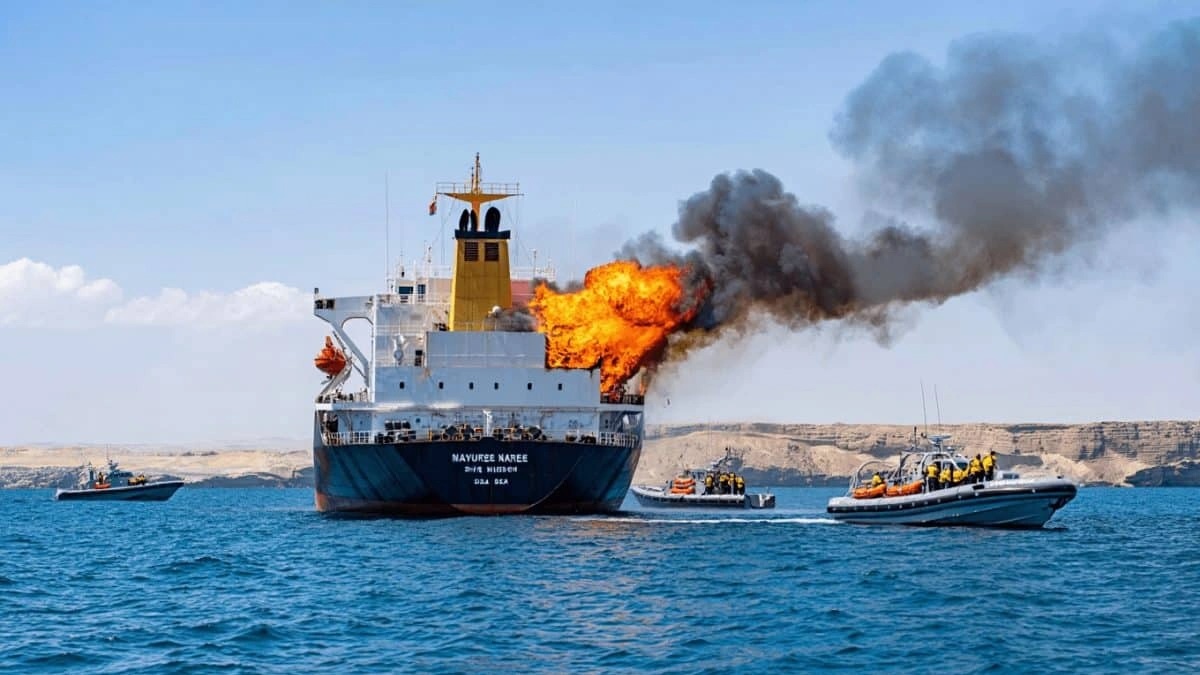
Six weeks into the joint U.S.-Israeli military campaign against Iran, a dramatic new escalation by former U.S. President Donald Trump has pushed a long-simmering geopolitical rivalry to the brink of direct superpower conflict. Trump’s recent decision to close the Strait of Hormuz to all commercial ship traffic has left China facing an unprecedented and high-stakes dilemma: comply with the American ban on trade with Tehran, a longstanding strategic partner, or defy the blockade and risk open military confrontation between the world’s two largest nuclear-armed powers.
Until the blockade was imposed, China had maintained a cautious, distance stance on the ongoing conflict. Beijing publicly criticized the large-scale U.S.-Israeli bombing campaign, noted the Trump administration’s repeated failures to force Iran into submission, and quietly benefited from deeply discounted Iranian crude oil and natural gas shipments that passed unimpeded through the strait to Chinese ports. That quiet balancing act is no longer possible.
Trump has stated the strait will remain closed to all commercial traffic until every vessel, including those from U.S. Arab allies, is permitted to transit under American terms. For China, maintaining its steady supply of discounted Iranian energy and upholding its decades-long alliance with Tehran now requires directly challenging the U.S. naval blockade.
Zineb Riboua, a Middle East analyst at the U.S. conservative think tank the Hoover Institute, argues the unfolding crisis is fundamentally rooted in Sino-American competition. Just days after Trump and Israeli Prime Minister Benjamin Netanyahu launched their aerial offensive, Riboua published a report noting that Beijing has invested hundreds of billions of dollars to build Iran into a core strategic asset in the Middle East. “By striking Iran directly, the Trump administration is dismantling – whether by design or by consequence – a pillar of China’s regional architecture,” Riboua wrote.
The stakes are also personal for the reputations of both Trump and Chinese President Xi Jinping, who have already been engaged in a gradual, low-intensity confrontation that has rolled back Chinese influence in areas Washington considers critical to its national security. A key precedent came when Trump deployed commandos to Caracas, Venezuela, to arrest then-president Nicolas Maduro on drug trafficking charges. Maduro, who sold oil to China in exchange for military hardware, received no direct intervention from Beijing, a choice that made strategic sense for China at the time: Venezuela only supplied 4% of China’s total oil imports, and the Caribbean falls firmly within the U.S.’s traditional sphere of influence, where China lacks the military capability to challenge American actions.
Iran is an entirely different proposition. For one, Iran meets 15% of China’s annual fossil fuel demand, all at prices well below the global market average. Beyond energy, Beijing has built a deep strategic partnership with Tehran to develop Iran’s vast rare earth mineral reserves – resources that have become one of the most globally sought-after commodities, due to their non-negotiable role in manufacturing advanced semiconductors. These chips power everything from consumer electronics and artificial intelligence systems to core components of modern military hardware, including the guidance systems for U.S. Tomahawk cruise missiles and the avionics and weapons controls for F-35 fighter jets and armed drones.
China currently controls roughly 90% of the world’s refined rare earth production, and has long sought to expand its grip on upstream mineral reserves. In 2021, Beijing signed a landmark 25-year agreement to invest $400 billion in Iran’s economy, in exchange for guaranteed long-term access to both Iranian oil and rare earth deposits. Online energy publication OilPrice notes that by positioning itself as a rare earth hub for China, Iran has become far more than just a discounted energy supplier to Beijing. “This gives Xi a reason to view the country as more than a ‘sanctioned’ gas station,” the outlet wrote, adding that the U.S. offensive against Tehran poses a direct threat to this Sino-Iranian resource alliance.
Beyond energy and minerals, Chinese firms have also played a central role in building and modernizing Iran’s domestic telecommunications and digital surveillance infrastructure. During widespread anti-government protests in Iran earlier this year, the Tehran regime used Chinese-supplied tools including facial recognition cameras to identify, detain and crack down on demonstrators, and deployed China’s “Great Firewall” censorship technology to shut down nationwide internet access to hide evidence of its repression. “Iran has not developed its censorship infrastructure in isolation,” the Washington-based Arab Gulf States Institute (AGSI) wrote in a January report. “The regime has received assistance from China, the world’s most experienced practitioner of internet control.” AGSI added that these Chinese-built systems allow governments to track online users, intercept communications, censor content, and isolate populations during periods of civil unrest.
All of these Chinese strategic gains, as well as recent diplomatic wins in the region, are now at risk from the U.S.-led offensive. Beijing brokered the historic 2023 reconciliation between long-time regional rivals Iran and Saudi Arabia, welcomed Iran into the Shanghai Cooperation Organization, China’s leading regional security bloc, and extended its signature Belt and Road Initiative through Iran to open new trade routes connecting Chinese goods from Central Asia to the Indian Ocean.
Since the start of the campaign, Beijing has initially taken a diplomatic, rule-based approach to the crisis. “The sovereignty, security, and territorial integrity of Iran and other regional countries must be respected,” China’s UN Ambassador Fu Cong stated. “China stands ready to work with the international community to advance peace efforts and help restore peace and stability in the Middle East at an early date.”
That diplomatic tone shifted sharply on April 14, the day Trump’s Hormuz blockade took effect. In a defiant public statement, China’s Foreign Ministry made clear it had no intention of backing down: “Chinese ships continue to move in and out of the waters of the Strait of Hormuz. We have trade and energy agreements with Iran, which we will respect and abide by. We expect others not to interfere in our affairs. Iran controls the Strait of Hormuz, and has opened it to us.”
A direct naval confrontation between two global nuclear superpowers has not occurred since the 1962 Cuban Missile Crisis, when then-U.S. President John F. Kennedy ordered a naval quarantine of Cuba to stop Soviet shipments of nuclear ballistic missiles. War was averted only when Soviet ships turned back, following a secret compromise that saw the U.S. agree to remove its nuclear missiles from NATO member Turkey.
Now, analysts warn the Hormuz standoff could escalate to open conflict if China follows through on its promise to continue trading with Iran. “Chinese support for a U.S. adversary could directly result in American casualties,” warned Joe Webster, a geopolitical and energy analyst who authors the China-Russia Report blog. “What will be the U.S. response if Chinese military intelligence support for Iran results in the deaths of US airmen or sailors?” It is a question that hangs over the entire Middle East, with global consequences that remain impossible to predict.