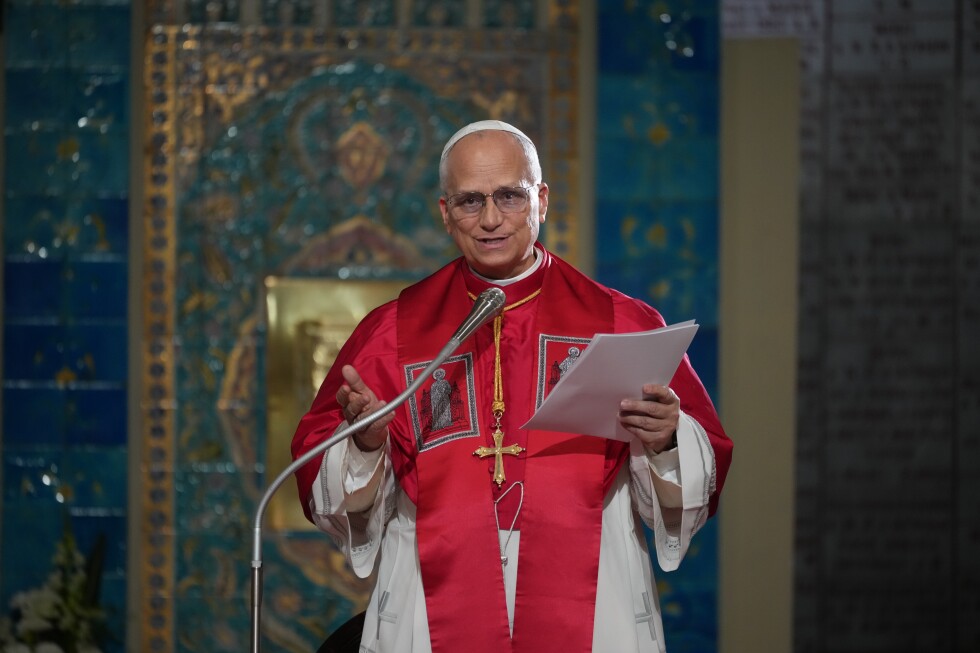
On just his second full day in Algeria, marking the first ever papal visit to the North African nation, Pope Leo XIV traveled to Annaba — modern-day Hippo — to walk in the footsteps of his greatest spiritual inspiration, St. Augustine. This pilgrimage is far more than a diplomatic stop: it is a deeply personal homecoming for the first American pope, who has anchored his pontificate to the legacy of the fifth-century Christian theologian, and comes against the backdrop of a growing public feud with U.S. President Donald Trump over Leo’s calls for peace amid the U.S.-Israel conflict with Iran.
Leo has long tied his papacy to Augustine, identifying himself as a “son of St. Augustine” the night of his election and repeatedly citing the theologian’s teachings in his first year in office. For this trip, which is centered on advancing a message of interfaith harmony between Christians and Muslims, Leo is framing Augustine as a timeless model of bridge-building across ideological and religious divides.
The visit also reframes a key figure in Western thought, drawing long-overdue attention to Augustine’s North African origins. Though Augustine is widely framed through a Eurocentric lens as one of the most influential European Christian thinkers, he spent nearly his entire life in what is now Algeria. Born in 354 CE to a Berber mother and Roman father in Thagaste — modern-day Souk Ahras, near Algeria’s border with Tunisia — Augustine was educated in Carthage (part of modern-day Tunisia) and taught rhetoric there before leaving for Italy in 383 CE. After his conversion to Christianity in Milan, he returned to North Africa just a few years later, founded a monastery in Hippo, served as a bishop, and wrote his most iconic works — including *Confessions* and *The City of God*, cornerstones of the Western intellectual canon — before his death in Hippo. Only five years of his life were spent on Italian soil.
Scholar Catherine Conybeare, an Augustine expert at Bryn Mawr College in Pennsylvania, explores this underemphasized African identity in her new book *Augustine the African*, which examines how Augustine viewed himself as a North African looking toward Rome as the center of his faith, yet grappled with insecurity over his Punic-accented Latin. Conybeare notes that the narrative of Augustine’s legacy was shaped for centuries by European successors who relocated his remains to Pavia, Italy, after his death — leaving only one forearm relic in Annaba’s St. Augustine Basilica. “One of the most important thinkers in the Western intellectual tradition actually came from Africa, spent almost his whole life in Africa,” Conybeare told the Associated Press. “How does that change things?”
Algerian President Abdelmadjid Tebboune welcomed the pope, expressing the nation’s “immense pride” in Augustine, calling him “a cherished son of this land, which having been his first cradle, proudly became his initial resting place.”
For Leo, the pilgrimage is the fulfillment of a long-held promise. He told reporters on the papal plane that he had planned this stop as the first trip of his pontificate, having announced as early as the previous May that he wanted his first international journey as pope to be to Africa. Multiple advisors immediately pointed him toward Algeria, given his deep ties to Augustine. Though other travel priorities intervened, Leo ultimately kept the commitment. This is not his first visit to the region: he traveled to Annaba twice before while serving as superior of the Augustinian religious order, which was founded in 13th-century Italy in Augustine’s honor.
Leo emphasized that Augustine’s legacy offers a critical model for a divided world today. The saint, he said, represents “a very important bridge in interreligious dialogue” that global communities urgently need. “We must always seek bridges to build peace and reconciliation,” he said. “This journey, then, truly represents a valuable opportunity to continue with the same voice, with the same message, that we wish to convey: to promote peace, reconciliation, respect and consideration for all peoples.”
During his time in Annaba, the pope toured the archaeological ruins of ancient Roman Hippo, including the theater, market, thermal baths, and the foundations of the original basilica where Augustine preached and the adjoining baptistry. He also met with a local order of nuns and the small Augustinian community based in the city, before closing the day with a Mass at the 19th-century Basilica of St. Augustine, which houses Augustine’s remaining forearm relic. The site draws thousands of pilgrims annually, including Muslim visitors, a testament to the shared cultural heritage Leo seeks to highlight.
This coverage of religion by the Associated Press is supported through a collaboration with The Conversation US, with funding from Lilly Endowment Inc. The AP retains sole responsibility for all content.