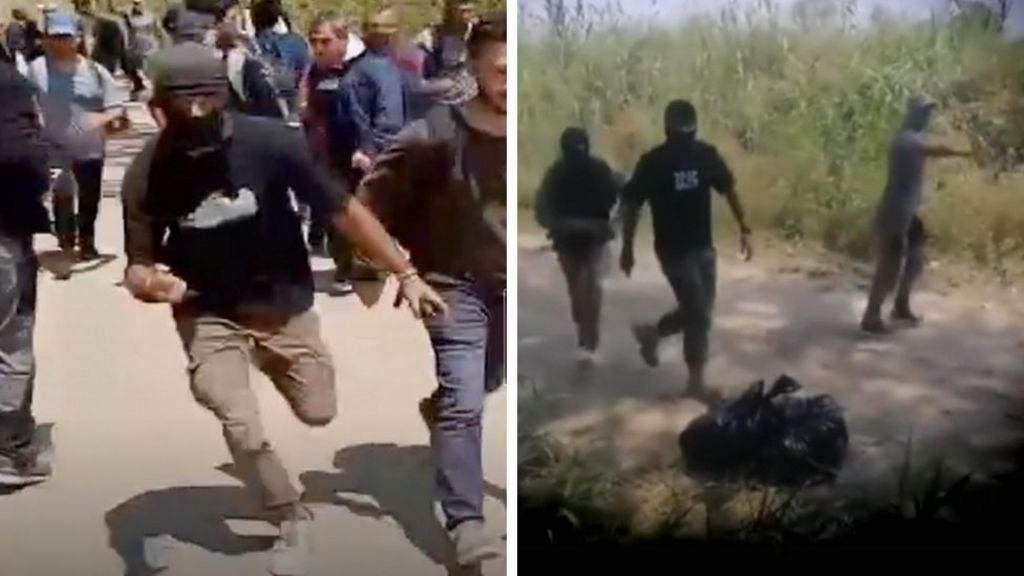
A years-long joint investigation by the BBC and the Consolidated Rescue Group (CRG) has uncovered explosive evidence of systematic illegal pushbacks at Greece’s Evros land border with Turkey, revealing that Greek police have been recruiting migrant mercenaries to carry out violent, unlawful expulsions of asylum seekers and irregular migrants since at least 2020. The 200-kilometer Evros border forms the European Union’s eastern external frontier, a heavily militarized restricted zone dotted with watchtowers that has been a key entry point for more than 1 million migrants arriving in Greece since 2015. What the investigation uncovered is a shadowy, officially overseen system that violates both international and European Union human rights law.
The inquiry began in autumn 2024, after a disgruntled smuggler shared graphic footage purporting to show migrants being abused by masked, third-country men at the border. While the BBC could not independently verify the footage’s content, its accounts aligned with testimony gathered from more than a dozen independent sources, including current and former Greek border guards, migrant victims, former mercenaries, leaked official disciplinary documents, and independent human rights investigations. Internal police documents reviewed by the BBC confirm that senior Greek police officers ordered and oversaw the recruitment of mercenaries, who are themselves migrants from countries including Pakistan, Syria, and Afghanistan. Recruits are compensated with cash, stolen mobile phones and valuables from other migrants, and unofficial permission to travel onward through Greece. In some cases, recruitment has happened under duress: Marwan, a Moroccan former mercenary who spoke to the BBC from Paris under a pseudonym, said he was pulled from a migrant detention cell in 2020 and given no choice but to agree to work. He described being held in an abandoned prison with other recruits, and told the BBC he witnessed routine brutal violence against migrants at the hands of Greek officers and other mercenaries, leaving him “completely destroyed” by trauma. “I am deeply sorry… I was under threat,” he said of his involvement.
Multiple witnesses and documents corroborate allegations of widespread brutality against migrants subjected to pushbacks. Testimony collected by the BBC includes accounts of migrants being stripped, beaten until unconscious, robbed, subjected to invasive and degrading body searches, and sexually assaulted. One Syrian migrant, Amal (using a pseudonym for security), described how her family was detained by Greek police in Orestiada in 2025 while traveling to reunite with relatives who had already been granted asylum in Greece. She said police handed the group over to masked mercenaries, who removed her young daughter’s diaper during a search for valuables, leaving the child screaming in fear, and beat a young migrant so severely he lost consciousness. Another Syrian migrant, Ahmad, said he was beaten unconscious by Greek police, then loaded into an overcrowded truck where many passengers struggled to breathe before being handed over to mercenaries who stripped him, beat anyone hiding money, and forced migrants into dinghies half-way across the Evros River, throwing those who refused to jump overboard despite the risk of drowning.
Official investigations and disciplinary records support these accounts. Excerpts from a 2024 Greek border guard disciplinary hearing reviewed by the BBC show multiple guards openly acknowledged the use of “boatmen” – the coded term for mercenary recruiters – for pushbacks. One guard told the hearing he was ordered to find recruits in 2020, when COVID-19 restrictions and heightened tensions with Turkey made direct police involvement too risky, and that the program was already active in southern Evros. Guards used coded language on the Viber messaging app to coordinate pushbacks, referencing “Special Team” operations, and told the hearing they had reported to senior officers that mercenaries were raping female migrants and stealing valuables, but no action was taken. Five border guards are currently awaiting trial on corruption charges related to the program, all of which they deny.
A 2023 investigation by Frontex’s own independent Fundamental Rights Office into one ambush of a group of asylum seekers near Evros found that between 10 and 20 third-country nationals were acting under direct instruction of Greek officers. The report confirmed the group was subjected to death and rape threats, invasive sexualized body searches, beatings, stabbings, theft, and forced expulsion back to Turkey, in clear violation of EU human rights law. Greek authorities have denied any migrants were present in the area that day. The Greek National Commission for Human Rights (GNCHR) has itself documented more than 100 alleged forced pushback incidents in Evros dating back to 2020, dozens of which involved third-country mercenaries, with the most recent incident recorded in October 2025. GNCHR president Maria Gavouneli called the BBC’s findings “extremely significant” evidence of widespread human rights abuse.
When confronted with the allegations by the BBC in March 2026, Greek Prime Minister Kyriakos Mitsotakis said he was “totally unaware” of any program using migrant mercenaries for pushbacks. He defended Greece’s border protection policies, adding that European leaders have made clear they will not repeat past “mistakes” of allowing a “massive influx” of migrants and refugees. Greek national authorities have not responded to the BBC’s detailed written requests for comment on the investigation’s findings. Frontex, the EU’s border and coast guard agency, has rejected claims it turns a blind eye to human rights violations, saying it works to ensure lawful border management and supports frontline states under pressure. A regional police source told the BBC that every uniformed officer serving in Evros – including Greek police, soldiers and Frontex staff – is aware pushbacks are taking place, with mercenaries pushing back as many as hundreds of migrants every week.
The investigation also identified a leading former mercenary, a Syrian man known as “Mike”, who is referenced in internal police documents and confirmed by five separate sources to have held a senior role in the program. A photo provided by the smuggler shows a group of masked men in a van, and facial recognition analysis found a 90% match between the right-most individual in the photo and publicly available images of Mike. When contacted via social media, Mike did not respond directly, and his lawyer sent a warning letter opposing publication of the image and what he called “unproven allegations”. A lawyer has also confirmed she has filed a case before the European Court of Human Rights on behalf of an Afghan woman who alleges she was raped by a Farsi-speaking masked mercenary during a 2023 pushback.
Pushbacks – the forced expulsion of migrants and asylum seekers across international borders without formal due process or access to asylum claims – are universally recognized as illegal under international law. Claims of masked third-country men carrying out pushbacks in Evros were first reported in 2022 by Dutch-based independent news outlet Lighthouse Reports. The BBC’s investigation provides the most comprehensive evidence to date of official involvement in the program, spanning more than five years and continuing into 2025.