Decades of repeated conflict have left many Lebanese civilians desperate for an end to bloodshed, creating deep divisions across the country over whether to proceed with unprecedented direct negotiations with Israel scheduled for this week in Washington.
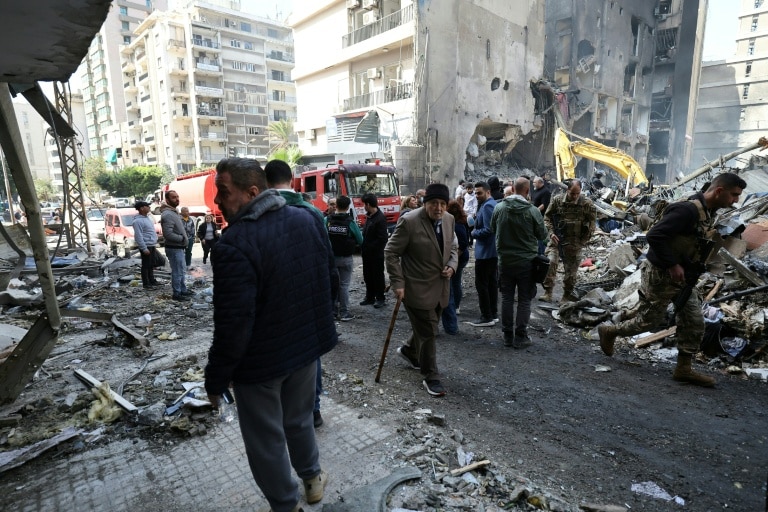
For residents like Qassem Saad, a 49-year-old shop owner who sustained minor injuries in a recent Israeli airstrike that leveled a neighboring Beirut building, exhaustion after generations of war has overridden long-held political enmity. From his damaged store overlooking the rubble, Saad told Agence France-Presse that while Israel remains an adversarial power to most Lebanese, the population can no longer bear the cost of ongoing fighting. “What matters to us is to reach a stage where we can raise our children and live in peace. If there is a comprehensive solution for peace, we are for it, on the condition that no one encroaches on the other,” Saad said. He added that he would fully support the talks if Israel agrees to withdraw from all occupied southern Lebanese territory, repatriate Lebanese prisoners, honor Lebanese sovereign rights, and end all cross-border attacks.
The upcoming Tuesday meeting between Lebanese and Israeli ambassadors in Washington comes as the death toll from the expanding regional conflict continues to climb. Lebanese official data confirms that at least 2,089 people, including 166 children and 88 healthcare workers, have been killed in Israeli strikes since violence spilled over into Lebanon from the Gaza conflict on March 2. A recent nationwide wave of Israeli air strikes last Wednesday alone killed more than 350 people across the country, leaving neighborhoods like Beirut’s working-class Corniche al-Mazraa in ruins.
Many ordinary residents recovering from the destruction share Saad’s hunger for peace. Kamal Ayad, another 49-year-old who was repairing strike damage in Corniche al-Mazraa, echoed calls for an end to decades of conflict. “We are in favor of (negotiations) if they serve Lebanon’s interest, if they will resolve matters, end the war, and let us live in peace,” Ayad said. “We want peace… and we hope Iran won’t obstruct it. We are extremely tired… We have lived through many wars and we want rest.”
But not all Lebanese are convinced that negotiations can deliver a just and lasting peace, especially while bombardment continues. Hezbollah, the Iran-backed militant group that has been the main target of Israeli strikes, has already rejected the talks out of hand. Hezbollah deputy leader Naim Qassem has demanded the meeting be canceled and vowed to fight Israel “until our last breath.” Hundreds of Hezbollah supporters held a protest march in Beirut Saturday to voice their opposition, though the group and its political ally the Amal Movement later called off further demonstrations to preserve domestic civil peace.
Skepticism also runs deep among some civilian residents who doubt Israel’s commitment to any negotiated agreement. Mohammad Al-Khatib, a 57-year-old electronics business owner whose shop sits near the site of the Corniche al-Mazraa airstrike, where soot still blackens building facades and the smell of smoke lingers, argues that talks held under ongoing attack are illegitimate. “You don’t hold negotiations under bombardment, shelling and humiliation. Where is the justice?” he asked. “They (the Israelis) have never stuck to peace in their lives. Their ambition is expansion and control over Lebanon… throughout its history Israel hasn’t been credible.”
Other residents warn that the push for talks risks igniting new internal strife in a country still grappling with the legacy of the 1975-1990 Lebanese Civil War. For decades, negotiating with Israel — which is officially classified as an enemy state under Lebanese law — has been a deeply taboo topic in Lebanese politics. Joe Ghafari, a 61-year-old resident of Beirut’s Ashrafiyeh district, noted that the ultimate fate of any peace deal depends on outside powers: the United States, Israel’s main backer, and Iran, which provides funding and military support to Hezbollah. “There has to be a solution between the US and Iran, otherwise negotiations are useless,” Ghafari said. “The decision isn’t in our hands. If it were, I would support negotiations.” He added that deep divisions within Lebanon over talks with Israel mean any progress on the diplomatic front could spark domestic conflict that the small country can no longer withstand. “How can we make peace with Israel if part (of the population) doesn’t want it?” Ghafari asked. “If these negotiations advance while the other side does not want them, there will of course be internal conflict. And Lebanon cannot bear internal wars.”
The path to talks is already complicated by competing positioning from both sides. Lebanese authorities have emphasized that Beirut’s top priority is securing an immediate bilateral ceasefire between Israel and Hezbollah before formal talks can proceed, but Israel has ruled out that outcome for the moment. Israel insists that Hezbollah must first fully disarm, and says it would rather move straight to formal peace negotiations with the Lebanese state itself. The diplomatic push comes just days after talks between the U.S. and Iran aimed at ending the broader regional war failed to produce a permanent agreement. The two sides agreed to a temporary two-week truce, which Iran and mediator Pakistan say covers cross-border fighting in Lebanon, a claim that both Israel and the U.S. have rejected.
This week’s meeting is not the first attempt at direct dialogue between the two longtime foes. In December 2024, Lebanese and Israeli civilian representatives held the first direct talks between the two sides in decades, as part of a monitoring mechanism for a temporary ceasefire that ended an earlier round of Israel-Hezbollah fighting. The last formal negotiations between the two countries followed Israel’s 1982 invasion of Lebanon, producing an agreement to end hostilities that was later annulled by Lebanese authorities.