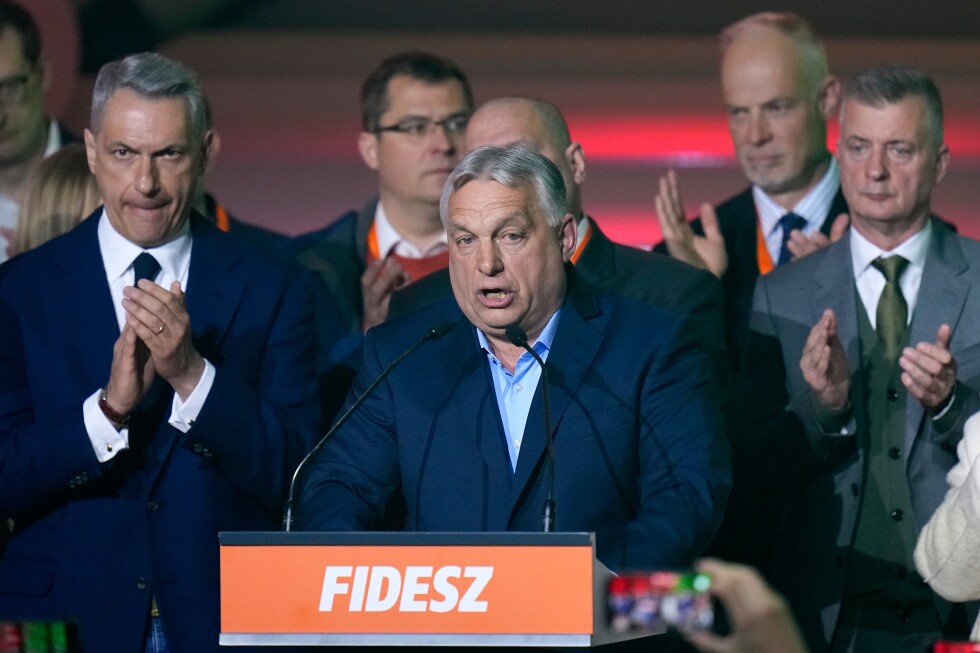
BUDAPEST, Hungary — After 16 years of dominating Hungarian politics and carving out an outsize role in global conservative movements, Viktor Orbán’s tenure as prime minister has come to an abrupt end following a crushing landslide defeat in Sunday’s national election. The political shakeup, which saw opposition challenger Péter Magyar secure an overwhelming mandate from Hungarian voters, is sending ripples across Europe and beyond, as leaders from Kyiv to Brussels react to the end of an era defined by Orbán’s controversial illiberal agenda.
During his four consecutive terms in office, Orbán built a global following among right-wing populists, who replicated his political playbook: systematically restructuring state institutions to consolidate ruling party power, rolling back protections for minority groups, narrowing the space for independent media, and positioning himself as a fiery champion of national sovereignty against what he framed as the overreach of globalization and uncontrolled migration. To his critics across the European continent, however, Orbán represented a direct threat to European democracy, eroding the bloc’s core shared commitments to human rights, the rule of law, and institutional accountability.
Ultimately, Hungarian voters delivered a clear verdict that it was time for political change, handing Magyar a decisive victory that has reshaped the European political landscape. The outcome carries particularly profound stakes for Ukraine, as Orbán maintained the closest ties to the Kremlin of any European Union leader, repeatedly blocking bloc-wide aid packages to Kyiv amid Russia’s full-scale invasion.
Within hours of the election results being confirmed, Ukrainian President Volodymyr Zelenskyy extended an olive branch to the new Hungarian administration, emphasizing Kyiv’s longstanding goal of building constructive, good-neighborly relations across the continent. “It is important when constructive approach prevails. Ukraine has always sought good-neighbourly relations with everyone in Europe and we are ready to advance our cooperation with Hungary,” Zelenskyy wrote on social media. “We are ready for meetings and joint constructive work for the benefit of both nations, as well as peace, security, and stability in Europe.”
For the European Union, Orbán’s defeat has been met with widespread relief, ending years of diplomatic gridlock and public friction between Budapest and Brussels. Despite Hungary receiving billions of euros in structural development funding from the bloc, Orbán consistently attacked EU institutions and its policy agenda, often deriding top EU leaders in public remarks.
Minutes after Orbán delivered his concession speech, European Commission President Ursula von der Leyen — a frequent target of Orbán’s criticism — issued a celebratory message on X: “Europe’s heart is beating stronger in Hungary tonight.”
Top leaders from Europe’s largest major powers quickly echoed the sentiment. British Prime Minister Keir Starmer called the election outcome “an historic moment, not only for Hungary, but for European democracy. I look forward to working with you for the security and prosperity of both our countries.” German Chancellor Friedrich Merz extended warm congratulations to Magyar, writing “Let’s join forces for a strong, secure and, above all, united Europe. Gratulálok, kedves Magyar Péter!” French President Emmanuel Macron added that “France welcomes the victory of democratic participation, the Hungarian people’s commitment to the values of the European Union, and Hungary’s commitment to Europe.”
Meanwhile, populist leaders and far-right parties that counted Orbán as a close ideological ally have reacted with measured, careful rhetoric following his defeat. Italian Prime Minister Giorgia Meloni, who aligned closely with Orbán on a range of EU policy issues, thanked her “friend Viktor Orbán” for their past collaboration, noting “I know that even from the opposition he will continue to serve his Nation.”
In France, the far-right National Rally — which is gearing up for a 2025 presidential run to unseat Macron and long supported Orbán’s agenda — struck a cautious tone. Party leader Jordan Bardella wrote that “This result, respectfully welcomed by Viktor Orbán, shows that the incessant accusations by European institutions in recent years against Hungarian democracy were unfounded.”
The election result marks one of the most significant political shifts in Europe in recent years, with implications for EU policy, Ukraine’s war effort, and the future of global populist politics. As Magyar prepares to take office, leaders across the continent are waiting to see how his new administration will reshape Hungary’s place in Europe.