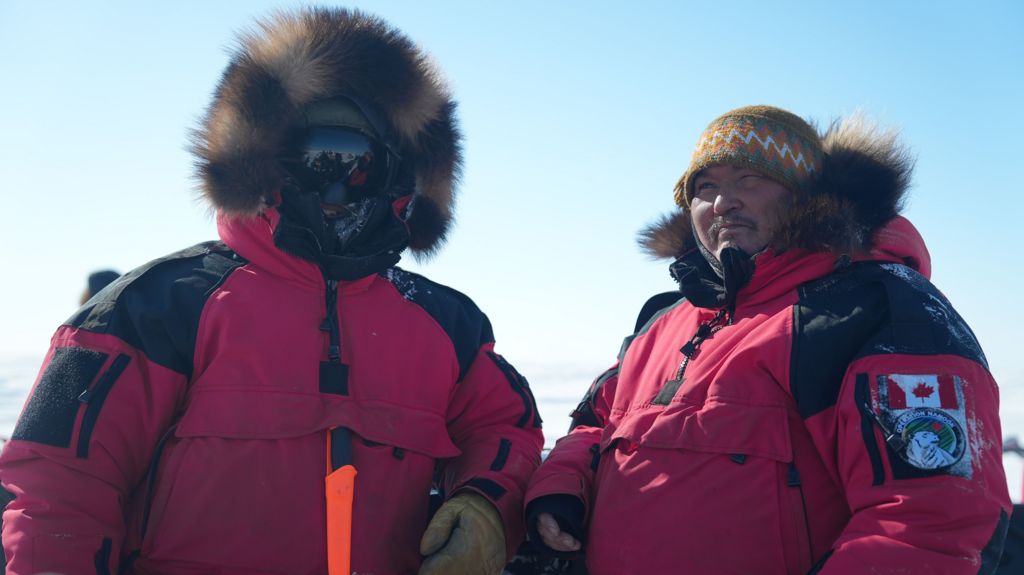
After 52 days of traversing some of the harshest frozen landscapes on the planet, two Canadian Rangers crossed a simple finish line marked by a row of spruce trees in Churchill, Manitoba, on Friday, capping the largest northern mission in the 75-year history of the Canadian Armed Forces reserve unit. The 5,200-kilometer journey, which retraced a route not attempted in 80 years, stood as a landmark test of Canada’s military readiness, indigenous knowledge, and sovereign claims to a rapidly changing Arctic region.
The patrol formed the core of 2026’s annual Operation Nanook-Nunalivut, a Canadian Armed Forces initiative designed to reinforce the country’s military presence across its northern territories — a region that makes up 40% of Canada’s total landmass and 70% of its entire coastline. More than 1,300 military personnel from Canada and allied nations joined this year’s operation, with broad objectives ranging from land surveying and climate change research to opening new navigation routes and testing cold-weather survival and combat capabilities.
The mission has taken on urgent new relevance in recent years, as melting Arctic ice driven by climate change unlocks access to vast untapped natural resources, triggering a global geopolitical scramble for influence in the region. The timing of this year’s patrol comes just months after former U.S. President Donald Trump’s controversial January threat to annex Greenland, an autonomous Danish Arctic territory that borders Canada, which sent shockwaves through NATO and prompted alliance members to reaffirm their commitment to defending regional sovereignty. While Brigadier General Daniel Rivière, commander of the army task force leading the operation, emphasized that Trump’s remarks had “zero effect” on collaborative work between Canadian forces and their allies, the incident underscored growing global interest in the Arctic’s strategic importance.
In response to shifting security dynamics, Canadian Prime Minister Mark Carney — the first Canadian prime minister born in the Northwest Territories — has unveiled a multi-billion-dollar defense plan focused on upgrading existing northern military infrastructure and boosting civilian access to the region through improved airports and highways. Carney has criticized previous Canadian administrations for decades of piecemeal, insufficient investment in the North, framing Arctic sovereignty as the country’s most urgent national security priority. The plan has faced pushback from the Conservative opposition, who argue that decades of Liberal neglect have left the country with a “gaping vulnerability” in the region, and have called for the construction of new permanent military bases to counter growing foreign influence. Despite the political debate, both military leaders and local northern residents have welcomed the new funding, with Rivière noting that it signals Canada is finally serious about building its northern capacity.
Security analysts and military leaders point to Russia’s ongoing military buildup in the Arctic as a key driver of Canada’s renewed focus on the region. Russia currently operates dozens of permanent military bases along its Arctic coast, while Canada maintains none. Rivière told the BBC that while Russia does not pose an immediate threat to Canadian sovereignty, it remains “a formidable force” that continues to conduct air probes and expand joint military exercises with China in international Arctic waters. “Is that an immediate threat? No. But are they getting smarter about Arctic waters? Absolutely,” he said. “This mission is about preparing for the worst-case scenario.”
Beyond geopolitical tensions, the patrol also highlighted the growing challenges posed by climate change to Arctic navigation. Lieutenant Colonel Travis Hanes, one of the lead Rangers on the 52-day journey, shared firsthand observations of shifting ice conditions: rivers that have reliably frozen solid for generations are now experiencing unseasonal overflow, creating layered, unstable ice sheets that pose major hazards to overland travel. At the same time, this winter brought unusually frigid temperatures that opened new travel passages across waters that have remained ice-free in recent decades.
A cornerstone of the Canadian Rangers’ success in the harsh Arctic environment has long been the unit’s large contingent of Indigenous Inuit members, whose generations of traditional knowledge have proven irreplaceable for navigating the landscape and surviving extreme conditions. “We would’ve failed without them,” Hanes said of the Inuit rangers and local community members who supported the patrol. Inuit members served as local guides between remote hamlets, shared traditional “country food” including dried Arctic char and caribou to supplement military rations, and provided handcrafted fur gear made from coyote and caribou to protect team members from life-threatening cold. One Inuk ranger from Aklavik, Julia Elanik, carried a high-powered rifle along the entire route to fend off potential polar bear encounters. More than a dozen Inuit communities along the route also provided housing and logistical support to the patrol.
Barnie Aggark, an Inuk Canadian Ranger with 27 years of experience who guided the patrol through its final 500 kilometers from Chesterfield Inlet, Nunavut, framed his participation as a responsibility to both his community and his country. “It has everything to do with our land and sea and how we control it, and who is allowed in it,” he said. “We have to let the rest of the world know that we are here, and this is our home, and we are going to protect it with everything that we have.”
The 52-day journey was defined by relentless hardship: team members traveled for hours daily between remote communities on snowmobiles, navigated repeated blizzards and gale-force winds, and camped on frozen ice in tents when temperatures plunged as low as -60°C (-76°F). Constant hazards including polar bear encounters, frostbite, and cold-weather dehydration required constant vigilance. On the final night before reaching Churchill, the team camped on the frozen shores of Hudson Bay beside an abandoned trading post, with shifting ice crackling under their tents and the northern lights swirling overhead.
Not all elements of the operation went according to plan: an artillery live-fire exercise in Cambridge Bay, Nunavut, was canceled due to an extreme blizzard, a small group of rangers suffered food poisoning linked to military rations, one ranger cracked a rib when his snowmobile flipped (and continued on with the mission), and another was evacuated by air after developing frostbite to prevent the injury from worsening. Despite these setbacks, Hanes classified the mission as a resounding success, noting that only one major injury among 250 participating personnel marked a far better safety record than comparable Arctic operations. “It is a testament to Canada’s growing expertise in an unforgiving climate,” he said.
In addition to Inuit traditional knowledge, the patrol also tested new satellite intelligence and ice-monitoring technologies, with air support from the Royal Canadian Air Force provided by Twin Otter survey planes flying ahead of the snowmobile team. Reflecting on the mission’s completion, Chief Warrant Officer Sonia Lizotte noted: “We have tested the limits, and we can now see the future.” Military leaders say the lessons learned from the historic patrol will inform Canada’s expanding Arctic security strategy, as the country works to build its capacity to defend its sovereign claims in a rapidly changing region. This year’s operation also included international cooperation: observers from Greenland joined the patrol, military personnel from the U.S. and UK monitored progress from a command center in Edmonton, and French and Belgian soldiers conducted joint ice-diving exercises with Canadian troops.