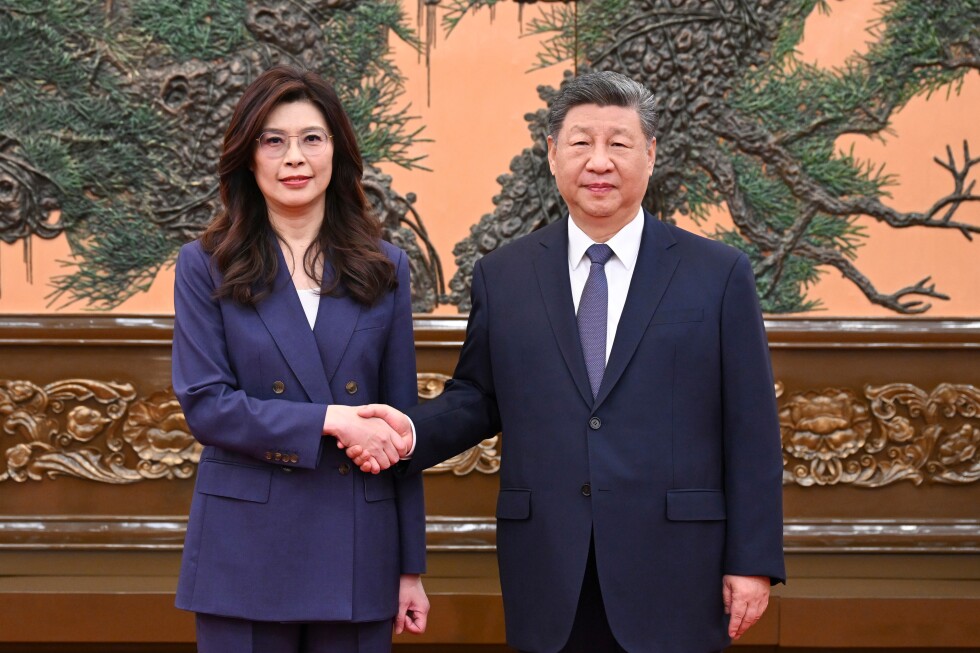
BANGKOK, Associated Press – More than seven decades after the cross-Strait split, and amid years of rising tensions between Beijing and the ruling Taipei administration, mainland China announced Sunday a series of measures to restore suspended cross-Strait connections, following a landmark meeting between Chinese leader Xi Jinping and the chair of Taiwan’s Beijing-leaning opposition Kuomintang Party (KMT), Cheng Li-wun.
The high-profile gathering between Xi and Cheng in Beijing on Friday centered on public calls for cross-Strait peace, though no concrete policy details were released by either side. In an official statement released Sunday, the Communist Party of China’s Taiwan Work Office outlined multiple steps to rebuild ties that have been frozen for years: the resumption of direct flights linking Taiwan to mainland cities including Xi’an and Urumqi, the restart of imports of Taiwanese aquaculture goods previously blocked by Beijing, and a plan to explore the establishment of a permanent communication channel between the CPC and the KMT. Beijing also reaffirmed its long-proposed plan to advance the construction of a cross-Strait bridge connecting mainland China to Taiwan’s Kinmen and Matsu islands, which lie just off the Chinese coast.
Cross-Strait relations have deteriorated sharply since 2016, when pro-independence Democratic Progressive Party leader Tsai Ing-wen won Taiwan’s presidential election. Beijing has cut off almost all official dialogue with Taipei’s ruling government, and increased regular military patrols of warships and fighter jets near Taiwan’s borders in a show of sovereignty. China continues to claim Taiwan as an integral part of its own territory, and has never formally ruled out the use of military force to bring the self-governing island under its control.
Taiwan’s Mainland Affairs Council, the government body that oversees cross-Strait relations, quickly pushed back on Beijing’s announcement, framing the new measures and proposed cross-party communication mechanism as unilateral political deals between the CPC and KMT that bypass Taiwan’s democratically elected government. The agency reaffirmed Taipei’s long-held position that all cross-Strait affairs involving public authority must be negotiated between the two governments on an equal, mutually respectful footing to deliver tangible benefits that protect the rights and well-being of Taiwan’s people. Critics note that it remains unclear how the new measures announced by Beijing can be implemented without formal approval from Taipei’s government, given existing cross-border travel and trade regulations.
To provide context for the latest developments: Beijing first banned individual tourism travel to Taiwan for Chinese citizens in 2019, and current Taiwanese entry rules require Chinese passport holders to hold a valid third-country residence visa (issued by nations such as the U.S. or EU member states) to qualify for a Taiwanese visitor visa. On the trade front, Beijing first blocked imports of Taiwanese pineapples in 2021, before expanding restrictions to other agricultural and aquaculture goods, including grouper, squid, and tuna. After the grouper import ban was imposed, Taiwan’s Ministry of Agriculture attempted to negotiate with Beijing to revise production standards to meet Chinese import requirements, but Beijing only approved a small, unelaborated list of individual Taiwanese firms for limited exports.