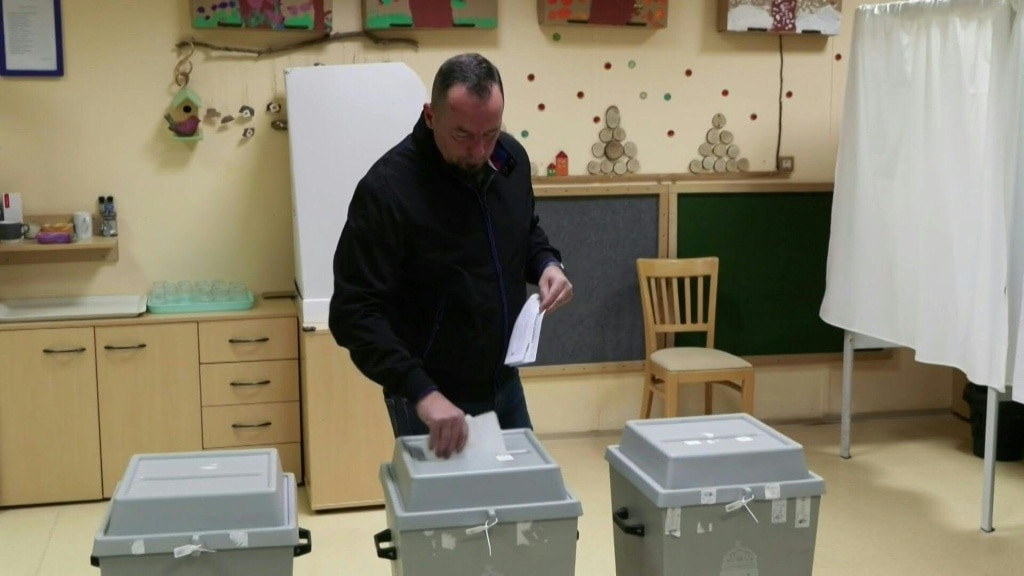
On a high-stakes Sunday morning, polling stations opened across Hungary for a parliamentary election that stands as one of the most consequential political moments in modern European history, with the 16-year incumbency of nationalist Prime Minister Viktor Orban — the European Union’s longest-serving leader and self-described “thorn in Brussels’ side” — hanging in the balance.
With opinion polls consistently placing opposition challenger Peter Magyar’s pro-European Tisza Party ahead of Orban’s ruling Fidesz party, the outcome of the vote has drawn intense international scrutiny from capitals across the continent and beyond. The race has been marked by bitter mutual accusations of foreign interference, dueling endorsements from high-profile American figures, and deep public division over Hungary’s future direction between alignment with the EU and continued closeness to Russia.
Orban, 62, is vying for an unprecedented fifth consecutive term in office, during which he has reshaped Hungary into what he terms an “illiberal democracy.” Mirroring the rhetorical framing of former U.S. President Donald Trump — who has publicly thrown his full support behind Orban’s campaign — the incumbent has framed mass migration and progressive “woke” values as existential threats to Western civilization. He has centered his campaign on hardline rhetoric against neighboring Ukraine, which is currently defending itself against full-scale Russian invasion, portraying Kyiv as hostile to Hungarian interests. In the lead-up to voting, he also reiterated pledges to expand his crackdown on independent civil society groups, critical media, and opposition political figures.
Long-simmering tensions between Orban’s government and EU institutions have boiled over in recent years, with Brussels freezing billions of euros in allocated cohesion funding over allegations that Orban has eroded judicial independence, cracked down on political dissent, and undermined the rule of law. U.S. Vice President JD Vance traveled to Budapest earlier this week to hold a rally in support of Orban, where he echoed the prime minister’s attacks on what he called overreach by Brussels bureaucrats. Trump, for his part, has promised to bring American economic leverage to Hungary if Fidesz secures another term.
Magyar, a 45-year-old former insider within Orban’s government who only emerged as a political force two years ago, has built a rapidly growing movement on promises of a complete “system change” that would return Hungary to full democratic alignment with the European Union. Despite an electoral system widely acknowledged to be structurally skewed in favor of Fidesz, and a backdrop of years of economic stagnation that has left many Hungarian households struggling, Magyar has managed to galvanize widespread discontent with Orban’s rule. He has campaigned on pledges to root out systemic corruption — an issue where Transparency International ranks Hungary as tied with Bulgaria for the worst performance in the EU — and improve access to public services for working Hungarians.
Outside polling stations on Sunday, voters from across the political spectrum expressed the historic weight of the moment, with many describing the election as a once-in-a-generation choice for the country’s future. “Now is our last chance to choose finally east or west. Do we want to be a normal democracy or turn back east with no point of return?” 18-year-old first-time voter David Banhegyi told AFP after casting his ballot for Tisza in a residential district of Budapest.
Edit Csillaghegyi, a 58-year-old shop worker who also supported the opposition, cited corruption as her core motivation for ousting Orban. “I have one main problem with this government, what it did, the robbing,” she said.
But for Orban’s supporters, the incumbent remains a bulwark against outside interference in Hungary’s domestic affairs. “It is so important for us that Viktor Orban stays in power,” said Maria Toth, a 31-year-old stay-at-home mother of two, after casting her ballot. “I feel Hungary is under siege from so many directions and big powers like Brussels are trying to dictate how we live. If he loses, I worry for my children’s future.”
Andrea Szabo, a senior research fellow at ELTE University’s Centre for Social Sciences, framed the election as a defining turning point for Hungarian democracy. “If Fidesz wins now, that will clearly mean… a shift towards authoritarianism,” she told AFP. “This is the last moment in which this process can be halted, and the pendulum can swing back in a democratic direction.”
Polling opened at 6:00 am local time (0400 GMT) and is scheduled to close at 7:00 pm local time. Analysts are projecting a record national turnout of roughly 75 percent, which would surpass the previous high of just over 70 percent set in 2002. The National Election Office has noted that while preliminary partial results will be released shortly after polls close, a final official winner may not be declared until next Saturday if the race remains extremely tight.
In the weeks leading up to voting, the campaign has been roiled by a steady stream of leaks, accusations, and counter-accusations. Recorded phone conversations between Orban and his foreign minister, leaked to the public, triggered alarm across the EU over the pair’s close ongoing ties to the Kremlin. Multiple independent reports have documented an active covert Russian disinformation campaign designed to boost Orban’s chances of re-election, while a recent investigative documentary has alleged that Fidesz and its coalition partners are engaging in widespread vote-buying operations in rural Hungarian districts. Both Orban and the opposition have traded claims of foreign meddling: the opposition has raised concerns about Russian and American interference to benefit Fidesz, while Orban has accused the opposition of colluding with foreign intelligence services and plotting to destabilize the election through chaos.