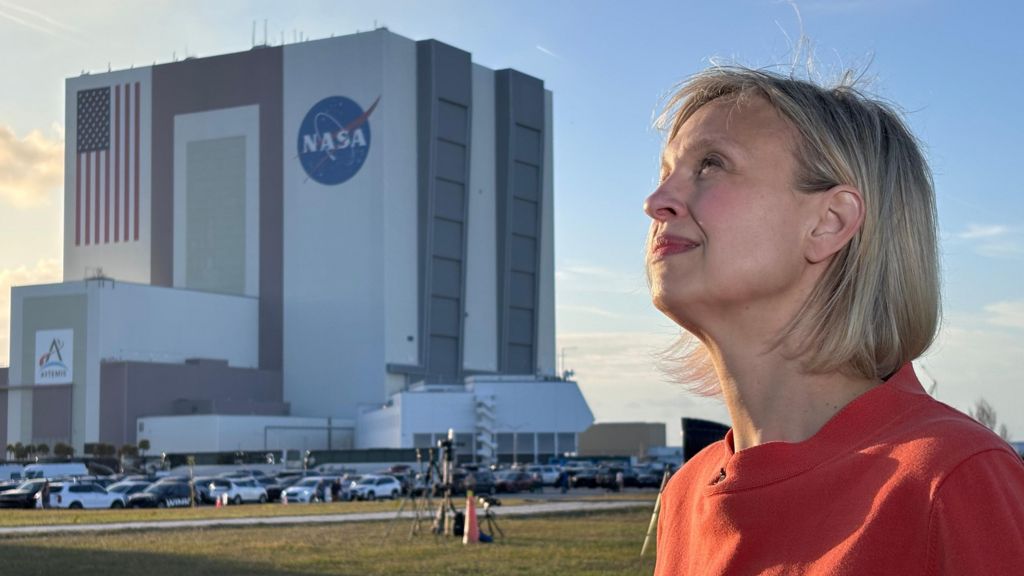
Over 10 extraordinary days that will be written into the annals of human spaceflight, four astronauts made unprecedented history, venturing deeper into deep space than any humans have ever traveled on a round-trip voyage to the Moon and back. As a BBC journalist embedded with the science team covering every phase of the Artemis II mission, I tracked every moment from the thunderous launch to the dramatic lunar flyby and the heart-pounding final landing back on Earth.
Before liftoff, the crew reminded reporters that on launch day, astronauts are consistently the calmest people on site. I cannot say the same. My excitement bubbled over completely, and my unfiltered reaction as the 98-meter tall rocket ignited its massive boosters and climbed skyward quickly went viral across social media.
Standing beside the countdown clock at Florida’s Kennedy Space Center alongside BBC colleagues Alison Francis and Kevin Church, the experience felt visceral enough to touch. The blinding burning white glow of the launch was impossible to look away from, the deafening roar took several seconds to reach the crowd and shook every bone in my body, and the shockwave of the blast rippled straight through the ground. More than anything, I still struggled to process the reality that four living, breathing people were strapped into the capsule at the top of that massive rocket, on their way to the Moon.
As commander Reid Wiseman, pilot Victor Glover, mission specialist Christina Koch and Canadian astronaut Jeremy Hansen caught their first full view of Earth from deep space, Glover shared his thought with the world: “Planet Earth, you look beautiful.” After a short burn of the Orion capsule’s main engine, the crew set off on the 250,000-mile journey toward the lunar orbit.
Live streams beamed directly back to Earth from the capsule as the crew adjusted to microgravity, and viewers immediately got a sense of just how cramped their living quarters were. For 10 days, the four astronauts ate, slept, worked and lived in a space no larger than the interior of a minivan. No privacy existed between crew members, and none from the millions of people around the globe following every development of the mission in real time.
One of the mission’s most high-profile (and widely discussed) snags emerged early on: the $23 million custom-designed Universal Waste Management System, better known as the crew’s toilet, developed unexpected plumbing issues. During a live media briefing, reporters got unvarnished details on how the issue impacted the crew’s daily routine. As it turned out, solid waste operations functioned as normal, but the crew had to rely on collapsible, portable contingency bags with funnels for urine collection.
Later in the mission, I got the chance to visit the Johnson Space Center in Houston to stand inside mission control, the central nervous system of the entire Artemis II operation. The team of flight controllers sat glued to their displays, monitoring a constant flood of real-time data from every one of the capsule’s systems, from navigation to life support. This constant vigilance was never unnecessary: Artemis II was a test flight, the first time humans had flown both the new Space Launch System rocket and the Orion capsule, and test flights carry inherent, tangible risks.
Those risks were driven home in an interview I did with Canadian astronaut Jeremy Hansen for the 13 Minutes Presents: Artemis II podcast, recorded while he was in pre-launch quarantine. Hansen told me he had spoken openly with his wife and three children about the very real possibility that he might not return home from the mission. Commander Reid Wiseman similarly shared that he had been fully honest with his two daughters about the dangers of the mission; Wiseman has raised his daughters alone as a single father since his wife Carroll died six years before the flight.
That personal loss became one of the most poignant, memorable moments of the entire mission. As the capsule approached the Moon, and the lunar surface grew larger in the capsule’s viewing window, the crew spotted a striking, bright new crater visible from Earth that had not yet been named. To honor Wiseman’s late wife, they officially named the crater after her. The entire crew, gathered to hug their commander, were all in tears, and back in Houston’s mission control, there was not a dry eye in the room, including among our BBC reporting team.
Every NASA staff member we spoke to, from administrator Jared Isaacman to junior engineers and veteran fellow astronauts, felt a deep personal connection to the four-person crew, and pulled for them with every fiber of their being. And in the end, the crew delivered on every expectation.
After breaking the 50-year-old record set by Apollo 13 for the farthest humans have ever traveled from Earth, the Artemis II crew kept pushing forward, ultimately reaching 252,756 miles from Earth’s surface. As they flew past the Moon, the crew captured thousands of high-resolution images and recorded detailed audio descriptions of the stark, desolate beauty of the lunar landscape passing beneath their capsule.
The legacy of the Apollo program runs deep through the Artemis program. Pre-recorded messages from Apollo veteran astronauts Charlie Duke and Jim Lovell (recorded before Lovell’s death in 2025) were played for the crew during their voyage. Still, critics have questioned whether the $93 billion investment in the Artemis program is just an exercise in nostalgic nostalgia, asking why the U.S. is returning to the Moon when it already landed astronauts there more than 50 years ago.
Administrator Isaacman explained that NASA’s goal is to build on the Apollo program’s achievements, not just repeat them. The agency already has a full slate of future lunar exploration plans, including a crewed landing scheduled for 2028, a permanent lunar outpost, and long-term ambitions to land the first humans on Mars. Critics have also questioned whether human exploration of the Moon is necessary at all, when robotic orbiters, rovers and landers can carry out research at a far lower cost and risk. Isaacman pushed back firmly, arguing that human exploration is encoded in human DNA, and that robotic missions cannot replace the insight and judgment that human researchers bring to exploration. He did, however, acknowledge that all progress in space exploration comes with inherent risk.
That risk was never more visible than during the mission’s final and most dangerous phase: the crew’s re-entry and return to Earth. Glover described re-entry as riding on the back of a fireball through the atmosphere; as the capsule hurtled toward the ocean, its heat shield reached temperatures equal to half the temperature of the surface of the Sun. Watching the descent from mission control was a nail-biting, anxiety-fueled experience, made all the more tense when communications went completely black for six long minutes as the capsule was enveloped in plasma during re-entry.
When a tiny, bright white dot of the descending capsule was spotted high above the Pacific Ocean, and Wiseman’s voice came through loud and clear with “Houston, We have you loud and clear,” the wave of relief in mission control was palpable. The capsule descended slowly under massive parachutes and made a gentle splashdown in the Pacific, and the four astronauts were safely back on Earth. The focused, quiet calm of mission control evaporated as the room erupted in cheers and celebration; the thousands of people who worked years on the project had brought their friends home safe.
The Artemis II crew has had an experience unlike any other in human history, and they have acknowledged it will take a long time to fully process what they have seen and done. They have also formed an unbreakable bond with each other. Near the end of their voyage, I spoke to the crew from Earth and asked what they would miss most once they got home. Without a moment of hesitation, Koch said she would miss the camaraderie – that after 10 days crammed together in deep space, the crew is now family.
When they launched, the four astronauts were little known to the general public. Now, after their historic voyage, Wiseman, Glover Koch and Hansen have returned to Earth as household names. Covering this mission has felt like having a front row seat to history being written. My colleagues and I have been constantly surprised by how deeply this mission has gripped the public imagination, as we worked around the clock to meet the world’s insatiable demand for every new update from the voyage. For 10 extraordinary days, the four astronauts took millions of people around the world along with them, pulling us away from our daily lives on Earth and letting us share in the adventure of deep space exploration. If NASA achieves its ambitious exploration goals, and other spacefaring nations join the effort, this will only be the first chapter of a new era of human lunar exploration.