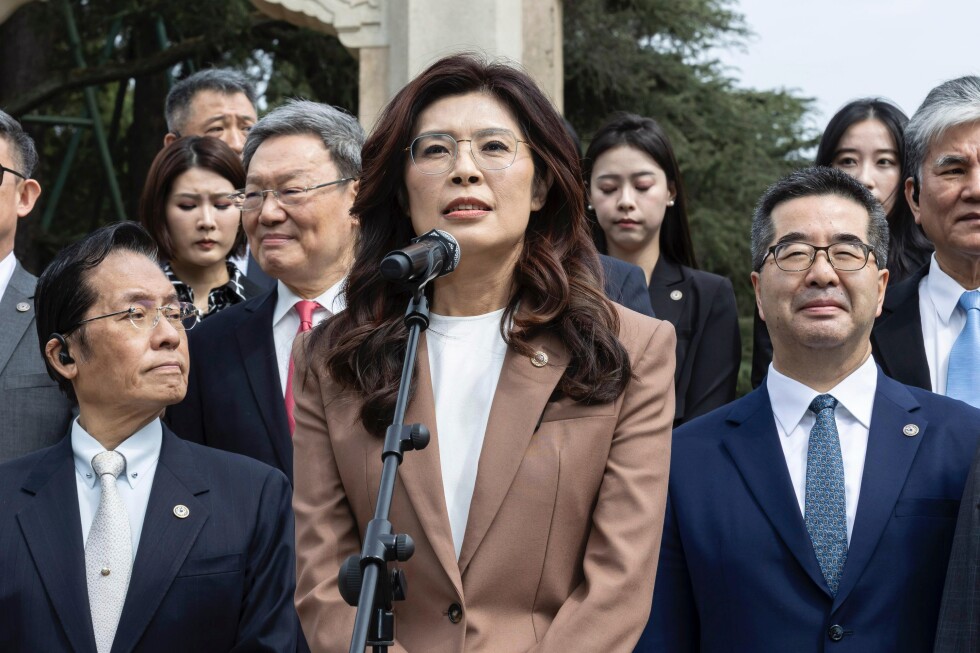
In a landmark event that marks the first high-level encounter between China’s ruling Communist Party and Taiwan’s main opposition Kuomintang (KMT) in more than a decade, Kuomintang chairperson Cheng Li-wun held a formal meeting with Chinese President Xi Jinping at Beijing’s Great Hall of the People on Friday. Both leaders used the historic gathering to issue joint commitments to upholding cross-strait peace across the Taiwan Strait and advancing the goal of eventual unification between mainland China and the self-governing island that Beijing claims as its sovereign territory.
The meeting comes amid escalating cross-strait tensions in recent years. Beijing has ramped up military pressure on Taiwan, conducting regular large-scale military exercises that send warships and fighter jets into areas adjacent to the island, while steadily poaching the small number of diplomatic allies that still recognize Taipei’s sovereignty. Beijing has never renounced the option of using military force to bring Taiwan under its control, a stance that has fueled widespread international concern over potential conflict in the strategically vital region.
Opening the meeting to a round of applause from delegates from both sides, President Xi welcomed Cheng and her KMT delegation, emphasizing the unshakable trajectory of closer ties between people on both sides of the Taiwan Strait. “The larger trend of compatriots on both sides of the strait walking nearer and nearer together will not change. This is a historical necessity. We have full confidence in this,” Xi stated.
Cheng, who framed her five-day trip to mainland China as a “journey for peace” long before her arrival, struck a conciliatory tone in her remarks. “Although people on both sides of the Taiwan Strait live under different systems, we will respect each other and move towards each other,” she said, adding that the KMT’s core goal is to “seek systemic solutions to prevent and avoid war” across the Taiwan Strait.
Cheng began her mainland visit on Tuesday, stopping first in Shanghai and Nanjing before traveling to the Chinese capital for Friday’s meeting. A longstanding advocate for peaceful cross-strait engagement, she has openly opposed large increases to Taiwan’s defense budget, and her KMT party currently holds enough legislative sway to block incumbent Taiwanese President Lai Ching-te’s proposed special defense allocation. The budget would fund major arms purchases, including the development of the “Taiwan Dome,” a domestically built air defense interception system.
The historical context of cross-strait relations stretches back to the end of the Chinese Civil War in 1949. When Mao Zedong’s Communist Party seized control of mainland China, defeated KMT forces retreated across the Taiwan Strait to the island, where they established a separate governing administration that has remained in place ever since.
A core point of agreement reaffirmed by both leaders at Friday’s meeting was commitment to the 1992 Consensus, the informal tacit agreement that underpinned decades of cross-strait engagement. While the agreement has never been formalized in a signed official document, both sides agree that it upholds the core principle that Taiwan and mainland China are part of a single “one China.” The two sides have long differed on interpretation, however: the KMT has long held that each side is free to interpret what “one China” means individually, a position Beijing has never formally recognized.
In closing her remarks, Cheng emphasized that both parties would work together to ensure the Taiwan Strait is transformed from a potential conflict flashpoint into a region of lasting peace, and would prevent the island from becoming a geopolitical pawn manipulated by outside powers.
This report was compiled with contributions from correspondent Wu reporting from Bangkok, Thailand.