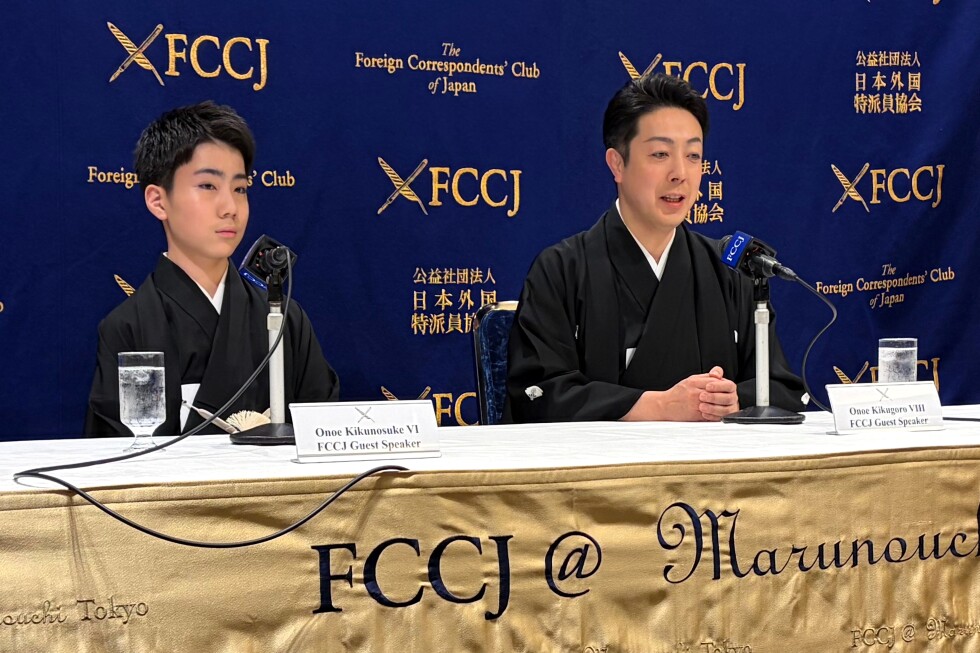
In the heart of Tokyo, a centuries-old cultural ritual is unfolding that reaffirms the enduring legacy of Japan’s iconic traditional theatrical art, Kabuki. For generations, passing down revered stage names through family lines has stood as the cornerstone of Kabuki tradition, celebrated every few years at major theaters and special ceremonies across the country. This year, the iconic title of Kikugoro transfers to its eighth holder, 48-year-old Kazuyasu Terajima, who inherits the honor from his 83-year-old father, the seventh Kikugoro — continuing an unbroken line of succession that stretches back multiple generations.
For Terajima, accepting the legendary name means far more than adopting a new stage title. “Taking on the name is about taking on the spirit and responsibility that’s created and passed down over generations by those who came before us,” he told reporters recently. “The job of the Kabuki actor is to carry on and develop in the present what we have inherited from our predecessors, and make sure it gets passed on to those who come after us.” This is not an unfamiliar practice for Kabuki: just two years ago, in 2022, the field saw another major succession when the 13th holder of the other iconic Kabuki family name, Danjuro, formally took on his title.
Dating all the way back to the 1600s, Kabuki remains a vibrant, widely beloved art form in modern Japan, and recent cultural milestones underscore its ongoing popularity. The hit domestic film *Kokuho*, which earned an Oscar nomination this year for best makeup and hairstyling, became the highest-grossing live-action domestic film in Japanese cinema history — a clear sign that the centuries-old theater still resonates deeply with contemporary audiences.
What makes Kabuki unique is its distinct, stylized performance language that sets it apart from realistic Western theatrical traditions. All roles, including female parts, are played by male actors: those who specialize in women’s roles are called onnagata, while artists like the Kikugoro line perform both male and female roles. The art form blends sweeping dramatic narratives, live music, dance, and song, with stories ranging from tales of wronged samurai seeking vengeance to tragic romances and supernatural tales of maidens who transform into serpents. Actors wear elaborate, vibrant costumes and striking stylized makeup, and deliberately reject realism to emphasize emotional and thematic core. Key dramatic moments are punctuated by striking poses called mie, emphasized by the rhythmic clack of wooden claves that freeze the performance to highlight courage, fear, or other intense emotions. Lines are often delivered in a melodic, poetic cadence, while live music serves as an integral narrative tool: thundering large drums evoke stormy weather, soft drumbeats mimic falling snow, and tinkling bells can conjure the image of floating butterflies. Performances utilize dynamic revolving sets — for example, cherry blossom trees that shower audiences with pink paper petals — and even incorporate acrobatic elements, such as wire-work for supernatural character dance sequences. One of the form’s most celebrated theatrical tricks is on-stage costume and character transformation, where stagehands called kurogo, cloaked in unobtrusive black robes, help actors shift from a human character to a demon right in front of the audience’s eyes.
Surprisingly, Kabuki shares striking thematic parallels with William Shakespeare’s Elizabethan theater, despite developing completely independently. One of Kabuki’s most famous tragic works, *The Love Suicides at Sonezaki*, tells the story of young lovers who choose death together over a life apart — often described as the Kabuki equivalent of *Romeo and Juliet*. The parallel is entirely coincidental: the play’s writer, Chikamatsu Monzaemon, created the work for Japan’s Bunraku puppet theater in the 18th century during Japan’s isolationist Tokugawa period, and never had access to Shakespeare’s works, which were written decades earlier.
Like all Kikugoro titleholders before him, Terajima was born into this legacy and trained from childhood to carry the art form forward. Far from resenting the predetermined path, he speaks of it only with gratitude and dedication. “I totally adored and admired my predecessors,” he shared during an appearance at the Foreign Correspondents’ Club in Tokyo last month. “First of all, I am filled with gratitude to our predecessors who created great works that continue to be loved by generations that came after. So I am grateful to be born into the family of such ancestors.”
The chain of succession already extends to the next generation: Terajima’s 12-year-old son Kazufumi will one day inherit the previous family title Kikunosuke, a name passed to the younger generation of the Kikugoro line. Like his father, Kazufumi has already begun his training, which requires intense physical and mental discipline: daily morning running, strict dietary rules, and early bedtimes. Though he shares interests with other children his age — including video games and Japanese rock band Mrs. Green Apple — he has already developed a calm, disciplined bearing far beyond his years. “It’s not only hard physically. It’s also pretty hard mentally, and I sometimes took it out on my parents,” he admitted with a smile. The multi-year shumei (name succession) ceremony, which launched last year with a series of performances across Japan, will continue through 2024.
Renowned American Kabuki scholar James R. Brandon describes the art form as centered on a strict cultural code: “a theater in which the art of acting is central, and in which playwright and actor cooperate to achieve the unique style of performance found only in Kabuki.” Central to this tradition is kata, the established “correct way” of performing each role and scene that serves as a model for all future generations of actors.
While some cultural observers have raised concerns about Kabuki’s long-term survival in an era of modern digital entertainment, Terajima says he remains confident in the art form’s enduring relevance, arguing that its core traditions do not need radical change. “By using kata, what we want to truly communicate the most in the tradition of Kabuki is human compassion, that spirit of caring for others,” he explained. For the eighth Kikugoro, that timeless message ensures that Kabuki will continue to thrive for generations to come.