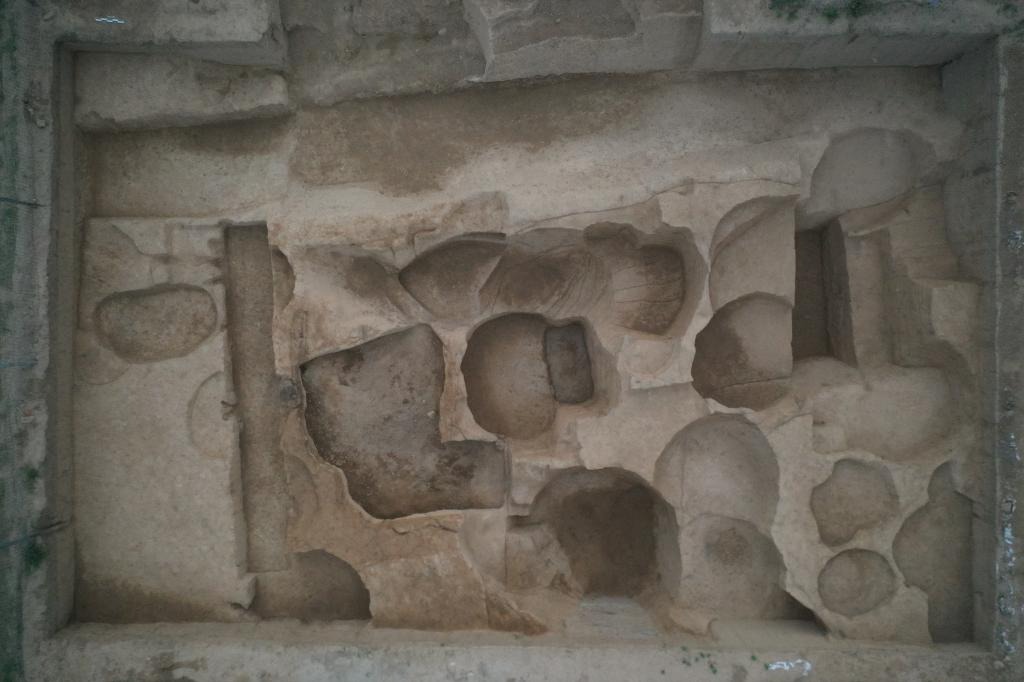
Zhengzhou, China – A well-preserved, purpose-built water channel network dating back approximately 4,000 years has been excavated at the Wangchenggang archaeological site in Dengfeng, central China’s Henan province. The landmark find, announced Thursday by Chinese archaeological authorities, is providing groundbreaking new evidence that confirms the advanced state-level organizational capabilities and structured urban planning of China’s first recorded dynasty, the Xia Dynasty, which ruled from approximately 2070 BC to 1600 BC.
The discovery was publicly unveiled at a academic forum highlighting Henan province’s most recent archaeological breakthroughs. Lead on-site excavation director Ma Long, a veteran local archaeologist, reported that two large early Xia Dynasty artificial ditches have been fully mapped at the site. Each ditch measures roughly 3 meters wide, with a confirmed excavated length exceeding 120 meters. Aligned on a consistent north-south axis, the two main ditches connect to a larger moat spanning approximately 10 meters in width, creating a fully integrated system that delivered water, removed waste, and divided the ancient settlement into distinct functional zones.
According to Ma, the uniform construction and alignment of the two main ditches reflect a remarkably high level of pre-construction planning, sophisticated design, and advanced engineering execution for the era. Preliminary calculations estimate that workers moved thousands of cubic meters of earth to complete the project – a feat that would only have been possible with the coordination of large, well-organized labor forces under a centralized governing authority.
Beyond the large main ditches and perimeter moat, archaeologists also uncovered a network of smaller secondary channels, ranging from just 0.3 meters to 1 meter in width. These smaller branches extend directly to individual residential buildings and ancient kiln sites across the settlement, allowing for fast and efficient removal of rainwater and domestic wastewater to keep living and working spaces dry.
Yang Wensheng, deputy director of the Henan Provincial Institute of Cultural Heritage and Archaeology, explained the broader significance of the find. The large, hierarchically organized artificial water network demonstrates that even in the early Xia Dynasty, the Wangchenggang site operated under a unified governing authority with the capacity to organize large public works projects and enforced standardized engineering practices. Yang emphasized that this system serves as critical tangible archaeological evidence confirming the maturity of early state formation in ancient China.
Additional excavation and academic analysis of the site and newly uncovered features is ongoing, with researchers expecting to reveal more details about urban life and governance during China’s earliest dynastic period in coming months.