For Italian soccer, 2024 has become a season of unprecedented disappointment, with a fresh wave of poor results pushing the country’s long-building crisis into the global spotlight. What began with early eliminations from the Champions League and a shocking third straight World Cup qualifying miss reached a new low this week, when two remaining Italian clubs competing in European competitions suffered heavy first-leg defeats that put them on the brink of exiting before the semifinal stage.
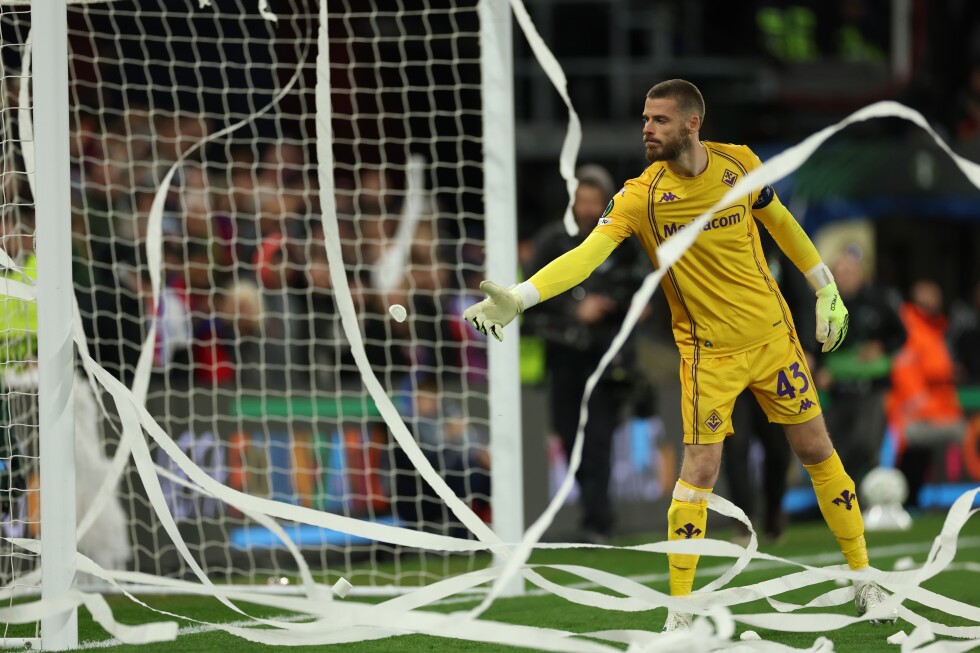
Bologna fell 3-1 to England’s Aston Villa in the first leg of the Europa League quarterfinals, while Fiorentina dropped an even more lopsided 3-0 defeat to Crystal Palace of the Premier League in the Conference League quarterfinals. Unless both clubs pull off historic comeback victories in the upcoming return legs, Italy will be left without any representatives in the final four of any major European club competition for the first time in seven years.
These latest results are only the most recent in a string of humiliating exits for Italian soccer this campaign. Last month, Atalanta, the only Italian side to advance to the Champions League round of 16, was eliminated by Bayern Munich by a crushing 10-2 aggregate score. Pre-tournament favorites Inter Milan and Juventus crashed out of the Champions League playoffs at the hands of much smaller underdogs Bodø/Glimt and Galatasaray, respectively. Defending Serie A title holder Napoli failed even to qualify for the playoffs, finishing a disappointing 30th out of 32 teams in the new league phase.
Across both matches this Thursday, Italian clubs managed just a single goal, scored by Bologna’s English winger Jonathan Rowe. Aston Villa striker Ollie Watkins wrapped up his brace deep into second-half stoppage time, a late concession that Bologna winger Federico Bernardeschi admitted will complicate the club’s path to a comeback. “At this level experience counts, and Aston Villa probably had more, as they made fewer mistakes and made the most of ours,” Bernardeschi told reporters after the match. “The third goal changes everything for the return leg. We can’t concede in the last minute of added time and that should teach us a lot. We need to grow.”
The gap in quality was even more stark between Fiorentina and Crystal Palace, despite the two clubs sitting in nearly identical mid-table positions in their respective domestic leagues: Palace 14th in the Premier League, and Fiorentina 15th in Serie A.
The string of club failures comes just 10 days after the Italian men’s national team suffered a devastating qualifying exit for the 2026 FIFA World Cup, falling to Bosnia-Herzegovina in a penalty shootout that eliminated the four-time World Cup champions from the tournament for the third consecutive cycle. In the wake of that defeat, Italian Soccer Federation (FIGC) president Gabriele Gravina and national team head coach Gennaro Gattuso both stepped down. Notably, the only Italian managers who will feature at this year’s World Cup are leading other nations: Carlo Ancelotti with Brazil, Vincenzo Montella with Turkey, and Fabio Cannavaro with Uzbekistan.
Staying on in a temporary caretaker role until federation elections in June, Gravina this week released a scathing, data-backed report exposing deep systemic flaws across every level of Italian soccer. The analysis laid out a clear picture of structural decline: Serie A squads carry an average player age of 27, older than top-flight leagues across England, Germany, France, the Netherlands, Portugal, Norway and Belgium. The average ball speed in Serie A play clocks in at just 7.6 meters per second, far slower than the 9.2 m/s average of Europe’s top five leagues and well behind the 10.4 m/s average pace of Champions League play.
Problems extend far beyond the top flight, Gravina’s report found. Since the 1986-87 season, nearly 200 lower-division Italian clubs have been expelled from their leagues due to crippling financial instability. Over the past 13 years alone, Italian clubs have been deducted a combined total of 519 league points for financial and regulatory violations. Italy also ranks outside the top 10 European nations for investment in new stadium construction and venue modernization over the past 20 years, a gap that limits revenue growth and fan experience.
Gravina argued that only sweeping, root-and-branch reform supported by the Italian government can reverse the decades-long decline. “For the good of Italian soccer, it’s more than evident that the only way to intervene is to do it in a radical manner … with fundamental support from the government,” he said. “No single person can create a complete reconstruction.”