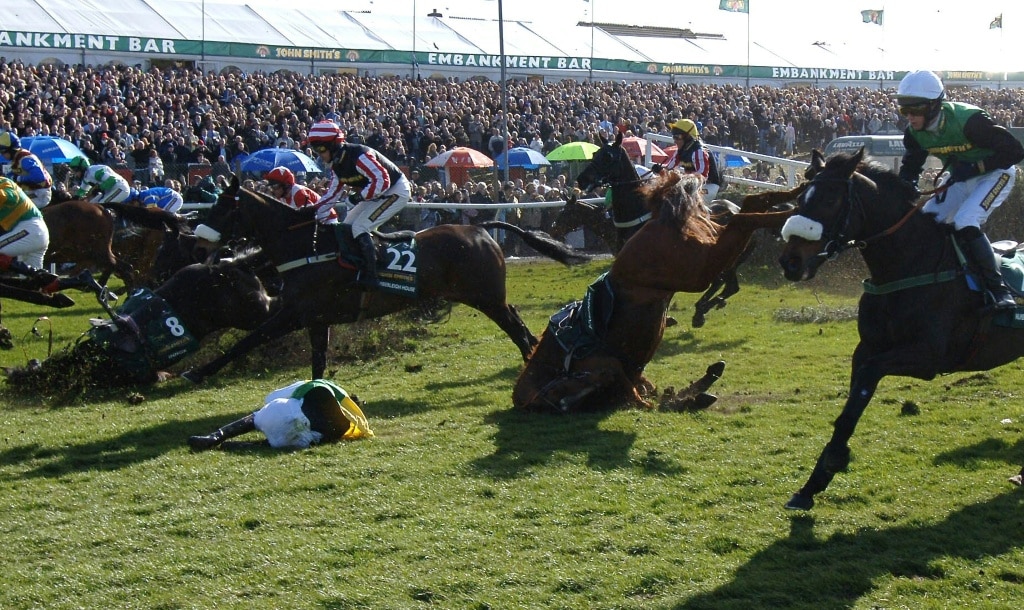
The Grand National, one of the most iconic steeplechase events in global horse racing, has undergone a dramatic transformation from the challenge it presented when Mick Fitzgerald secured his legendary 1996 victory aboard Rough Quest. In an exclusive interview with AFP, the 55-year-old Irish former jockey emphasized that these ongoing updates are not a dilution of the sport’s heritage, but an unavoidable adaptation to shifting public attitudes — a case of “evolve or die” for the historic race.
Stretching over four miles with 30 notoriously challenging obstacles, the Grand National long ago outgrew its status as a niche horse racing event. It draws millions of once-a-year casual bettors and commands a massive global television audience, cementing its place as a cultural phenomenon beyond the sport itself. In response to growing pressure from animal welfare organizations over equine safety, organizers have rolled out a series of course modifications in recent years, with the latest adjustments implemented in 2024.
Key changes include shortening the approach to the first fence, altering the design of multiple jumps including the iconic Becher’s Brook, and reducing the maximum number of starting runners from 40 to 34, all aimed at cutting the risk of serious injury and fatality for competing horses and jockeys. For Fitzgerald, who won the 1996 running before suffering a career-ending spinal injury in the 2008 edition of the race, these adjustments are a reasonable tradeoff to secure the event’s long-term future.
“If someone was to say we have to make these changes so the National can last 100 years then so be it,” Fitzgerald explained. “One has to evolve or die — to give a little so one can carry on.” He drew a parallel to shifting social norms around public smoking, noting that what was once widely accepted can become untenable as public values change. “Back in the day one could smoke in pubs, planes and cinemas. If somebody said to you today ‘Go ahead, smoke on the plane’ you would reply ‘You are kidding me’. Times have changed, as they have with the National. The risk has been reduced, but it was inevitable it would be, as people’s attitudes have changed as to what is acceptable.”
While Fitzgerald acknowledges the course is a far different test than it was 20 to 30 years ago, he insists the Grand National retains its unique aura and status as the world’s greatest steeplechase. “It is still a unique test,” he said. “I am not going to dress it up as still being the same race, though it is the greatest steeplechase, but it is not the same test it was 20-30 years ago. The fences are obviously not the same, the horses jump them differently. Most horses could get round these days whereas in the old days you needed a horse of a certain type to navigate the course.”
Thirty years after his iconic win, when he famously joked that even sex was an anticlimax after crossing the Grand National finish line, Fitzgerald still holds that winning the event elevates a jockey to a unique status unmatched by any other race in the sport. Even with a decorated career that includes wins at the Cheltenham Gold Cup and Champion Chase, he notes the first question casual racing fans ask is always about the Grand National. “If someone who knows little about racing asks you what you do for a living and you reply ‘jockey’, they will ask you not about did you win a Gold Cup or a Derby but the Grand National,” he said. “It has a unique fascination for people. Absolutely it makes a difference to have that on your CV. Gives you a bit of kudos. You have succeeded where some of the legends of the sport fell short — John Francome, Peter Scudamore and Jonjo O’Neill.”
Ahead of this year’s running, jockeys will once again visit Alder Hey Children’s Hospital in Liverpool, an annual tradition where Fitzgerald serves as a patron. He calls the visit a humbling “reality check” that puts the stakes of the race into perspective. “It makes one realise galloping round a track does not matter, when you see the parents and their seriously ill children,” he said. “You realise what is really important in life.”