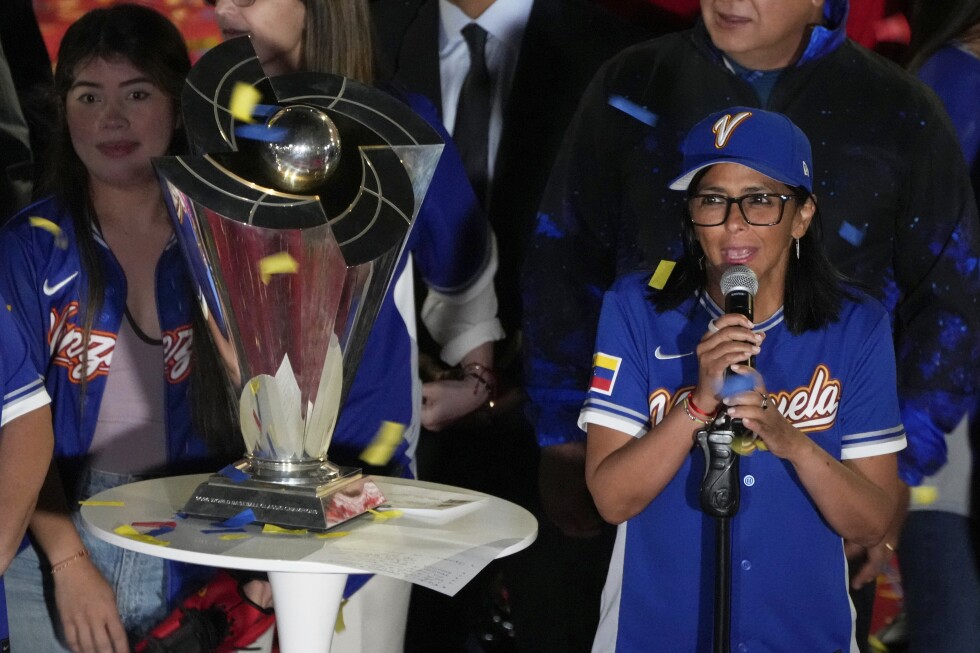
On Wednesday, the United States formally removed sanctions against Venezuela’s interim acting president Delcy Rodríguez, according to a public notice published on the Treasury Department’s Office of Foreign Assets Control (OFAC) official website. This latest sanctions rollback marks the most recent step in Washington’s formal recognition of Rodríguez as a legitimate governing authority in Venezuela, coming two and a half months after U.S. military forces captured former Venezuelan president Nicolás Maduro and his wife in Caracas, the country’s capital, on January 3.
Following their capture, the couple was extradited to New York City to face federal drug trafficking charges, and both have entered not guilty pleas in court. The lifting of sanctions clears regulatory barriers that previously barred Delcy Rodríguez from engaging in formal commercial and diplomatic dealings with U.S. firms and investors, opening new pathways for bilateral collaboration between the interim Venezuelan government and Washington.
Though Rodríguez did not explicitly reference the now-rescinded sanctions targeting her personally in her public comment, she framed the U.S. decision as a promising milestone for bilateral ties between the two nations. In a statement posted to her official Telegram channel shortly after OFAC’s announcement, Rodríguez said, “We value President Donald Trump’s decision as a step toward normalizing and strengthening relations between our countries. We trust that this progress will allow for the lifting of current sanctions against our country, enabling us to build and guarantee an effective bilateral cooperation agenda for the benefit of our people.”
This policy reversal represents a notable shift from the Trump administration’s first term, when both Delcy Rodríguez and her brother, National Assembly president Jorge Rodríguez, were placed under U.S. sanctions for their alleged roles in eroding democratic governance in Venezuela. The siblings, along with other close allies of Maduro, were added to OFAC’s sanctions blacklist in September 2018, just months after Maduro won a controversial re-election that was widely dismissed as illegitimate by the international community. The vote was boycotted by major opposition parties, and dozens of opposition candidates were barred from running for office. At the time of the 2018 designation, the Treasury Department said in an official statement that “Maduro has given Delcy Eloina Rodríguez Gomez and Jorge Jesus Rodríguez Gomez senior positions within the Venezuelan government to help him maintain power and solidify his authoritarian rule.”
Following Maduro’s removal from office in January’s U.S.-led military operation, the current Trump administration has opted to pursue collaboration with Delcy Rodríguez rather than align with traditional Venezuelan opposition factions. Since taking over as interim head of state, Rodríguez has overseen implementation of a Washington-backed phased economic recovery plan for the oil-rich nation. She has actively courted international investment, rolled out reforms to open Venezuela’s markets to private capital, and committed to binding international arbitration and greater regulatory transparency for foreign businesses.
Last month, the Trump administration formalized its recognition of Rodríguez’s authority by backing her claim as the “sole Head of State” of Venezuela during ongoing civil proceedings in U.S. federal court. The lifting of sanctions on Delcy Rodríguez is part of a broader rollback of punitive measures targeting Venezuela’s key economic sectors. In March, OFAC issued a sweeping general license that allows state-owned oil giant Petróleos de Venezuela S.A. (PDVSA) to sell crude oil directly to U.S. buyers and on global commodity markets, a dramatic policy shift after years of near-total U.S. restrictions on dealings with the Venezuelan government and its critical oil sector.
Despite Maduro’s ouster and detention, his legal status as Venezuela’s sitting president remains unaltered under Venezuelan domestic law. Within hours of the January 3 operation, Venezuela’s ruling party-aligned Supreme Court declared Maduro’s absence from office “temporary,” a ruling that eliminates the legal requirement to hold a snap presidential election and preserves the official immunity Maduro holds under international law as a sitting head of state. The court’s order installed Delcy Rodríguez as interim president for an initial 90-day term, with a provision allowing the National Assembly — which is controlled by the ruling party and led by her brother Jorge — to extend the appointment to a maximum of six months. That initial 90-day term is set to expire this Friday.