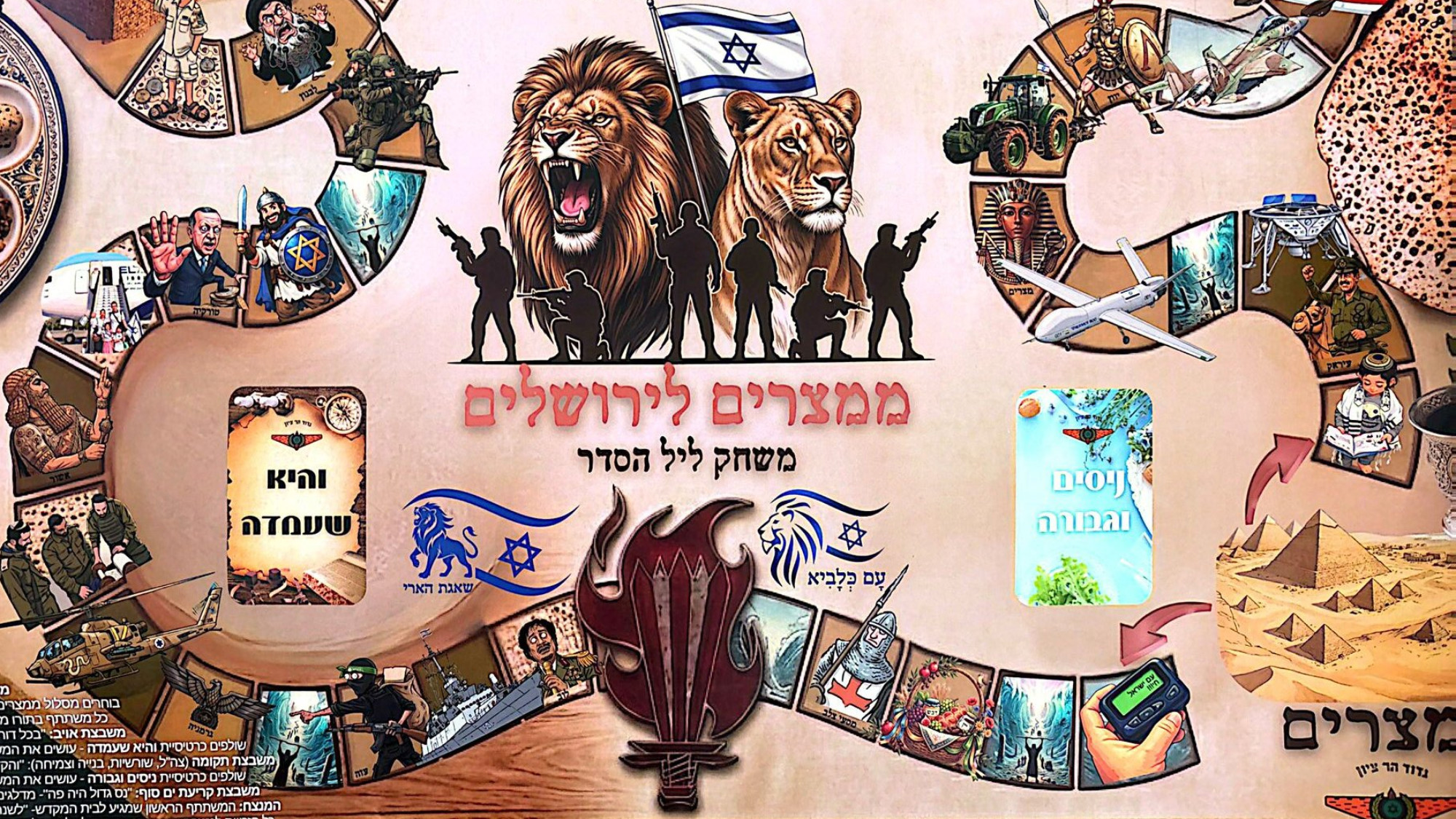
Against a backdrop of escalating regional conflict and growing religious nationalist rhetoric within Israeli society, a group of Israeli army reservists has independently developed and distributed a Temple-themed board game to fellow service members ahead of the 2026 Passover holiday, the Israeli military has confirmed. First reported by Israeli journalist Or Kashti in a social media post on March 31, the game, titled *From Egypt to Jerusalem*, centers on a core objective: guiding players from a starting point representing Egypt across a game board dotted with religious, national, and military imagery to reach the site of the ancient Jewish Temple in Jerusalem. The game’s instructions open by inviting players to “choose a route from Egypt” and advance along the path toward Jerusalem, closing with the traditional Passover refrain “Next year in Jerusalem” that anchors the holiday’s liturgy. Passover, one of the most sacred observances in the Jewish calendar, commemorates the biblical narrative of the Israelites’ escape from enslavement in ancient Egypt to seek freedom in the land of Israel, which this year began on the evening of Wednesday last week, coinciding with the game’s distribution. As players move across the board, they land on “revival” spaces adorned with Jewish and Israeli national symbols alongside military graphics, and can draw special cards marked “miracles and heroism.” Additional gameplay challenges included whimsical but politically charged tasks such as standing on one foot to share a positive recent event for the Israeli people, and performing a skit of a phone call between the biblical Pharaoh and Iran’s president, according to details shared in Kashti’s post. The game board also bears the logo of the Har Tzion battalion in the IDF’s Jerusalem brigade, indicating formal organizational connections between the creators and the unit. But not all spaces on the board carry positive framing: other squares depict figures labeled as historical and modern enemies of Israel, ranging from ancient adversaries like the Babylonians and Crusaders to contemporary political leaders. Those named include Turkish President Recep Tayyip Erdogan, assassinated Hezbollah secretary-general Hassan Nasrallah, a Hamas fighter, and recently killed Iranian supreme leader Ali Khamenei. The game’s text echoes another core Passover liturgical phrase: “In every generation they rise up to destroy us,” a line that has been recontextualized for modern political messaging in recent years. When contacted for comment by Middle East Eye, an Israel Defense Forces spokesperson clarified that the game was not an official military initiative. “It was created by reservists on their personal initiative,” the spokesperson said, distancing the institution from the project. The emergence of this privately made military-themed religious game comes amid a well-documented rise in religious nationalist rhetoric and symbolism across Israeli society and within the military, against the backdrop of the ongoing 2025 U.S.-Israeli military campaign against Iran. Just one month prior, during the Jewish holiday of Purim, many Israelis framed the ongoing conflict through a religious lens, drawing parallels between the war against Iran and the biblical Purim narrative of overcoming a Persian threat to Jewish communities. Israeli Prime Minister Benjamin Netanyahu has explicitly integrated Passover religious imagery into public remarks about the war against Iran. In comments last month ahead of the holiday, Netanyahu declared: “On the eve of this Festival of Freedom, Israel is stronger than ever.” He went on to rework the iconic Passover line cited in the board game: “In every generation they rise up to destroy us, and in this generation, the regime of the ayatollahs made a massive effort to annihilate us, to take over the Middle East, and to threaten the entire world,” he said, adding that the joint U.S.-Israeli assault was “crushing Iran.” He even invoked the biblical story of the ten plagues of Egypt, stating “We have dealt ten plagues upon the Axis of Evil.” At the time of reporting, the scale of the game’s distribution remains unconfirmed. The development also arrives alongside ongoing shifts in the long-standing status quo at the Al-Aqsa Mosque compound in occupied East Jerusalem, a site sacred to both Muslims (as one of Islam’s holiest sites) and Jews (who refer to it as the Temple Mount, the location of the ancient Jewish First and Second Temples). Last month, Israel extended the closure of the compound, and since far-right Israeli National Security Minister Itamar Ben Gvir took office in 2022, the site has seen a sharp increase in the number of Jewish nationalist visitors and worshippers entering the complex, a practice that violates the decades-old status quo agreement, which restricts Jewish prayer at the site to preserve Muslim administrative control. The increased prominence of religious symbolism within the Israeli military also tracks back to the start of the 2023 Gaza war, with growing reports of religious nationalist messaging among active-duty soldiers. Just last month, a CNN reporting team was detained by Israeli soldiers while covering the establishment of a new unauthorized settler outpost in the Palestinian village of Tayasir in the occupied West Bank. Footage from the encounter captured one soldier openly boasting about plans to take revenge against Palestinians, while a second soldier was seen wearing a patch referencing the Jewish Messiah on his uniform – a practice the Israeli army officially banned for all service members last year. Middle East Eye, which first published this report, provides independent on-the-ground coverage of the Middle East and North Africa region.