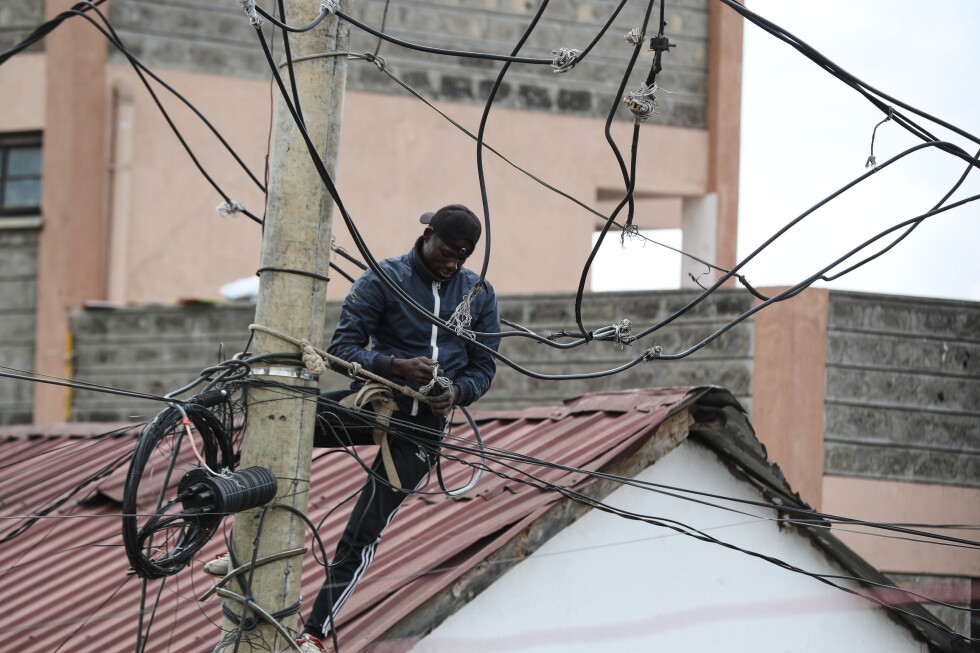
Deep in the pre-dawn darkness of Nairobi’s dense informal settlement of Mathare, Agnes Mbesa reaches up to flick on a single bare bulb suspended from her corrugated tin roof. Just a few years ago, the mother of three would have relied on a dim, smoke-choked kerosene lamp to navigate her small home. Today, electricity not only illuminates her living space but powers the small neighborhood shop she runs from her front veranda, transforming her ability to earn a living.
“Before we had power, we had to shut down the shop as soon as dusk fell — it was just too dark to work,” Mbesa explained. “Now customers stop by even late into the evening, and I can bring in extra income that I never could before.”
Hundreds of kilometers away in the lakeside village of Sori, in western Kenya, fisherman Samuel Oketch shares this story of transformation. When a community solar mini-grid was installed to serve his remote settlement, Oketch invested in a electric freezer to store his daily catch. Previously, he was forced to sell all his fish immediately at cut-rate prices to middlemen who controlled cold storage. Today, his catch can be preserved and transported to higher-value markets in larger nearby towns, cutting out exploitative brokers and boosting his household income.
“These small, quiet changes add up to everything,” Oketch said. “Electricity opens up choices we never had before. Now my wife can sell our fish directly, without being ripped off by the brokers who used to hold all the power with their freezers.”
The firsthand accounts from Mbesa and Oketch put a human face on a decades-long global push to expand energy access across Africa, where hundreds of millions of people still live without reliable power. Right now, more than 730 million people across the globe lack access to any electricity at all, and nearly 80% of that population lives in Africa. Widespread energy poverty holds back progress across every sector of development: it limits access to modern health care, stifles educational opportunity, blocks digital connectivity, and stunts the creation of small businesses and formal jobs.
To accelerate progress toward universal energy access, major international institutions and philanthropic organizations have announced billions in new financing for renewable energy projects across sub-Saharan Africa, unveiled in coordinated actions this March. The European Investment Bank committed more than $1.15 billion to support a range of projects, including utility-scale hydropower, wind and solar farms, and expansion of both national and community-level power grids.
“This funding represents Europe’s unwavering commitment to deliver cleaner, more affordable, and more reliable energy to hundreds of millions of people across Africa,” said European Investment Bank President Nadia Calviño.
The Rockefeller Foundation followed that announcement with a pledge of an additional $10 million in investment, made public during the Africa Energy Indaba conference in Cape Town, South Africa. The funding will be deployed in partnership with the Global Energy Alliance for People and Planet to strengthen national electrification strategies and support policy reforms that expand private and community-led energy solutions across at least 15 African nations.
“African governments are leading the transformation of their own energy sectors, committing to national energy compacts and investing in homegrown solutions that meet their people’s needs,” said William Asiko, senior vice president at the Rockefeller Foundation.
These new investments fold into the broader Mission 300 initiative, led jointly by the World Bank and the African Development Bank. The ambitious campaign set a target to connect 300 million people across sub-Saharan Africa to electricity by 2030, relying on a mix of national grid expansion and decentralized solutions like community mini-grids and household-level off-grid solar systems.
For most of sub-Saharan Africa, national power grids are often overstretched, unreliable, and do not reach many remote and low-income communities. That gap has turned decentralized mini-grids into a fast-growing and effective alternative. These small, community-managed systems, most often powered by solar or hybrid renewable sources, generate and distribute power locally, eliminating the need for costly large-scale transmission infrastructure to reach isolated areas.
Off-grid systems, by contrast, operate independently at the household level, with affordable stand-alone solar kits that give individual families access to power even when they are located far from any centralized infrastructure. These solutions have become critical for closing electricity gaps in the rural and informal settlement communities that are most often left behind by national grid expansion.
To hit the 2030 target, Mission 300 is providing tailored support to countries across the continent: governments in Malawi and Liberia receive technical assistance to refine their national energy plans, expand transmission networks, and improve the reliability and efficiency of power distribution. In Côte d’Ivoire, Nigeria, and Senegal, the initiative provides local currency financing and pooled procurement support to drive down costs and speed up project deployment.
Andrew Herscowitz, CEO of the Mission 300 Accelerator at RF Catalytic Capital, warned that scaling access to meet the 2030 goal will require sustained long-term financing and strengthened local implementation capacity, including improved impact monitoring and better aligned policy support to speed up new connections.
“Energy access is the foundational key that unlocks human potential and broad-based economic development,” Herscowitz noted.
Kenya, one of the early beneficiaries of Mission 300 funding, has already seen dramatic gains under the initiative. Since 2017, the country has received support from the World Bank, African Development Bank and partner organizations for its Last Mile Connectivity program, which targets households located near existing grid infrastructure — particularly those in rural areas and informal urban settlements — as the country works toward universal electricity access by 2030.
The results have been staggering: national rural electricity access jumped from less than 7% in 2010 to roughly 68% in 2023. Across eastern and southern Africa, where only 48% of the total population and just 26% of rural residents currently have access to power, World Bank programs aim to expand access across up to 20 countries over the next seven years through a portfolio of renewable energy projects.
Mbesa, the Mathare shopkeeper, received her grid connection in 2021 through the Last Mile Connectivity Project, which covered the standard $115 connection fee for eligible low-income households and small businesses located near existing transformers. In remote communities like Oketch’s village, which lies far beyond the reach of the national grid, the program has supported the deployment of off-grid solutions including solar mini-grids and stand-alone household systems.
For Mbesa, the tangible impact of that connection is impossible to overstate. The small bulb above her shop has extended her working hours, and the electricity has let her children study after dark instead of stopping when the sun goes down.
“Electricity changes everything,” she said. “Once you have it, life finally starts moving forward.”
—
The Associated Press receives philanthropic funding for its climate and environmental coverage, but retains full editorial control over all independent content. AP’s standards for partnership with philanthropic organizations, a full list of supporters, and details of funded coverage areas are available at AP.org.