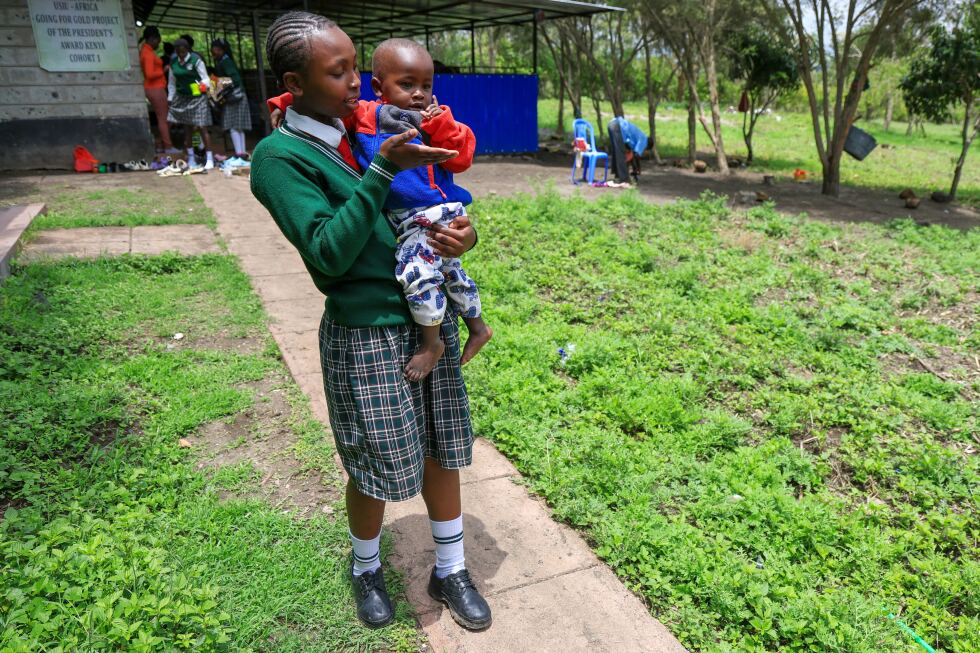
Nestled in Kenya’s Kajiado County, just south of the capital Nairobi, Greenland Girls Secondary School stands out as a revolutionary lifeline for young women who have been forced out of mainstream education by teenage pregnancy. Unlike any other institution in the country, this unique boarding school caters exclusively to adolescent mothers, providing them with free secondary education and on-site childcare for their children — opening a door to opportunity that would otherwise remain locked for most.
For 19-year-old Valarie Wairimu, a top-performing student at the school who dreams of becoming a doctor, the daily routine revolves around balancing coursework and caring for her infant son, Kayden. When break time hits at Greenland, Wairimu does not head to the courtyard or dorms to relax like her peers at other schools. Instead, she grabs a quick snack, hurries to the school’s on-site nursery, where nannies have been caring for Kayden while she attended class, and feeds her son before her next lecture. Wairimu’s path to Greenland was not easy: raised by a single father with a younger brother to support, she could not afford to care for her newborn after becoming pregnant. It was her grandmother who connected her to the school’s national referral network, which works with teachers and community leaders across Kenya to reach young mothers in need, even in far-flung regions like the western part of the country where Wairimu’s family lives.
Founded in 2015 and operated by the nonprofit organization Shining Hope for Communities, Greenland currently serves 310 students and cares for more than 80 of their children, ranging from newborn infants to walking toddlers. Nearly all students attend via full or partial grants, removing the financial barrier that pushes millions of young Kenyan women out of schooling each year. Most students come from low-income backgrounds across the country, and many were pushed into pregnancy through sexual assault or forced child marriage — abuses that remain widespread in parts of rural Kenya. In many cases, students face rejection from their own families and local communities, which often stigmatize teenage mothers and bar them from returning to school. According to school manager Paul Mukilya, outreach teams frequently have to negotiate with community elders to secure permission for pregnant girls and young mothers to enroll at Greenland. Once students arrive, the institution provides far more than just classroom education: it offers free psychological counseling, mentorship, and practical parenting training to help young women rebuild their confidence and care for their children. While students attend classes, trained staff handle childcare, and caregivers work with mothers who once saw their children as an overwhelming burden to develop positive parenting skills.
Kenyan law criminalizes sexual activity with minors under 18, but a gap in the legislation means only male perpetrators can face criminal charges, leaving young pregnant girls with no legal recourse and often bearing the social blame for their situation. Greenland supports students through court processes and liaises with local authorities to intervene in cases of unlawful underage forced marriage, standing as a legal advocate for vulnerable young women.
The need for this model of education could not be more urgent in Kenya, a nation with one of the fastest-growing youth populations on the African continent. Official 2024 Kenyan national statistics recorded more than 125,000 live births to adolescent mothers under the age of 19. Decades of research have repeatedly documented the link between teenage pregnancy and school dropout: a 2015 study from the Population Council, a global health and development think tank, found that two-thirds of teenage mothers in Kenya left school because of their pregnancy. As recently as 2022, research organization IDinsight confirmed that unintended pregnancy remains the second-leading cause of girls dropping out of secondary school, surpassed only by an inability to pay school fees.
Development experts praise Greenland as a replicable model for closing Kenya’s gender equity gap in education. “Every girl who gets pregnant and drops out during their school time must be allowed reentry,” explained Dr. Githinji Gitahi, chief executive of Amref Health Africa, a leading African development organization. “Special schools are important in supplementing the general scalable policy framework. We should focus on these schools that are helping to close the equity gap.”
Thanks to overwhelming demand from young mothers across the country, Greenland is preparing to expand: a second campus is set to open in Kilifi County along Kenya’s coast, where rates of teenage pregnancy and school dropout are particularly high. To date, the school has already helped hundreds of young women graduate secondary school, and many have gone on to build successful professional careers in fields ranging from government to medicine.
For students like 20-year-old Mary Wanjiku, who hopes to become a lawyer after graduation, what makes Greenland most transformative is the stigma-free learning environment it provides. “People used to judge me because I got pregnant,” Wanjiku said, whose son is now 18 months old. “The moment I came here, I was received with love.”