Nearly every strategic objective the United States laid out for its current conflict against Iran has failed to materialize, according to a leading scholar of protracted US military engagements. No popular uprising has unseated Iran’s ruling establishment, hardline leadership has merely reshuffled rather than fallen, Tehran’s missile and drone capabilities continue to strike targets across the Middle East, and the closure of the Strait of Hormuz has sent global energy prices soaring. Most notably, in direct contradiction of former US President Donald Trump’s demand for unconditional surrender, Iran has outright rejected a 15-point US-backed ceasefire proposal. What has caused such a sweeping deviation from Washington’s initial war plans?
In an analysis republished from *The Conversation*, Charles Walldorf, professor of politics and international affairs at Wake Forest University, argues the core issue is what he terms the “trap of asymmetric resolve.” This dynamic unfolds when a militarily dominant power with limited stakes in a conflict enters war against a far smaller, weaker state whose entire governing system hangs in the balance. When the weaker side possesses near-unwavering commitment to victory, overcoming that determination becomes exponentially harder – and often nearly impossible – for the stronger power.
“For Iran, the Islamic Republic’s very existence is on the line, a stakes Washington can never match in this conflict,” Walldorf explains. “That existential threat gives Tehran overwhelming incentives to maintain resistance and deploy highly effective countermeasures to wear down US advances.”
This pattern of asymmetric conflict has repeated throughout military history, dating back to the sixth century B.C., when a massive invasion force led by Persian Emperor Darius I was halted by a much smaller, deeply determined Scythian army. The lopsided standoff ultimately ended in a humiliating retreat for the Persian Empire. In the modern era, the United States has repeatedly fallen victim to this same trap.
The Vietnam War stands as one of the clearest modern examples. Over eight years of brutal conflict, an estimated 1.1 million North Vietnamese fighters and civilians lost their lives, compared to 58,000 US troops. Despite this massive casualty disparity, North Vietnam’s unyielding commitment to unification ultimately overwhelmed US willingness to sustain the war. After years of costly fighting, the US withdrew, and North Vietnam secured full victory over South Vietnam in 1975.
A near identical dynamic played out decades later in Afghanistan. The US ousted the Taliban regime in 2001, installed a Western-aligned government, and built a 300,000-strong Afghan national military backed by unlimited US firepower. Over 20 years of conflict, roughly 84,000 Taliban fighters were killed, compared to just 2,400 US service members. Yet the Taliban’s relentless commitment to retaking power eventually outlasted US political will. The US signed a withdrawal deal in 2020, pulled all remaining troops out in 2021, and the Taliban retook full control of the country within weeks.
This pattern is not unique to the US. The Soviet Union suffered an identical humiliating defeat in its 9-year Afghanistan occupation in the 1980s, despite suffering far fewer total casualties than the Afghan resistance. Post-World War II France likewise lost protracted asymmetric conflicts in Vietnam and Algeria, despite holding massive military advantages over independence fighters.
Today, that same asymmetry of resolve is playing out in the US-Iran war. Unlike the 12-day 2025 limited conflict that targeted only Iranian military and nuclear infrastructure, the current campaign has explicitly targeted the survival of Iran’s ruling government, with targeted assassinations of top leaders and open calls for popular uprising.
Tehran has followed through on pre-war warnings to retaliate across the region. Iran has launched strikes against Israeli targets, US military bases across the Middle East, and aligned Arab Gulf states, while drastically cutting commercial shipping access through the Strait of Hormuz – the world’s busiest energy chokepoint. Iran has taken far heavier losses than the US in the conflict: as of mid-March, more than 5,000 Iranian military personnel and 1,500 civilians have been killed, compared to 13 US service members. Even so, Tehran has refused to back down, declaring on March 10 that “We will determine when the war ends.”
This unyielding resistance has caught the Trump administration off guard. Before the war began, Trump openly questioned why Iran would not cave to US demands, and he has since acknowledged that regime change – a core opening war goal – is now a “very big hurdle.” This disconnect stems from misleading pre-war messaging to the American public: Secretary of State Marco Rubio claimed in January that Iran was weaker than it had ever been, with no intercontinental ballistic missiles capable of hitting the US mainland, a crippled nuclear program, and fewer regional allies than at any point in modern history. A March 6 Marist poll reflected this narrative, with 55% of Americans saying they viewed Iran as a minor or nonexistent threat.
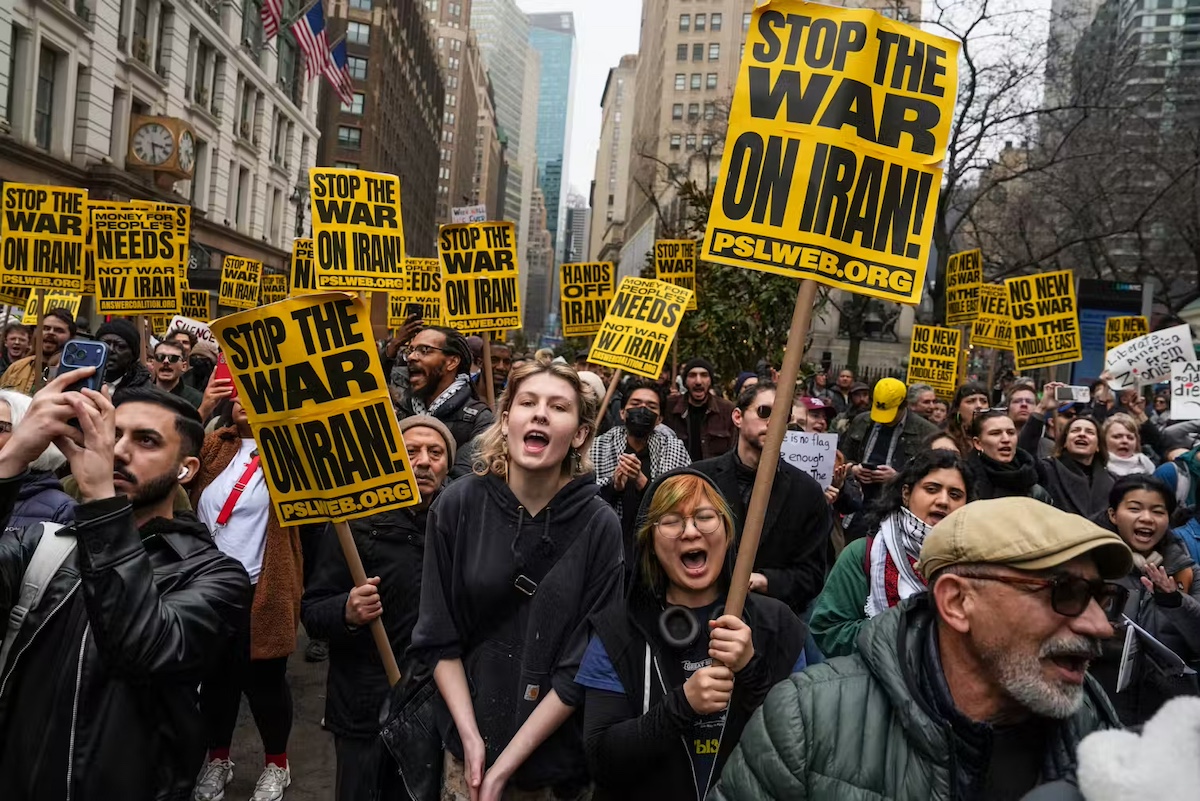
As Iran’s resilience has become impossible to ignore, US public opinion has turned sharply against the war. This shifting sentiment poses a unique challenge for democratic leaders, who face electoral consequences for maintaining unpopular conflicts. Today, the Iran war is among the least popular US conflicts since World War II, with consistent polling showing roughly 60% of Americans oppose continued military engagement. This mirrors the collapse of public support that drove past US withdrawals from asymmetric quagmires in Vietnam and Afghanistan.
While pre-war Iran faced widespread domestic protests that weakened public support for the government, a combination of a brutal government crackdown and a “rally around the flag” nationalist response to foreign invasion has muted domestic discontent, eliminating the domestic pressure for compromise that Washington faces.
Looking ahead, the Trump administration has attempted to manage the impact of asymmetric resolve by framing the operation as limited in scope and duration. To calm jittery financial markets and reassure war-weary voters, Trump has repeatedly promised a short conflict and delayed large-scale offensive strikes to make space for negotiations – claims that Iran has not corroborated.
Walldorf notes that history offers stronger powers two clear paths forward when facing a more determined weaker adversary. The first is to give in to the hubris of military power and escalate the conflict, a path that led to decades-long quagmires in Vietnam, Iraq, and Afghanistan. The second is to wind down hostilities, accept limited gains, and seek a negotiated end to the conflict.
Past leaders have overwhelmingly chosen escalation, convinced that a small increase in military force will tip the balance. President Barack Obama fell into this trap when he ordered a surge of 30,000 additional US troops to Afghanistan, incorrectly predicting the deployment would break the Taliban’s resistance. Despite public signals that he wants to exit the conflict, Trump could still take the same path: additional US troops are already deploying to the Persian Gulf, and B-52 bombers have begun flying combat sorties over Iranian territory for the first time in the current war.
History shows that escalating against a determined foe like Iran will come at massive cost to the United States. But the second path – de-escalation and negotiation – remains open to Trump. The president has already chosen this route twice before: he signed the 2020 deal with the Taliban to end the Afghanistan war rather than escalating, and he walked away from the 2025 Yemen air campaign when he realized defeating the Houthi movement would require a costly ground invasion.
Trump could choose the same exit strategy for Iran: declare that core US goals have been met, withdraw offensive forces, and enter sustained, good-faith negotiations to end the conflict. Any deal would require US concessions, such as restoring shipping access guarantees through the Strait of Hormuz or rolling back some crippling economic sanctions on Iran. While Trump may be reluctant to accept these compromises, polling shows a majority of American voters support this outcome. After decades of costly quagmires, Walldorf argues, few Americans are eager to repeat the mistakes of Vietnam and Afghanistan in the Middle East.