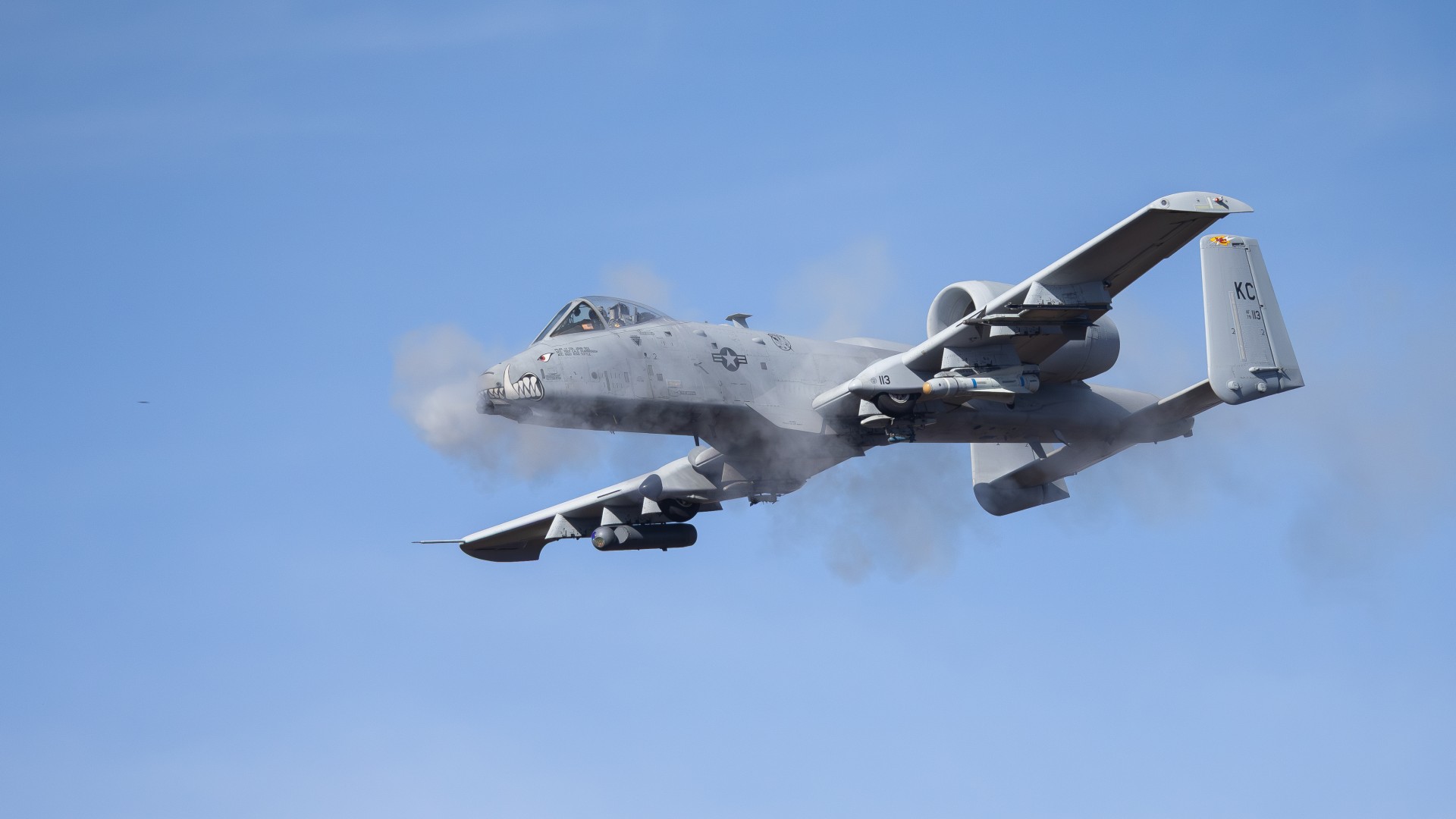
In a sharp escalation of military tensions between the United States and Iran on Friday, two American military aircraft were downed in Iranian airspace and near the Strait of Hormuz, sending already fraught diplomatic efforts for a de-escalation into further chaos. The first incident, confirmed by multiple anonymous U.S. officials cited by The New York Times, involved the crash of an A-10 Thunderbolt II, commonly known as the Warthog, a single-seat ground-attack jet. Iranian state media reported that its domestic air defense systems engaged and targeted the hostile A-10 near the strategically critical Strait of Hormuz, the world’s busiest oil shipping chokepoint. Fortunately, the lone pilot of the downed A-10 was successfully rescued by U.S. forces, per the NYT report. However, NBC News, also quoting an anonymous U.S. official, added that two U.S. military helicopters participating in the rescue operation were struck by Iranian gunfire; all service members onboard emerged unharmed.
The second downing, which occurred earlier the same day, involved a more advanced U.S. fighter jet over southwestern Iranian territory. Iran’s Islamic Revolutionary Guard Corps (IRGC) initially claimed the downed aircraft was a stealth F-35, but U.S. military sources later corrected the record to confirm it was an F-15E Strike Eagle, a twin-seat, all-weather attack jet that carries a price tag of approximately $31 million per unit, far more expensive than the $11.4 million A-10. A spokesperson for Iran’s supreme military command, Khatam al-Anbiya Central Headquarters, told the semi-official Tasnim News Agency that the F-15E was completely destroyed in the engagement. Local Iranian state television reported the jet was targeted over central Iran, with wreckage believed to have fallen in the mountainous, rural Kohgiluyeh and Boyer-Ahmad province. The outlet aired footage it claimed showed scattered remnants of the downed jet, and its anchor issued a public call for local residents to turn over any captured enemy pilots to law enforcement, offering a cash bounty for any U.S. service member taken into custody. The IRGC also claimed the downed F-15E belonged to a squadron stationed at Royal Air Force Lakenheath, a U.S. military base in eastern England. As of Friday, U.S. forces had rescued one member of the jet’s two-person crew, while search operations for the second pilot remain ongoing.
This is not the first reported engagement between Iranian air defenses and U.S. aircraft in recent months. In late March, Iran claimed it had shot down a U.S. F-35, a claim that Washington immediately rejected. At the time, the U.S. military only acknowledged that an F-35 had made an emergency landing following a combat mission over Iranian territory, adding that the pilot was in stable condition.
Beyond the military clashes, diplomatic efforts to broker a ceasefire between the two nations have hit repeated snags, according to multiple regional and international media reports. On Friday, Iran rejected a U.S.-proposed 48-hour temporary ceasefire, Iranian state-owned Fars News Agency reported, quoting an unnamed official source. The proposal was delivered via an unnamed third-party mediator on Wednesday, and it remains unclear whether Israel, which has joined the U.S. in its ongoing campaign against Iran, would have been a party to the agreement. The announcement comes after a public back-and-forth: earlier in the week, former U.S. President Donald Trump claimed Iran had requested a ceasefire, a charge Tehran immediately denied.
The Wall Street Journal also reported Friday that earlier mediation efforts led by Pakistan have collapsed entirely. Talks were set to be held in Islamabad, but Tehran refused to send representatives, citing what it calls unacceptable American negotiating demands. Iran’s core terms for any lasting peace agreement include a full U.S. military withdrawal from all bases across the Middle East, and financial compensation from the U.S. for widespread destruction to Iranian civilian infrastructure including schools and hospitals. Multiple other regional powers, including Turkey, Egypt, and Qatar, have been approached to lead new mediation efforts due to their established ties to the Trump administration, but progress has stalled. The WSJ added that Qatar has specifically resisted U.S. and regional pressure to take on the mediator role, declining the offer thus far.
A recent declassified U.S. intelligence assessment, first reported by CNN Thursday, suggests Iran has prepared for a protracted conflict, and retains significant military capability more than a month into the joint U.S.-Israeli military campaign. The assessment found that roughly half of Iran’s original missile launchers and kamikaze drone fleet remain operational, contradicting repeated public claims from Trump and Israeli government leaders that Iran’s military capabilities have been completely obliterated.
First entering U.S. military service in 1977, the A-10 Warthog is purpose-built for close air support of ground troops. A total of just over 700 A-10s were built between 1972 and 1984, and the jet has seen action in nearly every major U.S. military campaign of the past 40 years, including the 1991 Gulf War, the 2001 invasion of Afghanistan, and the 2003 Iraq War. The F-15E, by contrast, entered production later, with 435 units built between 1985 and 2017; the latest variant of the F-15 family, the F-15EX, costs between $90 million and $100 million per aircraft. In recent weeks, the U.S. has deployed thousands of additional troops to the Persian Gulf region, a move that U.S. officials have acknowledged sets the stage for a potential ground operation to seize key Iranian-held islands bordering the Strait of Hormuz.