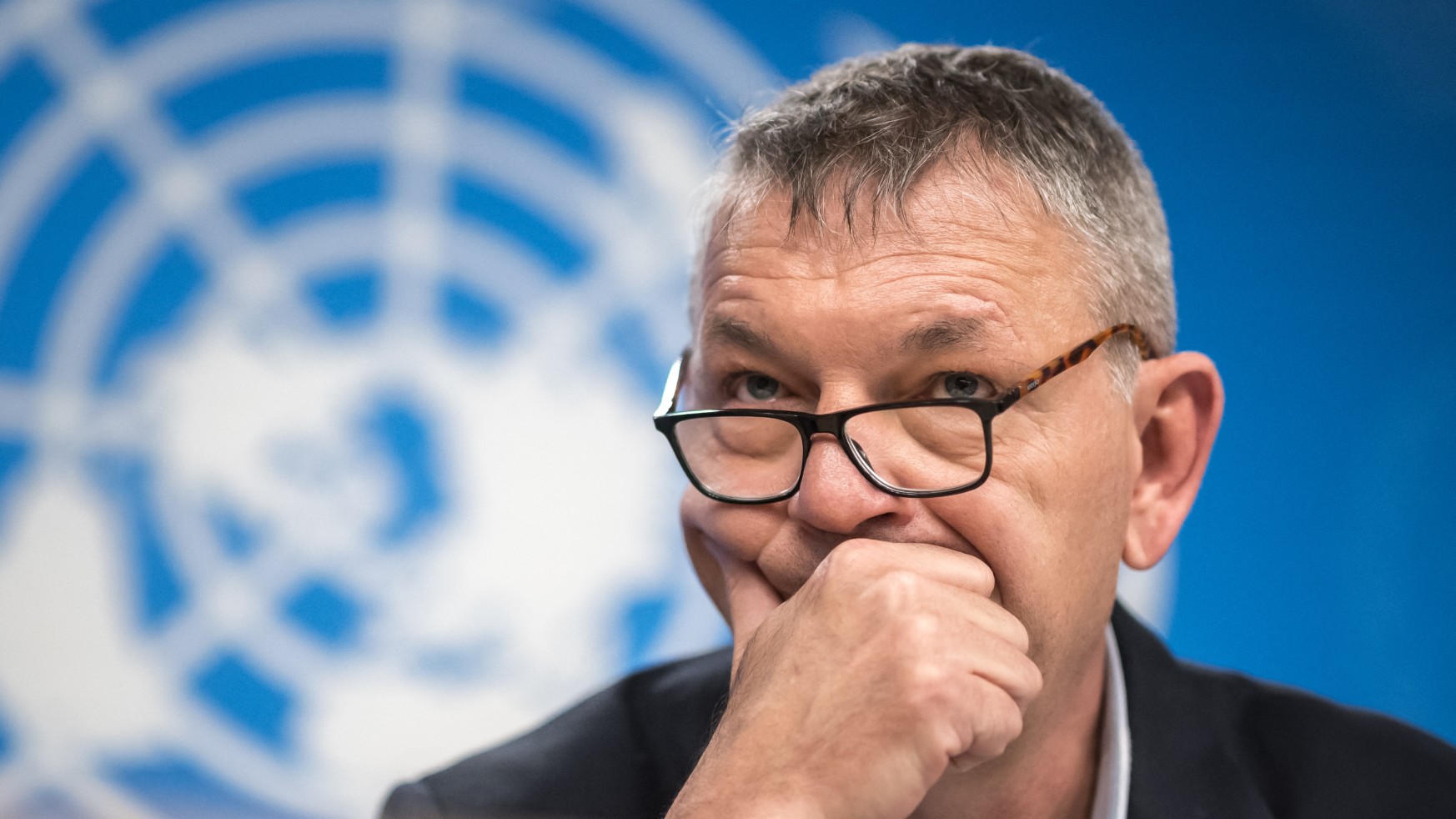
In a swansong interview with Middle East Eye’s David Hearst Podcast, outgoing Commissioner-General of the United Nations Relief and Works Agency (UNRWA) Philippe Lazzarini has issued a stark warning to the international community: if UN member states permit Israel to eliminate the only organization dedicated to delivering education and healthcare to Palestinian people, no UN agency will be safe from the same fate.
Lazzarini pulled no punches in his assessment of the global response to Israel’s open campaign to dismantle UNRWA, which he says has become an officially declared war objective. He described the agency as facing an unprecedented, overwhelming assault that has proceeded with complete impunity, largely unchallenged by the international community.
“The agency has come under massive, massive attack,” Lazzarini told the podcast. Since the outbreak of the Israel-Gaza war in October 2023, 391 UNRWA staff have been killed in Israeli strikes. Just weeks before the interview, the agency’s main headquarters in East Jerusalem’s Sheikh Jarrah neighborhood was stormed, demolished, and burned by Israeli forces, with government and parliamentary figures openly celebrating the act and even quarreling over who deserved credit for the destruction.
Beyond physical attacks, Lazzarini said the agency has been targeted by a large-scale disinformation campaign, multiple legal challenges, and three new domestic Israeli laws explicitly designed to force UNRWA to shut down. He expressed deep frustration that a formal UN agency is being openly dismantled without meaningful pushback from member states or global bodies.
Lazzarini made clear that the entire campaign against UNRWA is politically motivated, arguing that unsubstantiated claims the agency had been infiltrated by Hamas and Islamic Jihad were nothing more than a manufactured pretext to pressure donor countries into cutting funding. An independent investigation led by former French Foreign Minister Catherine Colonna found Israel failed to produce any evidence to back up its allegations of staff involvement in the October 7 attacks. Even so, 16 major donors including the United Kingdom froze funding within 48 hours of the claims being made; all have since resumed contributions except for the United States and Sweden.
Despite the relentless pressure, Lazzarini struck a defiant note, emphasizing that UNRWA remains the leading provider of public services to Palestinians in Gaza even amid the ongoing conflict. The agency continues to run vaccination campaigns, deliver clean water access, and manage waste disposal to stop outbreaks of disease, and is working urgently to restore learning opportunities for displaced children.
Since Israel launched its military campaign in Gaza in October 2023, relentless bombardment has systematically targeted civilian infrastructure including residential neighborhoods, schools, hospitals, places of worship, and UN-run shelters. Gaza’s healthcare system is already on the edge of total collapse: doctors are forced to perform surgeries without proper equipment or medication, and disease is spreading rapidly in overcrowded displacement camps. Even in this crisis, Lazzarini confirmed that around 11,000 UNRWA staff remain on the ground in Gaza, delivering 20,000 primary healthcare consultations every day. To date, roughly 70,000 children have returned to in-person classes, and more than 250,000 access distance learning programs run by the agency.
The roots of Israel’s campaign against UNRWA stretch back to the agency’s core mandate, Lazzarini explained. When Israel was admitted to the United Nations in 1949, its membership was conditional on recognizing UN General Assembly Resolution 194, which affirms the natural and legitimate right of Palestinian refugees to return to their homes and receive compensation for seized property. UNRWA is the only UN agency that formally recognizes Palestinian refugees and their descendants, so eliminating the agency is a deliberate attempt to erase this right to return — a core issue in any future final-status peace negotiations. Lazzarini pushed back against the narrative that dismantling UNRWA would revoke Palestinian refugee status, stressing that status is legally independent of the agency’s operations and will pass to future generations until a lasting political settlement is reached.
Even with the extraordinary resilience of its on-the-ground staff, Lazzarini warned that UNRWA is fighting to stay operational, crippled by growing funding gaps and shrinking operational space. He specifically called out the 90 percent drop in contributions from Arab states since 2024, alongside the ongoing funding freezes from the U.S. and Sweden, once a top-five donor. “Have member states done enough? Obviously not enough to protect the agency,” he said. “Hence my alarm to the members of the General Assembly, telling them that if you do not pay more attention to UNRWA, the agency might not be viable anymore in the future. We cannot continue to navigate a constant chronic lack of resources and at the same time seeing also our operational space shrinking because of political considerations.”
As global media and diplomatic attention has shifted to recent tensions between Israel and Iran, Lazzarini pointed out that Israel continues to block the entry of sufficient food and medical aid into Gaza. After the recent ceasefire agreement, aid groups expected 800 aid trucks to enter Gaza through the Rafah crossing every day, but Lazzarini said the actual volume is nowhere near that target. Aid organizations estimate a minimum of 600 trucks a day are needed to meet the basic needs of Gaza’s population, and even that low bar is rarely met: Israeli authorities often require trucks to carry only partial loads, further restricting the flow of supplies. Medecins Sans Frontieres (Doctors Without Borders) has been unable to bring any new supplies into Gaza this year, with critical shortages of chronic disease medication, surgical supplies, and essential medical equipment. “Since we cannot bring in new supplies or spare parts, malfunctioning equipment can force us to postpone or suspend surgeries, with serious consequences for patients,” explained Dr Randa Abu El-Khair Masoud, MSF’s project medical referent.
Lazzarini also rejected Israeli claims that other UN agencies can easily replace UNRWA’s services, arguing that no other body has the mandate, capacity, or resources to deliver the full range of public services UNRWA provides. For example, UNICEF can support supplementary education programs, but it cannot run the entire primary and secondary education system for hundreds of thousands of Palestinian children across Gaza and the region. Lazzarini stressed that the only legitimate replacement for UNRWA is a fully functioning sovereign Palestinian state — exactly the original vision behind the agency’s creation 75 years ago.
Over decades, UNRWA has educated generations of Palestinians, and Lazzarini said he regularly meets Palestinians who credit their UNRWA schooling for every achievement they have made. “Palestinians have had their land, their houses taken away from them. We have to redouble our effort to make sure that education remains an asset that we cannot take away from the Palestinians,” he said. He warned that the current crisis risks losing an entire generation of Palestinian children in Gaza if UNRWA cannot continue its work, and even across the wider region, ongoing erosion of the agency’s capacity will damage education quality and undermine long-term social cohesion for Palestinian communities.