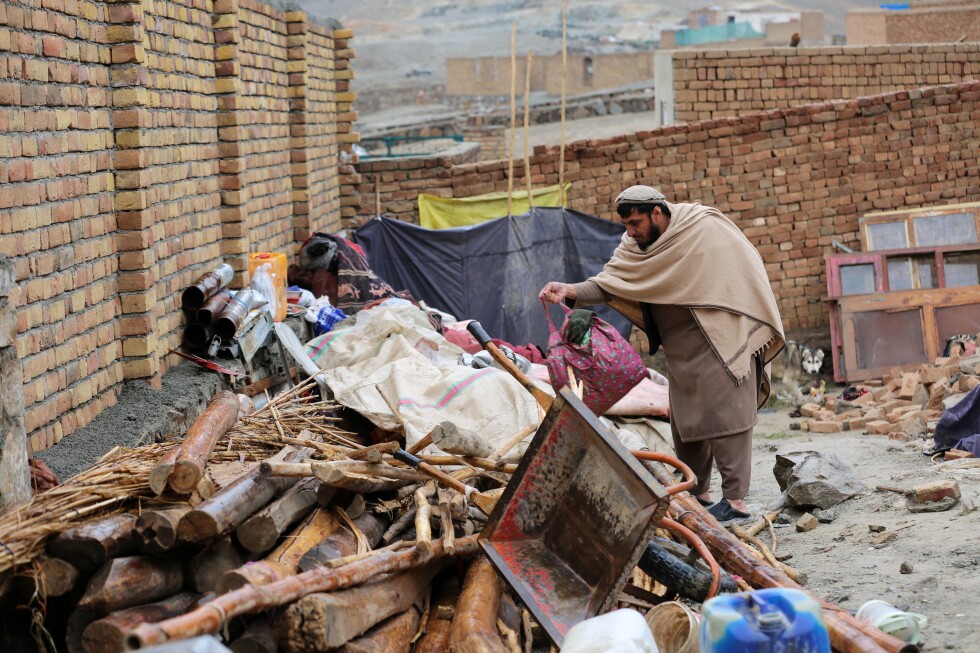
Deep in the village of Ittefaq, on the eastern outskirts of Afghanistan’s capital Kabul, the mud-caked rubble of a collapsed wall still holds the traces of a recently shattered life. Piles of salvaged blankets, dented cooking utensils and scattered personal belongings sit alongside broken bricks, a quiet marker of the tragedy that unfolded late Friday, when a 5.8 magnitude earthquake ripped through northern Afghanistan.
For Mohibullah Niazi, the neighbor who led early rescue efforts, the sounds of that disaster will linger. For three full minutes after the wall collapsed onto the refugee family camped next to his property, Niazi told reporters Saturday, he could hear the trapped family screaming for help. By the time a larger group of rescuers could clear the heavy mud and rock, the screams fell silent.
Eight members of the family, all Afghan refugees who had just returned to their home country 15 days earlier after being pushed out of neighboring Iran, were killed. The only survivor is 3-year-old Aarash, who was pulled from the rubble with a severe head injury and airlifted to a hospital in central Kabul for emergency care.
This small, already vulnerable family was among millions of Afghans forced to return to their unstable homeland in 2023, after neighboring Iran and Pakistan launched harsh crackdowns on undocumented foreign residents, most of whom are Afghan refugees who fled years of conflict and economic collapse. Najibullah, the 50-year-old head of the killed family, had nowhere else to go after crossing back into Afghanistan: the family set up a makeshift tent on empty low-lying land adjacent to Niazi’s home, because he could not afford permanent shelter. Just 30 minutes before the earthquake struck, Niazi said he offered the family space in his guest room to escape cold, heavy rains that had soaked the region for days. They declined his invitation.
Days of heavy rainfall had already softened the sodden earth holding the adjacent retaining wall in place, local residents explained. When the earthquake hit, the wall crumbled directly onto the family’s tent, trapping everyone inside before they could escape. Niazi and a handful of nearby neighbors immediately began digging by hand and with small spades, but the weight of the rock and mud was too much for their small group. “We tried our best,” Niazi recounted Saturday, standing at the disaster site. “But for two or three people, this was impossible work.”
Local authorities were alerted quickly, and Taliban-led rescue teams and ambulances arrived within an hour to continue recovery efforts. By Saturday morning, all eight bodies had been recovered, and the injured toddler had been transported for care. On Saturday, Health Ministry spokesperson Sharafat Zaman confirmed the boy remained hospitalized for his head injury, saying medical teams were monitoring his condition closely.
In the wake of the quake, official death toll numbers have seen a small discrepancy: Afghanistan’s deputy government spokesman Hamdullah Fitrat released an updated count Saturday putting the total national death toll at 12, with four additional people injured across the affected regions. Fitrat added that five full homes had been completely destroyed, and another 33 suffered major damage, impacting 40 families across six provinces: Kabul, Panjshir, Logar, Nangarhar, Laghman, and Nuristan. The Afghanistan Disaster Management Authority has meanwhile put the total death toll at nine, and officials have not yet explained the gap between the two counts.
Friday’s earthquake originated in the seismically active Hindu Kush mountain range, roughly 150 kilometers east of Kunduz in northern Afghanistan, and 290 kilometers northeast of Kabul, according to data from both the Euro-Mediterranean Seismological Center and the U.S. Geological Survey. Afghanistan sits on one of the world’s most active tectonic fault zones, and major earthquakes have killed thousands of Afghans in just the last two years, as poorly constructed, informal housing across much of the country leaves communities extremely vulnerable to seismic activity.
Just last August 2023, a 6.0 magnitude quake struck a remote mountainous region of eastern Afghanistan, killing more than 2,200 people. In October that same year, a 6.3 magnitude quake and subsequent powerful aftershocks hit western Afghanistan, leaving thousands dead. Two months later, a 6.3 magnitude quake hit Samangan province in the north, killing 27 people, injuring more than 950, and damaging iconic cultural sites including the historic Blue Mosque in Mazar-e-Sharif.