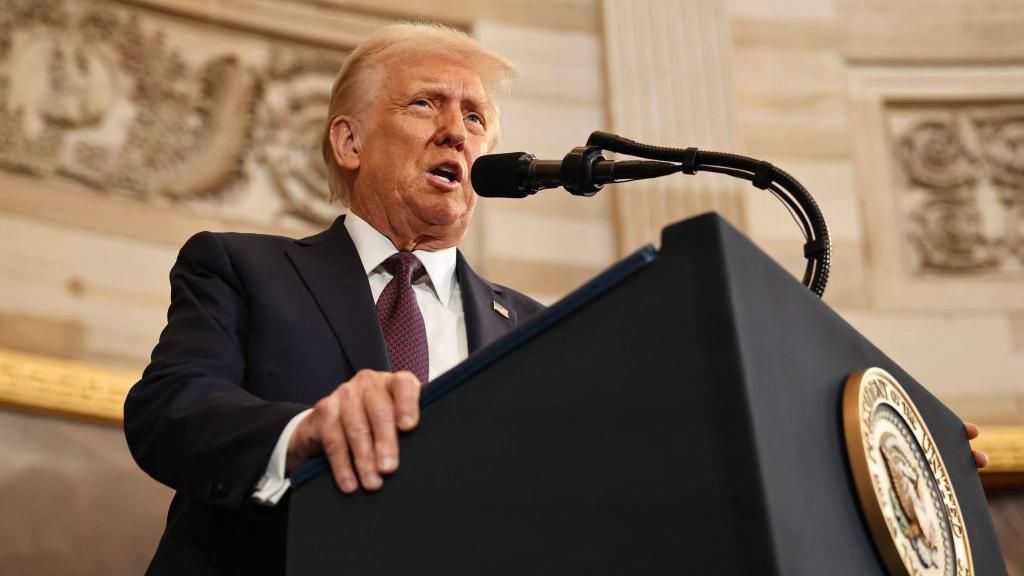
As one of the first policy moves of his second term as the 47th U.S. President, Donald Trump has followed through on a years-long campaign promise by signing an executive order to revoke automatic birthright citizenship for nearly all children born on U.S. soil to non-citizen parents. Now, after lower courts blocked the order from going into effect amid widespread legal pushback, the U.S. Supreme Court is set to hear oral arguments in the high-stakes constitutional case on April 1.
Trump’s order targets children born to two groups of non-citizen residents: those residing in the U.S. without legal authorization, and those staying in the country on temporary visas. The policy’s roots stretch back to decades of anti-immigration rhetoric that frames birthright citizenship as a pull factor for unauthorized border crossings and the controversial practices of “anchor babies” and “birth tourism” – where foreign nationals travel to the U.S. specifically to secure citizenship for their newborn children before returning to their home countries.
The future of the policy hinges on interpretation of the 14th Amendment, ratified in 1868 in the aftermath of the U.S. Civil War to codify citizenship for formerly enslaved Black people. The amendment’s opening clause explicitly states that “All persons born or naturalized in the United States, and subject to the jurisdiction thereof, are citizens of the United States and of the state wherein they reside.” Trump and his administration argue that the phrase “subject to the jurisdiction thereof” excludes children of unauthorized immigrants and temporary visa holders, a reading that has been uniformly rejected by lower courts and most constitutional legal scholars.
This interpretation of the 14th Amendment is not new. The Supreme Court first cemented the broad application of birthright citizenship in the landmark 1898 case United States v. Wong Kim Ark. The case centered on a U.S.-born child of Chinese legal immigrants who was denied re-entry to the country after a trip abroad. The Supreme Court ruled in Wong’s favor, holding that a person’s birth on U.S. soil grants citizenship regardless of their parents’ immigration status, with only narrow exceptions for children of foreign diplomats and other sovereign agents. That ruling has stood unchallenged for more than 125 years.
“Wong Kim Ark vs United States affirmed that regardless of race or the immigration status of one’s parents, all persons born in the United States were entitled to all of the rights that citizenship offered,” explained Erika Lee, director of the Immigration History Research Center at the University of Minnesota. “The court has not re-examined this issue since then.”
Most legal experts agree that the president lacks the unilateral authority to rewrite a foundational constitutional principle via executive order, a power that would require a full constitutional amendment. Amending the Constitution, however, is a notoriously high bar: it requires a two-thirds majority vote in both chambers of Congress followed by ratification from three-quarters of U.S. states. Given the deeply polarized current state of U.S. politics, such an outcome is widely considered functionally impossible for this controversial proposal.
Constitutional scholar Saikrishna Prakash, a professor at the University of Virginia Law School, noted that while Trump can direct federal agencies like Immigration and Customs Enforcement to apply a narrower interpretation of citizenship, any denial of citizenship will immediately trigger legal challenge. “He’s doing something that’s going to upset a lot of people, but ultimately this will be decided by the courts,” Prakash said. “This is not something he can decide on his own.”
Past Supreme Court precedent also undermines the Trump administration’s position. In the 1982 case Plyler v. Doe, the high court rejected Texas’ argument that unauthorized immigrants were not covered by the 14th Amendment’s jurisdiction clause, ruling that all people physically present in the U.S. are subject to U.S. law and entitled to the constitution’s protections.
The policy fight over birthright citizenship carries major demographic consequences. Pew Research Center data shows that in 2016, around 250,000 babies were born to unauthorized immigrant parents in the U.S., a 36% drop from the 2007 peak. By 2022, the most recent year for which data is available, there were 1.2 million U.S.-born citizens with unauthorized immigrant parents. Analysis from the nonpartisan Migration Policy Institute think tank projects that ending automatic birthright citizenship would create a growing underclass of non-citizens born in the U.S., pushing the total unauthorized population to 4.7 million by 2050 when accounting for second-generation descendants.
Trump has repeatedly stated that he would deport entire families, including U.S.-born children, to avoid family separation, writing that the only way to avoid splitting families is to deport all members together. Lower courts across the country have already struck down Trump’s order, with district judges in Maryland, Massachusetts, and Washington issuing nationwide injunctions to block its implementation. Seattle-based Judge John Coughenour called the order “blatantly unconstitutional”.
The Trump administration appealed these injunctions to the Supreme Court, arguing that lower court judges should have restricted authority to block federal policy. In a ruling last June, the conservative majority on the high court sided with the administration, limiting the power of district courts to issue nationwide injunctions against presidential orders. Trump called the decision a “big win” and a “monumental victory for the constitution, the separation of powers and the rule of law”, though the ruling only addressed judicial authority, not the core question of whether Trump’s executive order itself is constitutional. The three liberal justices on the court dissented, warning the ruling would have the effect of eroding individual civil rights.
Around the globe, more than 30 countries practice unrestricted birthright citizenship, while other major nations including the United Kingdom and Australia only grant automatic citizenship if at least one parent is a citizen or permanent resident.