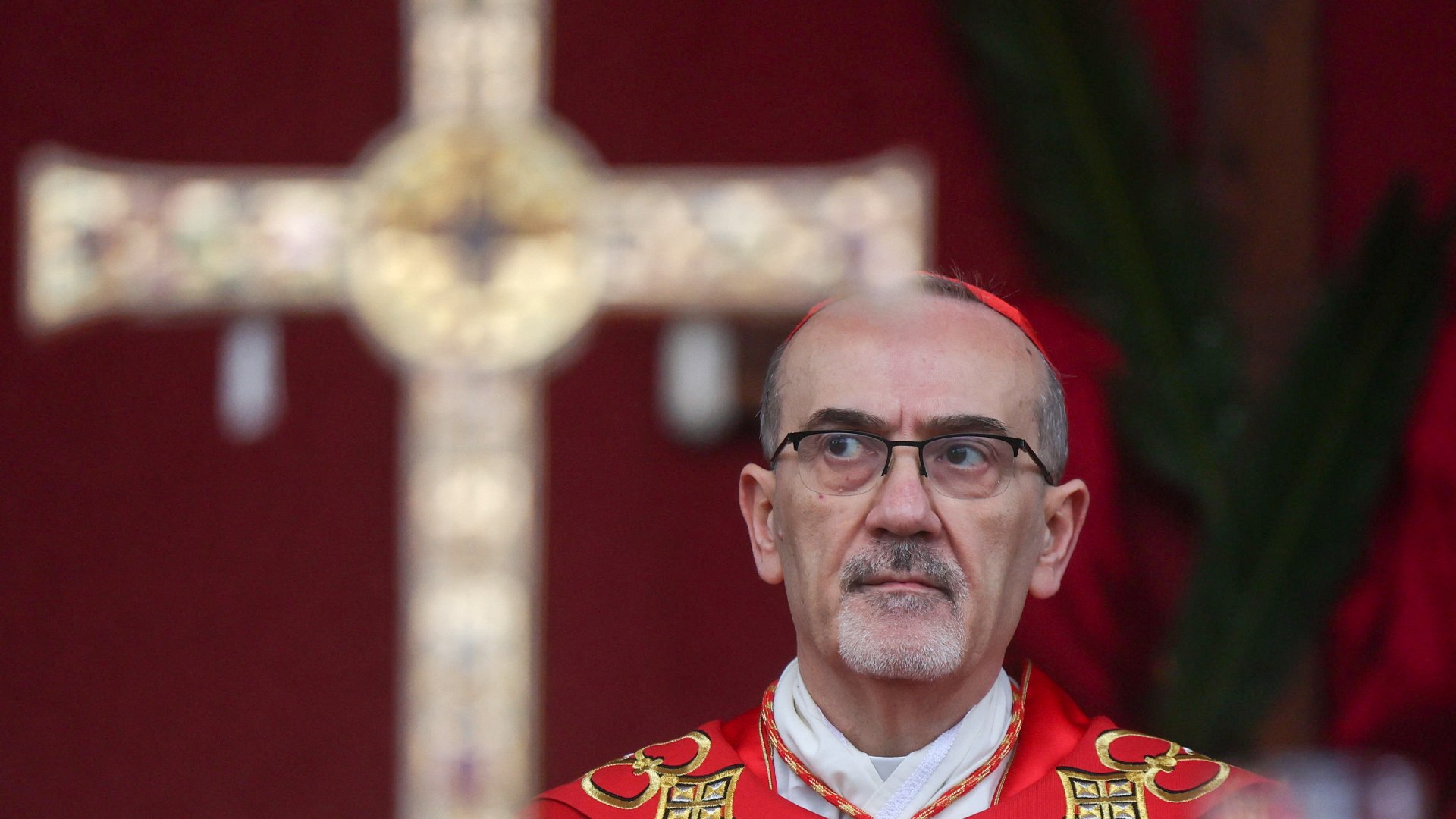
On Palm Sunday 2026, a major incident that sparked global attention unfolded in Jerusalem: Israeli security forces blocked Cardinal Pierbattista Pizzaballa, the top-ranking Catholic Patriarch of Jerusalem, from reaching the Church of the Holy Sepulchre, Christianity’s most sacred site, where he intended to lead traditional holy week prayers. The incident quickly drew an outpouring of international sympathy for the cardinal, but a on-the-ground reporting visit to the ancient church, located in Jerusalem’s Old City Christian Quarter, a day later revealed a sharp rift within the local Palestinian Catholic community over the patriarch’s response to the blockade.
Weeks before the incident, after Israel joined the United States in military strikes against Iran, the Old City has been largely sealed off to visitors. Israeli security forces are deployed at every entrance gate, imposing strict access controls to all religious holy sites in the area. For most of the holy month of Ramadan and the recent Eid al-Fitr holiday, Al-Aqsa Mosque, the third-holiest site in Islam, has remained entirely closed to Muslim worshippers.
Israeli authorities publicly defend the sweeping restrictions, citing credible safety risks stemming from Iranian missile attacks. Small fragments from intercepted Iranian missiles have indeed caused minor damage across Jerusalem in recent weeks. But Palestinian residents of the Old City are uniformly skeptical of this justification, arguing the access limits are actually a deliberate tactic to further entrench Israel’s long-standing control over the occupied East Jerusalem territory. Israel has occupied East Jerusalem, including the Old City, since the 1967 Six-Day War, and the International Court of Justice reaffirmed the international community’s consensus that this occupation is illegal under international law in a 2024 ruling.
Many local Palestinian Catholics say Pizzaballa, an Italian cleric widely respected and celebrated in global Catholic circles, responded to the blockade with too much deference to Israeli authorities. Boutros, a local Catholic shopkeeper who requested a pseudonym for personal safety, told reporters the cardinal should have directly confronted the blocking soldiers rather than quietly agreeing to turn back. “He should have found a way,” Boutros said. “If necessary, he should have prayed in the street.”
After being turned away, Pizzaballa instead held an alternate service at the Church of All Nations on the Mount of Olives, located just outside the Old City walls. Boutros criticized the patriarch’s willingness to enter into negotiations over access to the holy site with Israeli officials, arguing that any negotiation implicitly recognizes Israel’s contested authority over the occupied Old City. “By negotiating, you acknowledge the authority of the Israelis,” he explained.
Shortly after the Sunday incident, Israeli Prime Minister Benjamin Netanyahu announced he had ordered Israeli officials to grant Pizzaballa “full and immediate access” to the Church of the Holy Sepulchre. Israeli police confirmed they had reached a formal agreement with church leadership to allow planned Easter celebrations to proceed. In a public statement following the agreement, the Latin Patriarchate said it had maintained “continuous dialogue with the authorities, including the Israeli police”, and thanked Israeli President Isaac Herzog for his “prompt attention and valued intervention”. The statement also appeared to endorse Israel’s safety justification for the original restrictions, noting that “naturally, and in light of the current state of war, the existing restrictions on public gatherings remain in force for the time being”. This marked the first time in hundreds of years that a sitting Jerusalem Patriarch was unable to celebrate Palm Sunday mass at the Church of the Holy Sepulchre, according to the Patriarchate’s own records.
But for local Palestinian Christians, this outcome is far from a victory. Many see the entire incident as a reflection of a long-standing pattern of excessive deference to Israeli occupation by senior Christian religious leaders across all denominations—Catholic, Orthodox, Armenian, and other groups. Critics argue church leaders have prioritized protecting the limited status and privileges Israel grants them over advocating for and serving their local congregations.
During on-the-ground interviews in the Old City’s narrow alleyways, most local residents declined to share their full names, due to surveillance and pressure from Israeli security forces. One local Palestinian woman returning home with groceries pointed to the near-empty streets, a stark contrast to the crowded, festive atmosphere that normally marks the lead-up to Easter. “There are no celebrations. At this time of year the city should be crowded. They are killing any sense of joy,” she said.
Constant, intrusive Israeli military and police presence around the Church of the Holy Sepulchre itself already violates the decades-old “status quo” agreement that grants full control of the site to Christian religious authorities, residents and rights groups note. The International Centre of Justice for Palestinians (ICJP), a London-based legal advocacy group, has condemned the blockade of Pizzaballa as a “flagrant act of religious persecution”, drawing a parallel to repeated Israeli infringements on the authority of the Jerusalem Waqf, the Muslim custodian body that manages Al-Aqsa Mosque.
The ICJP also accuses Israel of blatant religious double standards. Even amid the current conflict with Iran, Israeli authorities allowed large public Jewish Purim celebrations to take place across Jerusalem earlier this month, when Iranian missile strikes were already occurring. Israeli media documented young, intoxicated celebrants dancing in costumes in the streets with loud music, but no restrictions were imposed on these events. Meanwhile, access restrictions targeting Palestinian Christian and Muslim worshippers remain fully in place.
When reporters arrived at the Church of the Holy Sepulchre during the visit, its main doors remained closed, and Israeli security gestured for the press team to move away when they approached. An Israeli security flag hangs above the church entrance, a symbol for local Palestinians of illegal foreign occupation. For the city’s Palestinian Christian community, the restrictions on worshippers are not a well-intentioned safety measure as Israel claims—they are a deliberate, cruel act of colonial domination that erodes their centuries-old connection to their most sacred site.
Boutros summed up the widespread despair among local residents: “The church is older than countries and empires. When I was a boy, my father would take the day off to go to the Old City to enjoy the traditions. Now who really wants to come to the Old City to be bullied by the Israeli police?” The frustration felt by local Christians is shared broadly across the Old City’s Palestinian community, who face daily humiliating searches, harassment, and restrictions on their movement as part of Israel’s ongoing occupation.