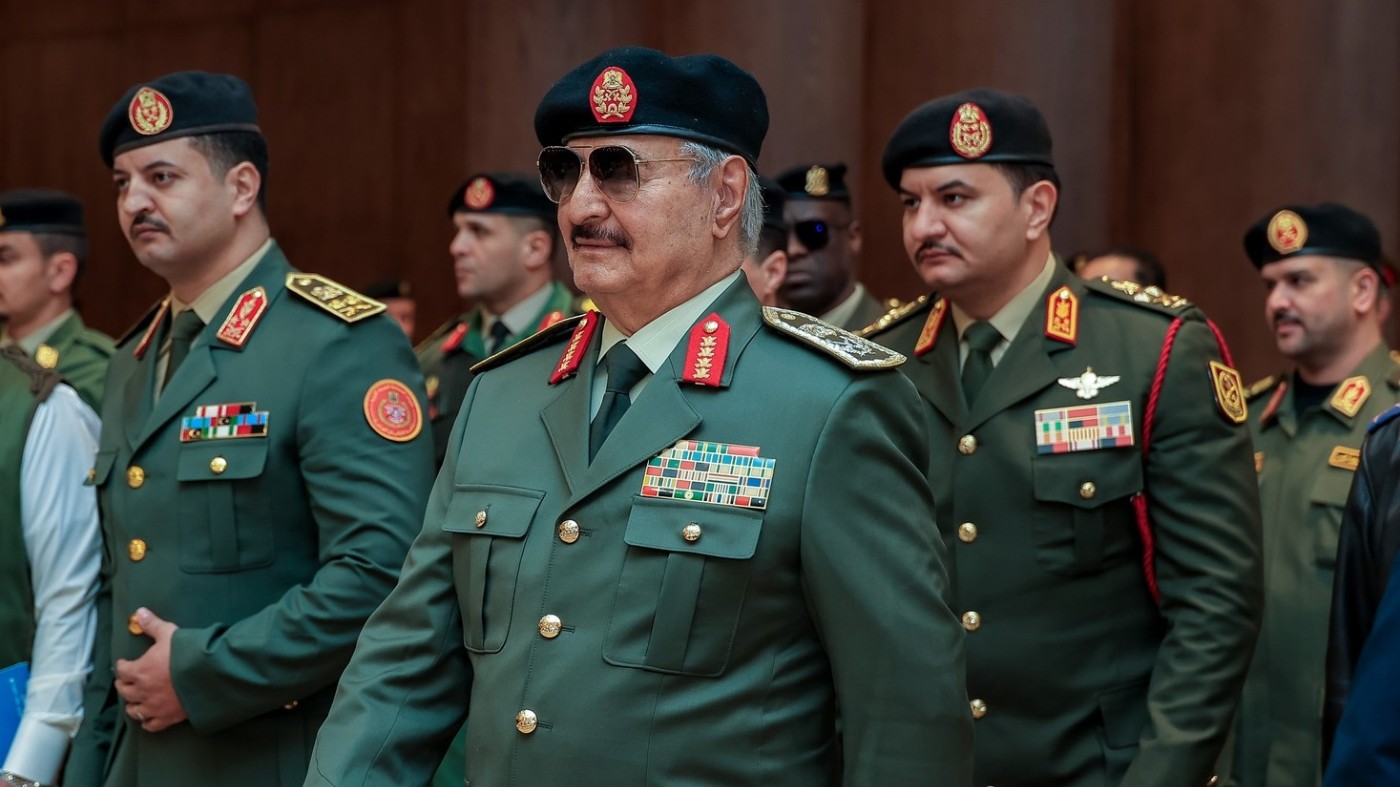
A confidential draft report compiled by a United Nations panel of experts, obtained exclusively by Middle East Eye ahead of its official publication, has pulled back the curtain on extensive illicit activities linking the powerful Haftar family to transnational smuggling networks operating out of eastern Libya. The 288-page investigative document, set for public release on 9 April, connects senior leadership of the Libyan Arab Armed Forces (LAAF) – led by veteran eastern commander Khalifa Haftar and his son Saddam Haftar – to a sprawling web of illegal activity, including unauthorized oil exports, unreported fuel smuggling, large-scale capital flight, coordinated criminal financial networks, and unauthorized arms transfers to Sudan’s Rapid Support Forces (RSF).
Consistent with prior reporting from Middle East Eye, the report documents that Subul al-Salam, a Libyan militia formally aligned with Haftar’s LAAF, has acted as a key intermediary to move weapons and other contraband to the RSF. The Sudanese paramilitary group, which receives backing from the United Arab Emirates, faces widespread international accusations of perpetrating genocide in the Darfur region of Sudan amid the country’s ongoing civil conflict.
Beyond arms trafficking, the investigation uncovered a marked expansion of illicit fuel smuggling operations originating from the eastern Libyan port of Benghazi, with new smuggling infrastructure built out across both Benghazi and the major oil export hub of Ras Lanuf to facilitate the illegal trade. The report also details a surprising level of coordinated illicit business between the Haftar-aligned eastern Libyan administration and its main political rival, the internationally recognized Government of National Unity based in Tripoli, particularly in the country’s critical oil sector.
Libya’s economy is almost entirely reliant on hydrocarbon exports, with oil and gas revenue accounting for more than 90% of all state income. UN investigators found that armed factions connected to Saddam Haftar and Ibrahim Dbeibah – the national security adviser to Libyan Prime Minister Abdul Hamid Dbeibah, who is also Dbeibah’s nephew – have systematically infiltrated and taken control of decision-making at every level of Libya’s state-run National Oil Corporation (NOC). The panel’s findings confirm that the NOC’s official budget has been misused as a front to divert public funds to networks tied to these armed groups, severely eroding the state oil firm’s institutional independence.
The report calculates that total recorded oil revenue for Libya in 2025 hit $18.78 billion – nearly $10 billion lower than the projected revenue that should have entered state coffers, with the missing sum largely traced to unreported and diverted illicit exports.
One of the report’s most damning findings centers on Arkenu, Libya’s first private oil company, which the UN panel concludes is indirectly controlled by Saddam Haftar through a network of proxies, most notably Rafat al-Abbar, a former deputy oil minister in the internationally recognized Tripoli-based government. Between October 2024 and February 2026, the investigation found Arkenu diverted more than $3 billion in earned oil revenue to offshore bank accounts outside Libyan state control. Just months after its founding in 2023, Arkenu exported roughly 7.6 million barrels of crude oil between May and December 2024, valued at an estimated $600 million, with a large share of that revenue never transferred to Libya’s Central Bank as required by law.
The UN panel emphasizes that the contractual agreement between Arkenu and the NOC violates core Libyan national laws: Arkenu failed to pay required taxes to the state and never fulfilled key contractual obligations. The report names both Abbar and Belqacem Shengeer, a former member of the NOC’s board of directors, as key operatives advancing Saddam Haftar’s interests in the oil sector. Abbar is described as playing an instrumental role in placing political pressure on NOC leadership at critical institutional levels to prioritize the financial interests of Saddam Haftar and his inner circle. The former deputy minister built a parallel shadow decision-making structure within the NOC by leveraging his close alliance with Haftar, who in turn relies heavily on Abbar to extend his influence and capture profits across the sector. Shengeer, for his part, is identified as the technical mastermind behind Arkenu’s creation; though he formally holds a position with the Tripoli-based NOC, he resides in Benghazi, the seat of Haftar’s eastern administration. To move its illicit crude exports, Arkenu has leveraged subsidiaries of major established energy traders including the United Arab Emirates’ BGN Energy, according to the report.
In addition to smuggling and corruption in the energy sector, the UN investigation documents other controversial international ties to the LAAF: the force has conducted formal military training exercises in Belarus, Pakistan’s chief of army staff personally presented advanced Eyes weapons systems to both Khalifa and Saddam Haftar, and a well-established permanent air bridge connects the UAE to territories under Haftar family control. The report explicitly confirms that the LAAF as an institution has been directly involved in coordinating cross-border overland fuel smuggling operations, using ports and logistics networks that fall under its full territorial control.