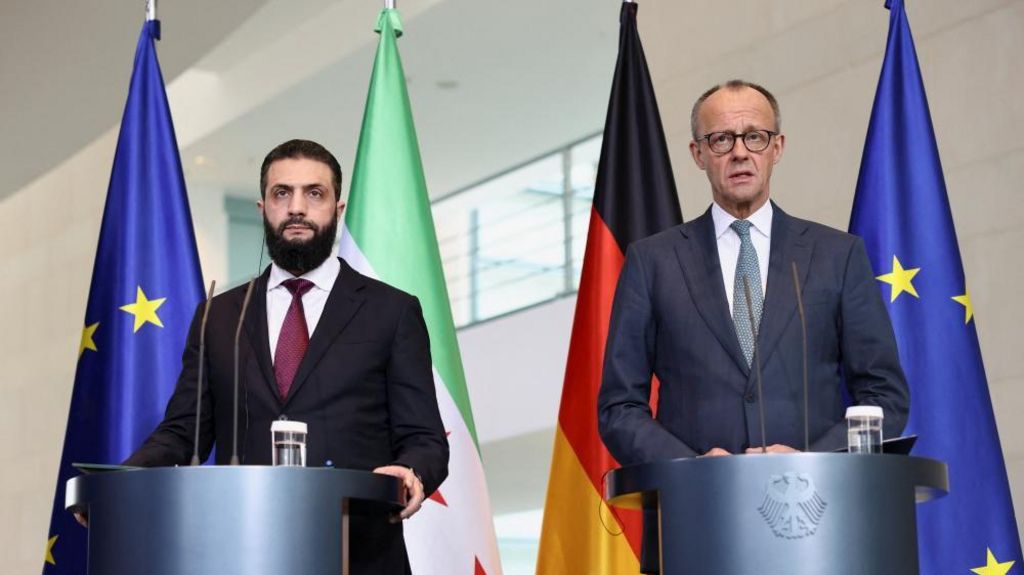
In a landmark meeting that signals shifting European migration policies, German Chancellor Friedrich Merz and Syrian President Ahmed al-Sharaa convened in Berlin on Monday to announce a comprehensive framework for the repatriation of Syrian refugees. The two leaders revealed an ambitious target: facilitating the return of approximately 80% of Syrians currently residing in Germany within the next three years.
Chancellor Merz emphasized that Syria’s post-conflict transformation necessitates a fundamental reassessment of protection needs. “The situation in Syria has now changed fundamentally following the conclusion of the civil war,” Merz stated during a joint press conference. “Our initial priority will be returning those who no longer have valid residence rights, particularly criminal offenders, but this will extend to broader populations in subsequent phases.”
The German leader acknowledged the significant contributions made by Syrian refugees while simultaneously asserting that most express desire to return home and participate in national reconstruction efforts. Merz clarified that exceptions would be made for certain professionals, noting that “it is in our country’s interest that Syrian doctors and carers would be able to remain if they wanted to.”
President Sharaa expressed profound gratitude for Germany’s hospitality during Syria’s conflict, stating that his nation “would never forget how Germany had opened its doors to refugees during the civil war.” The Syrian leader proposed establishing a circular migration model that would enable Syrians to contribute to reconstruction “without giving up the stability and lives they have built here, for those who wish to stay.”
The announcement occurs against a backdrop of rising anti-immigration sentiment in Germany, where support for the AfD party has surged significantly. Merz’s government has consequently adopted increasingly stringent refugee policies amid broader European concerns regarding migration management.
However, the proposal faces substantial opposition from German political factions and human rights organizations. Franziska Brantner of the opposition Green Party challenged the feasibility of large-scale returns, citing Syria’s compromised infrastructure and unstable security situation. “Many Syrians were deeply anchored in Germany,” Brantner noted, “holding systemically important jobs and with children in school.”
The Kurdish Community in Germany (KGD organized protests during Sharaa’s visit, demanding binding commitments regarding minority protections in Syria. The group has accused the Syrian president of human rights violations and war crimes during the Islamist rebel offensive that toppled former leader Bashar al-Assad in December 2024.
Despite the official conclusion of Syria’s decade-long civil war, the country remains deeply divided and has experienced recurrent sectarian violence, particularly between government-aligned forces and Kurdish groups in the northeast. Recent attempts at constitutional reform through an interim parliamentary body have faced criticism from Kurdish representatives who allege exclusion from meaningful negotiations and insufficient guarantees for minority rights.
This development represents a significant evolution from Germany’s 2015 refugee crisis response, when then-Chancellor Angela Merkel declared “Wir schaffen das” (We’ll manage this) while keeping borders open to those fleeing conflict. That policy decision, once viewed as pragmatic, ultimately became a political liability that fueled the rise of anti-immigration parties across Europe.