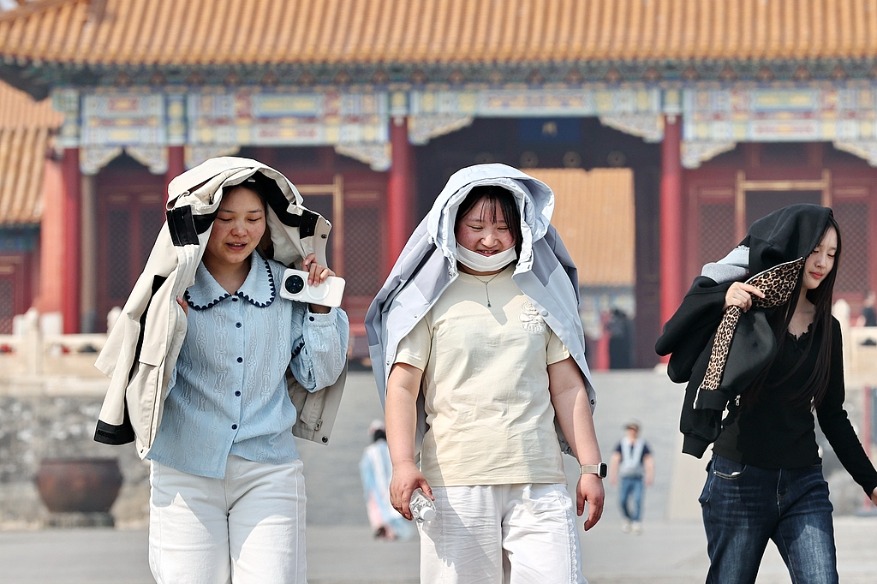
Meteorological authorities report that Northern China is currently experiencing an extraordinary warm spell, with temperatures forecasted to reach unprecedented seasonal highs of approximately 25°C (77°F) in specific regions this week. The unusual warming phenomenon began manifesting across most northern territories on Tuesday, with numerous urban centers already recording temperatures exceeding 20°C (68°F).
According to Weather China, the official platform of China Meteorological Administration, the thermal peak is projected to occur during Wednesday and Thursday. The 20°C isotherm—a meteorological boundary indicating equal temperature points—is anticipated to extend unusually northward, reaching northern Hebei province and western Liaoning province. This pattern suggests central and southern North China along with northern Huanghuai region may experience midday temperatures approaching 25°C.
Notable milestones include Hohhot in Inner Mongolia Autonomous Region potentially recording its first 20°C reading of 2026, while Jinan in Shandong Province might reach 25°C—temperatures typically characteristic of late April or early May in climatological records. Nocturnal temperatures will similarly rise, with central and southern North China and Huanghuai region expected to experience minimum temperatures above 10°C by Thursday.
Meteorological analyst Tang Xiaojing attributes this anomalous warming to optimal atmospheric conditions: “The warming effect is particularly pronounced in North China, Huanghuai region and Northeast China due to predominantly clear skies or limited cloud cover, which significantly enhances daytime radiative heating.”
Conversely, southern China remains largely unaffected by this thermal anomaly, with temperatures aligning with seasonal averages. Weather models indicate a potential temperature inversion phenomenon around Wednesday, where northeastern cities including Shenyang, Changchun and Harbin might paradoxically experience higher daytime temperatures than southeastern urban centers like Shanghai, Hangzhou and Nanjing, where highs may not exceed 15°C due to cloud cover and precipitation.
Residents in northern regions are advised to implement layered clothing strategies as substantial diurnal temperature variations—exceeding 10-15°C—will persist despite daytime warmth. Northeastern areas will maintain near-freezing overnight temperatures while North China experiences single-digit nocturnal readings.
The China Meteorological Administration confirms that suppressed cold air activity through March’s conclusion will facilitate the persistence and intensification of this unusual early spring warmth across northern territories.