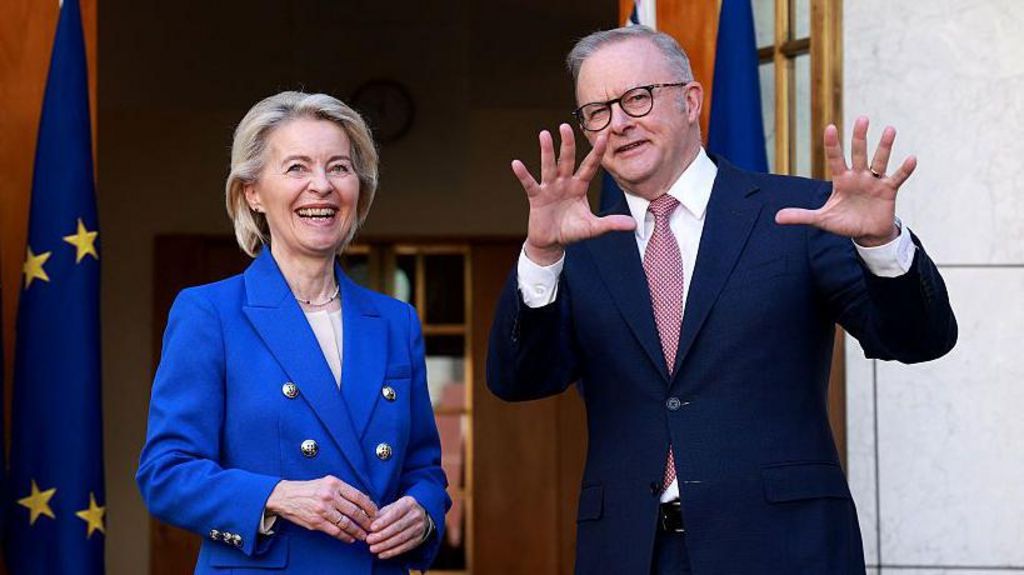
After eight years of intensive negotiations, the European Union and Australia have finalized a landmark free trade agreement that significantly reduces trade barriers between the two economies. The deal, valued at approximately A$10 billion (US$7 billion), was formally signed on Tuesday by European Commission President Ursula von der Leyen and Australian Prime Minister Anthony Albanese, who both characterized the agreement as mutually beneficial.
The comprehensive pact eliminates nearly all EU tariffs on Australian agricultural exports, including wine, fruits, vegetables, olive oil, seafood, most dairy products, and grains. This tariff reduction is expected to save Australian wine producers and exporters an estimated A$37 million annually. Conversely, Australian consumers will gain access to more affordable European products including wines, spirits, biscuits, chocolates, and pasta.
A particularly sensitive aspect of the negotiations involved geographical indications and naming rights for food products. The agreement permits Australian producers to continue using names such as parmesan domestically, while establishing lengthy phase-out periods for certain terms like feta. Notably, Australia has become the only country outside Italy to secure EU permission to use the name prosecco for its sparkling wines, with a 10-year transition period for exports.
Prime Minister Albanese emphasized Australia’s multicultural heritage in addressing the naming rights issue: ‘Our modern history was built on migrants. That’s why whether it’s Greeks coming here and creating feta, or Italians coming and doing parmesan or people from Eastern Europe doing kransky sausages – it’s a connection with Europe.’
While the agricultural provisions were broadly welcomed, the meat export component drew criticism from Australian producers. The agreement allows for approximately 30,000 tonnes of beef exports annually, significantly below the 50,000 tonnes sought by Australian farmers and industry representatives. Andrew McDonald of Meat and Livestock Australia called this ‘unquestionably a missed opportunity for Australia’s red meat producers, processors and exporters.’
Beyond trade, the two parties signed a new security and defense partnership enhancing cooperation in defense industries, counter-terrorism, space exploration, and maritime security. Von der Leyen described the agreements as focusing on ‘collective resilience’ in a rapidly changing global landscape where ‘trust matters more than transactions.’
The partnership also extends to critical minerals collaboration, with von der Leyen announcing expanded cooperation on lithium and tungsten projects. She additionally praised Australia’s pioneering social media policy that prohibits under-16s from having accounts on ten platforms, highlighting the broader strategic alignment between the partners.