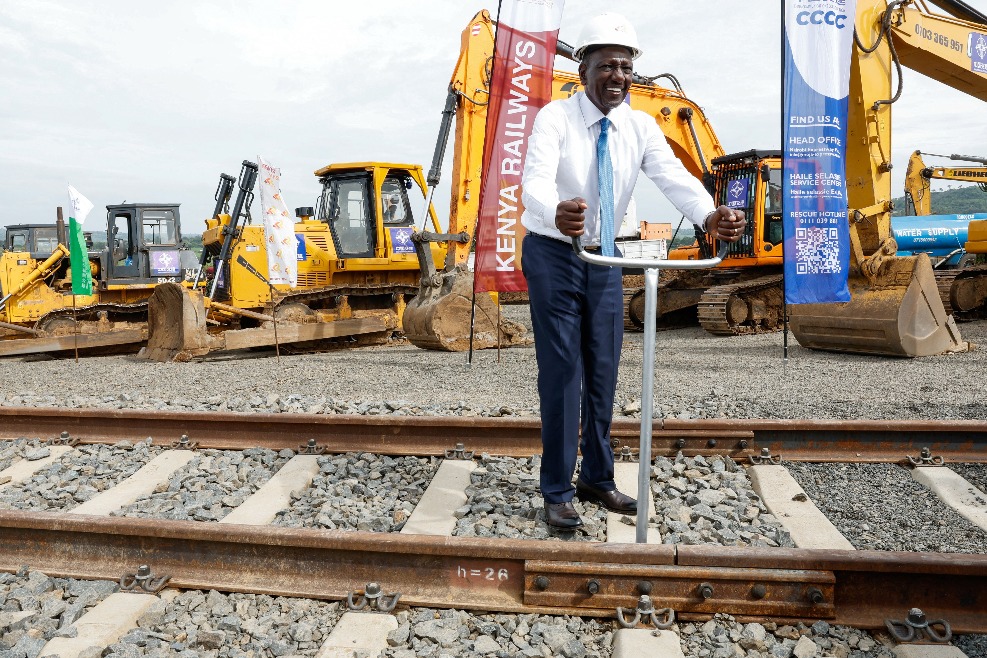
Kenya has inaugurated a monumental infrastructure endeavor—the 263-kilometer Standard Gauge Railway extension from Naivasha to Kisumu—designed to catalyze economic transformation in the nation’s western regions. This strategic project connects to the existing Chinese-built Nairobi-Mombasa line, creating an integrated transport network that penetrates Kenya’s agricultural heartlands while extending toward vital trade routes across East and Central Africa.
President William Ruto emphasized the project’s critical role in consolidating Kenya’s position as the logistical nexus for the region during Thursday’s launch ceremony in Narok. “A railway terminating at Naivasha remains incomplete,” Ruto stated, “as it fails to reach western Kenya’s primary production zones or integrate with Kisumu’s lake transport ecosystem on Lake Victoria.”
The railway’s implementation addresses pressing logistical challenges. Current transport inefficiencies see cargo from Mombasa Port requiring over 100 hours to reach Kampala, Uganda, despite nearly 70% of the port’s 7.37 million metric tons of first-half 2023 cargo being Uganda-bound. The new corridor will directly link Nairobi’s industrial district with key agricultural zones—Narok, Bomet, Kericho, and Nyamira—before terminating at Kisumu’s commercial hub.
Economic revitalization stands as a central objective. Western Kenya produces substantial tea, maize, sugar, and rice harvests, while Lake Victoria sustains extensive fishing industries. The railway is projected to reduce transport costs, increase freight capacity, generate employment during construction, and alleviate road congestion by transitioning cargo from trucks to rail.
China Communications Construction Company (CCCC) will execute the project as part of the Belt and Road Initiative framework. Chairman Song Hailiang committed to implementing enhanced environmental safeguards, building upon the ecological protection model established by the Nairobi-Mombasa line—a project previously recognized by the UN Environment Programme. “Green design and low-carbon construction will be implemented throughout the route,” Song affirmed, “with alignment optimized to avoid ecologically sensitive areas.”
Kenyan officials highlighted the project’s significance for regional integration under the African Continental Free Trade Agreement, anticipating strengthened trade connections across East and Central Africa through this transformative infrastructure development.