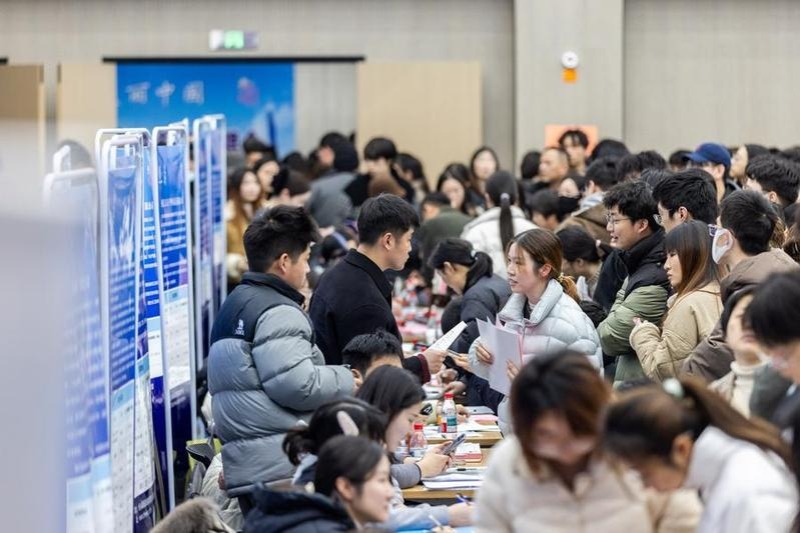
China’s spring recruitment season has unveiled an unprecedented battle for artificial intelligence talent, with companies scrambling to secure skilled professionals amid explosive industry growth. Recent employment data reveals AI has become the most competitive sector in China’s job market, fundamentally reshaping recruitment strategies across the technology landscape.
According to comprehensive reporting from domestic recruitment platform Maimai, AI-related job postings skyrocketed approximately twelvefold year-on-year during the first two months of 2026. This staggering growth dramatically outpaced the broader new economy sector, with AI positions now constituting 26.23% of all new economy jobs—a massive leap from just 2.29% the previous year.
The intensifying competition has created severe talent shortages across specialized AI domains. High-performance computing engineers face the most critical deficit with a supply-demand ratio of 1:7, meaning only one qualified candidate exists for every seven open positions. Other roles experiencing acute shortages include simultaneous localization and mapping specialists, navigation algorithms engineers, and cloud computing experts.
The recent emergence of OpenClaw’s open-source AI agent has further accelerated demand for AI application roles. Recruitment portal Zhaopin reported a 455% year-on-year surge in AI-related job postings during the first three weeks following the Spring Festival holiday.
This demand translates into substantial financial incentives for qualified professionals. AI positions now offer average monthly salaries of 60,738 yuan ($8,837), representing a 26% premium over average compensation in the new economy sector.
Industry experts attribute this hiring explosion to accelerating commercialization of large language models and expanding AI integration across business operations. Zhu Keli, founding director of the China Institute of New Economy, identifies three dominant trends reshaping internet industry employment: AI-centered specialization, vertically integrated scenarios, and increasingly hybrid skill requirements.
“The job landscape is evolving from software-defined models toward hardware-software integration and physical-digital convergence,” Zhu noted. “Future employment value will be directly tied to technological implementation capabilities.”
Major technology firms have responded with aggressive recruitment initiatives. Ant Group revealed that 85% of its current openings target technical roles, with over 70% specifically focused on AI including large model algorithms and multimodal generation. ByteDance announced its largest-ever internship program, planning to onboard more than 7,000 interns with over 60% allocated to AI-focused research and development. Meituan similarly launched recruitment programs emphasizing foundation models, AI applications, autonomous driving, and intelligent decision-making.
Mo Rong, chief expert at the Chinese Academy of Labor and Social Security, emphasizes that AI literacy is becoming fundamental: “Digital proficiency and AI application capabilities are transforming into new ‘basic skills.’ Modern workers must understand AI principles and effectively utilize AI tools.”
This shift is reflected in job requirements, with 34.39% of new positions explicitly mandating AI or large model-related skills—a significant increase from 22.35% year-on-year. Job seekers are actively adapting, with Liepin reporting a 139.67% year-on-year surge in resumes highlighting AI tool proficiency during the post-Spring Festival period.
As technological evolution continues to shorten skill shelf lives, experts stress that continuous learning and adaptability have become professional necessities in China’s rapidly transforming digital economy.