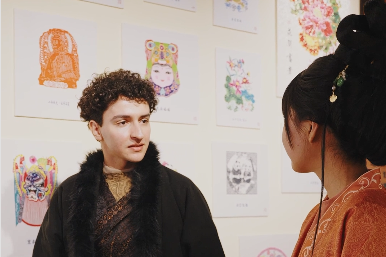
Peking University has unveiled the second episode of its groundbreaking micro-drama series “The Datong Code,” creating an innovative fusion of cultural heritage preservation and digital storytelling. The production follows protagonist Kai (portrayed by Abdelquoddousse Kailil from PKU School of Chinese as a Second Language) as he navigates a mysterious world where losing means permanent disappearance.
In this latest installment, Kai mistakenly identifies a discovered element as Fire, only to learn that the universe of The Datong Code operates under its own distinct rules. Guided by Yuwen (played by Hou Shuyue from PKU School of Journalism and Communication) while evading pursuit by enigmatic hunters, Kai’s journey leads him to an extraordinary encounter with Guangling paper-cutting artistry.
The narrative strategically introduces Master Artisan Zhang Duotang, the representative inheritor of this ancient technique. Guangling paper-cutting holds prestigious recognition as part of Chinese paper-cutting, which UNESCO has designated as an item of Intangible Cultural Heritage. The episode creatively explores the ambiguous nature of this art form—challenging characters and viewers alike to determine whether it constitutes painting, sculpture, or something entirely unique within the artistic spectrum.
The production masterfully incorporates suspenseful elements, emphasizing how a single touch could irrevocably alter the course of events. This approach not only maintains dramatic tension but also symbolically represents the fragile nature of cultural preservation—where each action carries significant consequences for heritage conservation.
Peking University’s initiative represents a pioneering approach to cultural education, utilizing digital media to engage global audiences with China’s rich intangible cultural heritage. By embedding authentic cultural elements within an accessible narrative framework, the series demonstrates how academic institutions can innovatively contribute to heritage preservation and cross-cultural understanding.