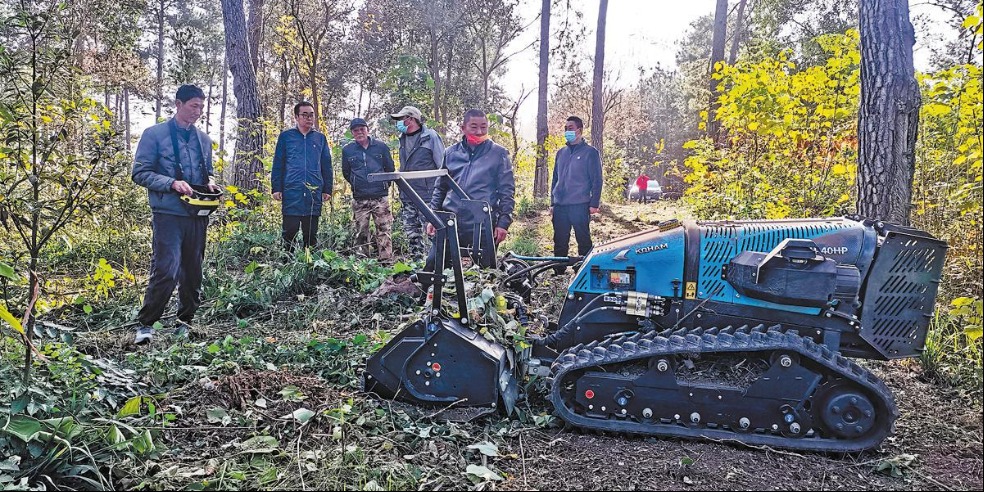
Hubei province has entered a new era of ecological conservation through the strategic implementation of autonomous robotics in forestry management. The province’s pioneering remote control robot, specifically engineered for forest fire prevention, represents a significant technological advancement in combating wildfires.
Operational in Jingshan city since November, this crawler-type machine demonstrates exceptional capabilities in navigating challenging terrains with slopes up to 60 degrees. Its engineering specifications include a 150-meter wireless control radius and high-strength steel cutting apparatus capable of processing trees measuring 15-20 centimeters in diameter. The equipment excels in creating critical firebreaks, clearing emergency access routes, and removing hazardous burning vegetation with unprecedented efficiency.
Chen Yong, Fire Prevention Division Director at Hubei Taizi Mountain Forestry Management Bureau, emphasized the transformative impact: ‘This innovation triples operational efficiency while fundamentally enhancing worker safety through remote operation capabilities. The machine operates continuously for eight hours, eliminating direct human exposure to dangerous fire conditions.’
The technology addresses historical challenges in the Taizi Mountain region, where complex topography and extensive forest coverage previously hampered emergency response efforts. Traditional manual methods, which required personnel to dig firebreaks with basic tools near active flames, have been replaced by robotic solutions that significantly reduce response times and life-threatening risks.
Beyond immediate fire prevention applications, the robots support year-round forestry management including land reclamation, undergrowth clearance, and forest maintenance operations. Hubei authorities are implementing comprehensive training programs in collaboration with manufacturers to ensure optimal utilization of the technology.
This robotic deployment forms part of Hubei’s broader digital ecosystem upgrade, which includes 128 strategically placed drone hangars in the Wuhan Donghu High-Tech Development Zone achieving complete aerial coverage. The integrated system combines satellite remote sensing, ground video surveillance, and AI-powered monitoring platforms with approximately 85% identification accuracy, all supported by human verification protocols according to Tao Huan, Drone Project Director at the zone’s urban operation management center.